
United Parks & Resorts: Navigating Post-Pandemic Recovery with Strategic Resilience
The post-pandemic leisure sector has emerged as a dynamic arena for innovation and growth, with consumers increasingly prioritizing experiences over material goods. United ParksPRKS-- & Resorts, a key player in this space, finds itself at a critical juncture as it balances financial challenges with strategic initiatives aimed at capturing pent-up demand. This analysis explores the company's positioning in the evolving leisure market, its ability to adapt to shifting consumer preferences, and the long-term viability of its growth strategies.
Strategic Positioning in a Resilient Sector
The global leisure sector has demonstrated remarkable resilience, with consumer spending reaching £4.2 trillion in 2024-a 24% increase compared to 2019 levels, according to OurCultureMag. This growth is driven by a cultural shift toward experiential travel, wellness-focused activities, and immersive entertainment. United Parks & Resorts has strategically aligned itself with these trends through a four-pillar plan: driving attendance, maximizing in-park spending, expanding lodging, and fortifying financial stability, as highlighted in a SWOT analysis.
The company's focus on immersive experiences is evident in its recent attractions, such as "Jewels of the Sea" at SeaWorld San Diego and "Expedition Odyssey" at SeaWorld Orlando, as noted in its Q1 2025 financial insights. These projects cater to the demand for IP-driven, story-rich environments, a trend that aligns with the amusement parks market's projected growth to $101.2 billion by 2030 at a 4.68% CAGR, as reported in the same Q1 discussion. Additionally, United Parks & Resorts has leveraged dynamic pricing and AI-driven tools to optimize revenue per guest. For instance, three parks now use AI to adjust pricing in real time, contributing to a 1.1% year-over-year increase in in-park spending to $38.58 per guest in Q1 2025, according to Leisure Industry Statistics.
Capitalizing on Pent-Up Demand
Post-pandemic consumer behavior reveals a strong appetite for leisure activities, particularly in family-centric and sustainable travel. In 2023, 70% of leisure travelers opted for eco-friendly accommodations, and 65% preferred curated experiences over traditional vacations, according to Leisure Industry Statistics. United Parks & Resorts has responded by expanding its lodging portfolio, including the completion of the SeaWorld Orlando hotel in 2025. The company aims to achieve an 85% average occupancy rate across on-site properties, extending guest stays and boosting ancillary revenue, as outlined in the aforementioned SWOT analysis.
However, the company faces headwinds. Attendance in Q1 2025 declined by 1.7% to 3.4 million guests, reflecting broader challenges in the sector, including weather volatility and economic uncertainty, a trend noted in its Q1 report. Despite this, the company's financial discipline-evidenced by a $500 million share repurchase program and a $759 million liquidity facility-positions it to weather short-term fluctuations while investing in long-term growth, according to Travel and Tour World.
Challenges and Opportunities
United Parks & Resorts' $1.7 billion debt load remains a significant constraint, limiting capital flexibility for new attractions or acquisitions, as noted in the SWOT analysis. Yet, its strategic focus on per-capita spending-which hit $77.66 in Q3 2024-demonstrates a successful pivot toward monetizing existing assets, a point highlighted by Travel and Tour World. The company's upcoming attractions, such as a flying ride at SeaWorld Orlando and a Wild Oasis realm at Busch Gardens Tampa Bay, aim to reinvigorate attendance while diversifying offerings, according to the same Travel and Tour World coverage.
From a broader industry perspective, the rise of digital leisure presents both competition and collaboration opportunities. Virtual reality and augmented reality technologies have grown by 40–60% in 2023, but United Parks & Resorts' physical experiences remain irreplaceable for families and event-driven travelers, per Leisure Industry Statistics. The company's Howl-O-Scream and Christmas Town events, for example, have historically driven seasonal attendance and in-park spending, as described in the SWOT analysis.
Conclusion: A Calculated Path Forward
United Parks & Resorts' ability to navigate post-pandemic recovery hinges on its capacity to balance cost management with innovation. While attendance declines and debt pose risks, the company's emphasis on high-margin in-park spending, lodging expansion, and IP-driven attractions positions it to capitalize on the sector's long-term growth. Investors should monitor the success of its 2025 hotel openings and new attractions, as well as its ability to maintain financial discipline amid macroeconomic volatility.
For now, the company's strategic alignment with consumer demand trends-particularly in sustainability, family experiences, and immersive entertainment-suggests a resilient, if cautious, path forward.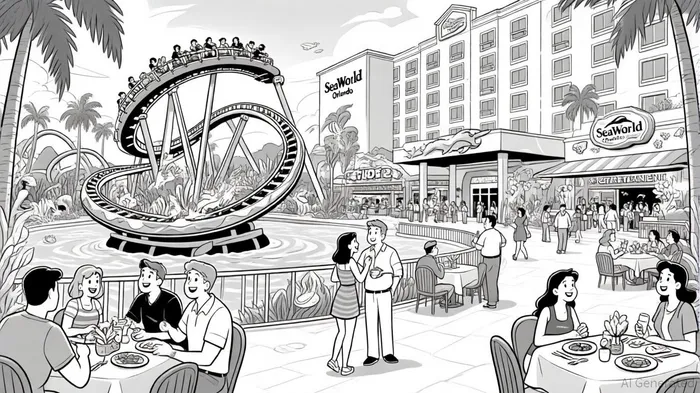





Comentarios
Aún no hay comentarios