
United Natural Foods (UNFI): Strategic Position in the Growing Natural & Organic Food Sector
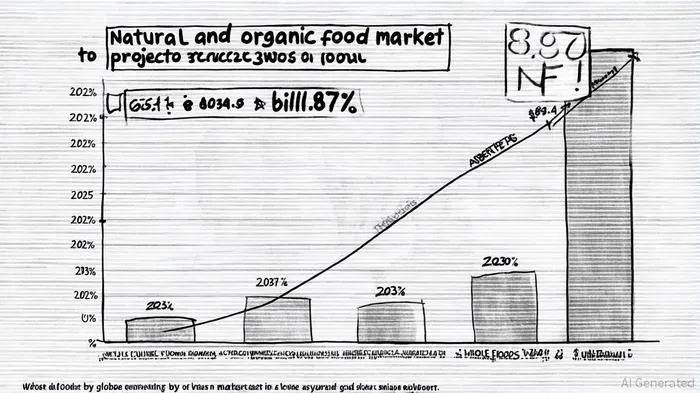
The natural and organic food sector is undergoing a seismic shift, driven by a confluence of health-conscious consumerism, sustainability mandates, and innovation in product offerings. United Natural FoodsUNFI--, Inc. (UNFI), a key player in this space, finds itself at a pivotal juncture as it navigates both industry tailwinds and operational headwinds. With the global market projected to balloon from $224.4 billion in 2024 to $634.85 billion by 2034, according to a market forecast, UNFI's strategic positioning and scalability will determine whether it solidifies its leadership or cedes ground to rivals.
Financial Resilience Amid Challenges
UNFI's fiscal 2025 results underscore its resilience despite a disruptive cyber incident. The company reported $31.8 billion in net sales, a 2.6% year-over-year increase, with adjusted EBITDA rising 6.6% to $552 million, according to a UNFI press release. The same press release noted free cash flow surged to $239 million in 2025, reversing a negative $92 million position in 2024. While the cyber incident contributed to a $118 million net loss, management's ability to exceed sales guidance and maintain profitability highlights operational agility. However, historical data from earnings beats since 2022 reveals a cautionary trend: a simple buy-and-hold strategy following these events resulted in a cumulative abnormal return of approximately –15% over 30 days, with a 50% hit rate. This suggests that market reactions may be influenced by forward guidance or expectations already priced in, rather than the EPS surprises themselves[^backtest].
The natural segment, a cornerstone of UNFI's business, saw $3.998 billion in sales-a 1.4% growth-contrasting with a 12.8% decline in the conventional segment, as noted in the press release. This divergence reflects shifting consumer preferences toward organic and sustainable products, a trend corroborated by market data: 68% of global consumers now prioritize organic options (Global Growth Insights).
Market Leadership and Scalability
UNFI's dominance in the natural/organic niche is evident in its 8.87% market share among grocery competitors like Kroger and Albertsons, according to CSIMarket data. However, that CSIMarket data also shows its 1.56% share in the broader retail sector pales against Amazon and Walmart's 32.40% and 31.92%, respectively. This dichotomy underscores UNFI's specialization in a high-growth subsector but also exposes its vulnerability to macroeconomic pressures in the wider retail landscape.
The company's scalability is bolstered by its $300 million investment in supply chain modernization, targeting logistics automation and supplier integration, as disclosed in UNFI's business update. These initiatives aim to reduce shrinkage and restore pre-pandemic margin levels, a critical step given the conventional segment's struggles. Additionally, UNFI's Community Marketplace platform is expanding e-commerce capabilities, enabling emerging brands to access wholesale networks-a strategic move to diversify revenue streams.
Strategic Risks and Competitive Dynamics
Despite its strengths, UNFIUNFI-- faces significant challenges. Its reliance on major clients, particularly Amazon-owned Whole Foods (35% of revenue), introduces concentration risk, according to a SWOT analysis. Competitors like Sprouts Farmers Market and Trader Joe's are also gaining traction, with Sprouts reporting 5.61% year-over-year growth in 2023, as noted in a competitor analysis. Meanwhile, General Mills and Hain Celestial are accelerating organic product lines, intensifying competition in processed organic foods-a segment projected to account for 53.4% of the 2025 market, per an organic foods report.
The cyber incident further complicates UNFI's trajectory, with projected sales reductions of $350–$400 million in 2025 reported in the press release. Yet, management's revised guidance-targeting a 20% EBITDA growth in 2026-signals confidence in overcoming these hurdles (UNFI press release).
Future Outlook and Investment Implications
The U.S. market, which accounts for 39% of the global organic food sector (Global Growth Insights), presents a critical growth avenue. With 61% of American households regularly purchasing organic products and online sales surging 52% (Global Growth Insights), UNFI's focus on digital expansion aligns with consumer trends. Its debt reduction plans-targeting a net leverage ratio of 2.5x by 2026-are outlined in the company business update and position the company to capitalize on M&A opportunities or invest in innovation.
However, investors must weigh UNFI's strategic bets against broader industry dynamics. For instance, the processed organic segment's dominance (53.4% market share in 2025, per the organic foods report) suggests that companies with strong manufacturing capabilities, like General Mills, may outpace distributors like UNFI in long-term value creation.
Conclusion
United Natural Foods occupies a unique vantage point in the natural/organic food sector, leveraging its supply chain expertise and niche market share to navigate a fragmented industry. While its financial performance in 2025 demonstrates resilience, the path to sustained leadership hinges on mitigating customer concentration risks, accelerating digital transformation, and capitalizing on the U.S. market's innovation edge. As the sector's CAGR of 10.83% (Global Growth Insights) accelerates, UNFI's ability to scale efficiently will determine whether it remains a bellwether or becomes a casualty of its own specialization.





Comentarios
Aún no hay comentarios