
United Natural Foods: Assessing Its 2025 Performance in a Ripe but Competitive Organic Market
The U.S. organic food market has matured into a $71.6 billion industry in 2024, growing at a 5.2% annual rate, according to a NextMSC analysis. This expansion, driven by health-conscious consumers and sustainability trends, has created both opportunities and challenges for players like United Natural FoodsUNFI--, Inc. (UNFI). While the company reported $31.78 billion in fiscal 2025 sales-a 2.6% increase from 2024-its performance reflects the dual pressures of market saturation and intensifying competition. For investors, the critical question is whether UNFIUNFI-- can sustain its growth trajectory while mitigating risks of value erosion in a sector increasingly dominated by retail giants like Costco, Amazon, and Kroger.
Financial Performance: Growth, But With Structural Weaknesses
UNFI's fiscal 2025 results highlight a mixed picture. The Natural segment, which accounts for 50.4% of total sales, grew 7.2% to $16.02 billion, driven by strong demand for organic produce and new customer acquisitions, as noted in the same NextMSC analysis. However, the Conventional segment declined 1.9% to $14.67 billion, underscoring the challenges of competing in a market where organic products are outpacing traditional offerings. Adjusted EBITDA rose 6.6% to $552 million, and free cash flow hit $239 million, while net debt fell to $1.83 billion-the lowest level since 2018.
Yet, these gains were partially offset by a cybersecurity incident in Q4 2025, which disrupted operations and reduced Adjusted EBITDA by $50 million, according to a SWOT analysis. This incident exposed vulnerabilities in UNFI's supply chain resilience, a critical concern given its role as a key supplier to retailers like Whole Foods. The company's 2026 guidance-anticipating 20% EBITDA growth-hinges on the success of new automated distribution centers in Pennsylvania and Florida, according to UNFI's SEC 10-K, but such capital-intensive projects carry execution risks.
Competitive Pressures: A Market Awash in Giants
The organic food sector is no longer a niche market. Costco, for instance, surpassed Whole Foods in organic produce sales in 2024, capturing over $6 billion in this category through its low-cost, high-volume model, as reported in a Tasting Table article. Amazon's 22.48% wholesale market share and Kroger's 5.78% retail sector dominance, according to an OTA report, further illustrate the scale of competition. UNFI's 8.87% market share in the grocery industry, per CSIMarket, is respectable but lags behind these behemoths, which are leveraging private-label brands, e-commerce, and technological innovation to capture market share.
The shrinking price gap between organic and conventional products was also highlighted in the NextMSC analysis and threatens UNFI's margins. As retailers like Aldi and Trader Joe's expand their organic offerings at lower prices, UNFI must balance its value proposition with cost pressures. This dynamic is compounded by the rise of "clean-label" expectations and social media-driven consumer trends, which demand agility in product development-a domain where UNFI's supplier partnerships could provide an edge, as the OTA report notes.
Strategic Responses: Innovation and Resilience in a Fragile Ecosystem
UNFI's 2025 strategic priorities focus on three pillars: innovation, customer retention, and supply chain modernization. The company's 95%+ customer retention rate, according to the SWOT analysis, is a testament to its ability to deliver tailored solutions for retailers, but diversifying its customer base remains a priority. With 35% of revenue tied to Whole Foods, UNFI is vulnerable to shifts in retailer dynamics, particularly after the cyberattack disrupted its distribution network, as described in the OTA report.
To address this, UNFI is investing in AI-powered demand forecasting and automated distribution centers, as outlined in the SEC 10-K, aiming to reduce operating margins from 2.5% to 3.2%, per the SWOT analysis. These initiatives align with broader trends in the sector, such as e-commerce growth and sustainability-driven logistics (e.g., carbon-neutral delivery options noted by the SWOT analysis). However, the success of these efforts depends on execution speed and the ability to scale without compromising service quality.
Risks and Opportunities: A Balancing Act
The organic food market's projected $18 billion growth by 2029, according to the OTA report, offers long-term optimism, but UNFI's path to capturing this growth is fraught with risks. Market saturation, as evidenced by the entry of Amazon and Costco into organic retail, could erode pricing power. Additionally, the cyberattack in June 2025 revealed systemic vulnerabilities in the supply chain, a sector where trust and reliability are paramount, as the OTA report and the SWOT analysis both emphasize.
Conversely, UNFI's deep supplier relationships and expertise in natural and organic distribution position it to capitalize on niche opportunities. Its focus on sustainability and e-commerce aligns with consumer trends, but execution will determine whether these initiatives translate into durable competitive advantages.
Conclusion: A Tenuous Position in a High-Stakes Market
United Natural Foods' 2025 performance underscores its resilience in a rapidly evolving sector. While its financial metrics and strategic investments are promising, the company faces a paradox: operating in a high-growth market that is simultaneously becoming more crowded and commoditized. For investors, the key takeaway is that UNFI's long-term sustainability will depend on its ability to innovate faster than its rivals, mitigate supply chain risks, and maintain its value proposition in an era of price sensitivity. The coming years will test whether UNFI can transform its operational strengths into lasting shareholder value-or become another casualty in the race to dominate the organic food landscape.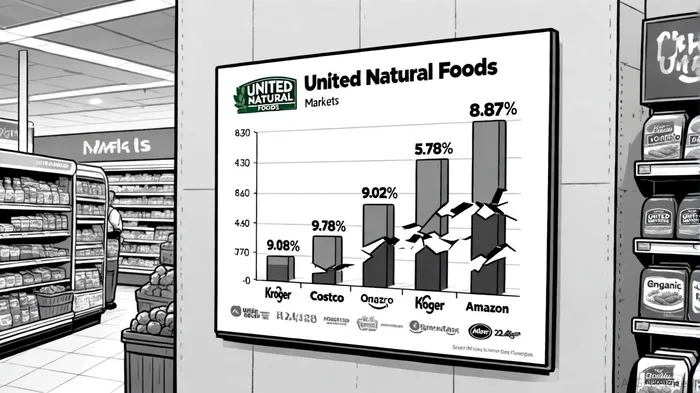





Comentarios
Aún no hay comentarios