
United Imaging Healthcare's Global Surge: A Strategic Breakthrough in Emerging Markets
A Global Footprint Built on Innovation and Localization
UIH's international success hinges on a dual strategy: cutting-edge product development and localized execution. The company's R&D investment of CNY 1.86 billion in the first three quarters of 2025-a 13.5% year-over-year increase-has fueled the launch of high-end systems like the uMR Ultra 3T MRI, which now holds FDA and CE certifications, enabling global clinical deployment, as noted in a PR Newswire release. This regulatory agility is critical in markets where access to advanced imaging technology remains limited.
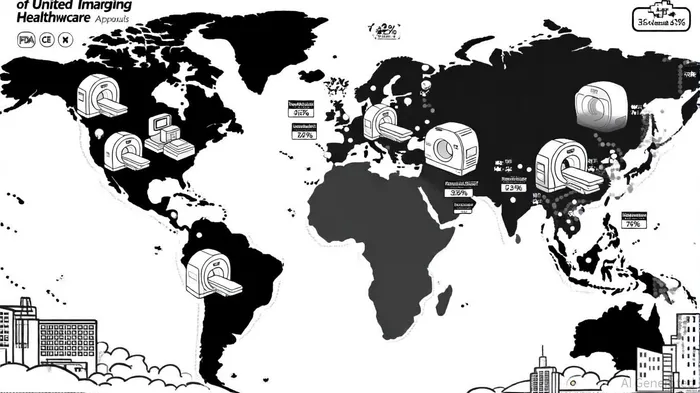
Geographically, UIH has targeted both developed and emerging economies. In the Asia-Pacific region, it has strengthened its presence in Japan and South Korea while expanding into India, where demand for high-end medical equipment is rising, according to a UIH announcement. In Latin America and the Middle East, the company has completed multiple system installations in countries like Brazil, Mexico, and Turkey, leveraging partnerships with local healthcare providers to address infrastructure gaps, as described in an EqualOcean report.
Competitive Positioning: Navigating a Crowded Market
UIH's ascent in emerging markets is particularly notable given the dominance of established players like Siemens Healthineers, GE HealthCare, and Philips. While these firms hold significant market shares in molecular imaging and diagnostics, UIH's localized approach-such as its U.S. manufacturing hub in Houston and regional spare parts hubs in 32 countries-enables faster deployment and cost efficiency, as highlighted in a U.S. market report.
The company's partnerships further differentiate it. Collaborations with institutions like Al Mana Group in Saudi Arabia and KPJ Healthcare in Malaysia have allowed UIH to integrate AI-driven diagnostics into local healthcare systems, addressing both technological and operational needs, according to a PR Newswire release. This contrasts with the more standardized strategies of its competitors, who often rely on global pricing models that may not align with the fiscal constraints of emerging markets.
Long-Term Revenue Implications for Investors
The financial metrics paint a compelling picture. With overseas revenue now representing nearly a quarter of total sales, UIH's international business is no longer a side note but a core growth engine. The company's Q3 2025 revenue of CNY 2.84 billion-a 75% year-over-year increase-suggests that its global strategy is not only scaling but accelerating, as reported in the Q3 2025 results.
For investors, the key risks lie in regulatory shifts and competitive responses. However, UIH's focus on localization-such as its 7 regional spare parts hubs and 32 national warehouses-mitigates supply chain vulnerabilities, a critical advantage in a post-pandemic world, as noted in the UIH announcement. Additionally, its R&D-driven product pipeline ensures a steady stream of innovations to sustain demand.
Conclusion: A Strategic Leader in a Fragmented Market
United Imaging Healthcare's Q3 2025 results reflect more than just revenue growth; they signal a redefinition of how medical technology is deployed in emerging markets. By combining cutting-edge innovation with localized execution, UIH is not only competing with global giants but also addressing unmet healthcare needs in regions where access to advanced diagnostics is a luxury. For investors, this positions the company as a long-term play in a sector poised for structural growth.







Comentarios
Aún no hay comentarios