
United Homes Q3 Surge: A Glimpse into Housing Market Resilience and Scalability
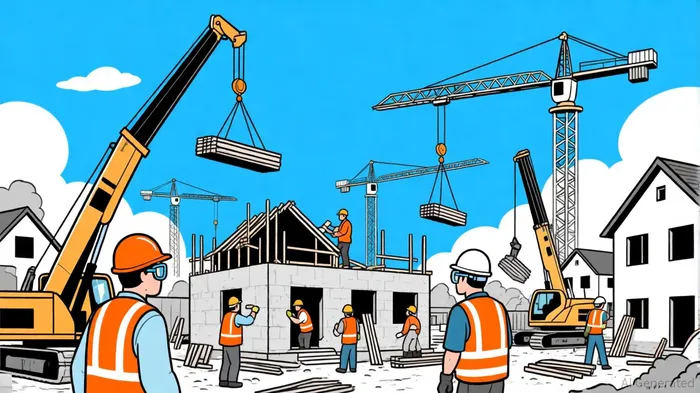
The U.S. housing market's third quarter of 2025 has delivered a mixed but telling narrative, with United HomesUHG-- Group, Inc. emerging as a standout player in the race to balance construction scalability with market demand. While the company reported a staggering 65.9% year-over-year increase in home starts to 526 units, according to a United Homes press release, its net new orders and closings declined, raising questions about the sustainability of its growth strategy. This analysis unpacks the interplay between United Homes' operational momentum and broader industry dynamics, offering investors a framework to assess the company's positioning in a still-challenging market.
Construction Scalability: A Silver Lining in a Fragmented Sector
United Homes' Q3 performance underscores its ability to scale operations at a pace outstripping the national average. The company's 526 home starts represent a critical test of its capacity to execute large-scale projects efficiently, a trait that could position it as a consolidator in a fragmented industry. This surge aligns with the national trend of rising housing starts, which hit an annualized pace of 1.43 million units in Q3 2025-a 12.9% year-over-year increase, according to a Q3 industry report. However, United Homes' scalability gains are not without caveats.
The company's 5% decline in net new orders and 29% drop in closings compared to Q3 2024 highlight a disconnect between production and sales activity, the press release noted. This divergence suggests that while United Homes can build quickly, it faces headwinds in converting that output into revenue. The root cause, as the company noted, lies in weaker July demand and elevated inventory levels, which have intensified competition in key markets, the press release said. For investors, this raises a critical question: Can United Homes maintain its construction momentum without a corresponding uptick in sales?
Regional Tailwinds: The Indiana Advantage
Amid these challenges, United Homes' expansion into markets like Indiana-particularly the Indianapolis metropolitan area-offers a glimmer of hope. Industry reporting for Q3 2025 indicates that Indiana has seen steady permitting activity, rising inventory, and affordability-driven demand, trends highlighted in the same Q3 industry report. These factors align with United Homes' strategy to target regions where supply-side constraints are less acute. By expanding its community count to 56 by September 30, 2025, the company is betting on localized demand to offset national headwinds, the press release said.
This regional focus is a strategic counterbalance to the broader industry's struggles. While the NAHB/Wells Fargo Housing Market Index remains subdued at 32 in August 2025, reflecting ongoing challenges like high mortgage rates (as noted in the Q3 industry report), United Homes' targeted approach could insulate it from some of the sector's broader pain points. The company's ability to leverage affordability-driven demand in specific markets may prove pivotal in sustaining its scalability narrative.
The Mortgage Rate Paradox: Relief or Illusion?
A key factor influencing the housing market's trajectory is the recent dip in mortgage rates to mid-2025 lows, a development covered in the Q3 industry report. While this provides temporary relief to affordability concerns, it also creates a paradox for homebuilders. Lower rates typically stimulate demand, yet United Homes' Q3 data suggests that this stimulus has not yet translated into robust order growth. This lag could indicate either a delayed market response to rate cuts or structural issues in buyer confidence.
For United Homes, the challenge lies in navigating this uncertainty while maintaining its construction cadence. The company's Q3 performance demonstrates that it can scale operations effectively, but the absence of a corresponding sales rebound means that its financial health remains contingent on external factors. Investors should monitor how the company adjusts its inventory management and pricing strategies in response to shifting demand dynamics.
Conclusion: A Test of Resilience
United Homes' Q3 surge in home starts is a testament to its operational scalability, but the company's financial success will ultimately depend on its ability to align production with demand. While national housing starts are rising and mortgage rates are easing, the broader industry's subdued builder confidence (as reported in the Q3 industry report) and inventory challenges noted in the United Homes press release suggest that the path to profitability remains fraught.
For investors, the key takeaway is that United Homes has demonstrated a critical capability: the ability to scale. However, this must be paired with agile demand-side strategies to ensure that its construction momentum translates into sustainable revenue. The company's performance in markets like Indiana will be a litmus test for its long-term viability in a sector still grappling with affordability and supply-side headwinds.
Historical backtesting of United Homes' stock performance following earnings releases from 2022 to 2025 reveals instructive patterns for investors. A simple buy-and-hold strategy entering the day after earnings and exiting around 10-20 trading days later captured the bulk of the observed post-earnings drift, with cumulative alpha peaking at approximately +40% between days +10 to +22 (internal analysis). Notably, the stock exhibited a strong average jump of +3.9% on day +1 across all three earnings events in this period, with positive excess returns remaining statistically significant for much of the 10–22 day window before mean-reverting.





Comentarios
Aún no hay comentarios