
United Airlines Stock Plunges 6.1% As Death Cross Signals Bearish Trend
Generado por agente de IAAinvest Technical Radar
martes, 17 de junio de 2025, 7:01 pm ET2 min de lectura
UAL--
Candlestick Theory
Recent price action for United Airlines HoldingsUAL-- reveals notable bearish patterns. The June 17, 2025 session formed a long red candle closing near $73.65 after testing resistance near $77.24, confirming the $75–$78 zone as strong resistance. Prior to this, the June 16 green candle closed at $78.52, but the subsequent engulfing bearish candle invalidated its bullish sentiment. Key support is emerging near $72–$73, aligning with the March 2025 lows. The rejection near $78 highlights selling pressure, and failure to hold $72 may trigger further downside.
Moving Average Theory
The 50-day moving average (MA) has crossed below both the 100-day and 200-day MAsMAS--, signaling a "death cross" and reinforcing a bearish long-term trend. The 200-day MAMA-- (sloping downward near $75) and 100-day MA (near $77) act as dynamic resistance. The current price ($73.65) trades below all key MAs, confirming a downtrend. Short-term bounces face resistance confluence at the 50-day MA ($75–$76), which aligns with the June 16 peak.
MACD & KDJ Indicators
The MACD histogram shows sustained negative momentum, with the MACD line below the signal line and both in negative territory. The KDJ oscillator (14-period) exhibits bearish alignment: the %K line (26) remains below %D (31), while the J-line approaches oversold territory (sub-20). Though KDJ nears oversold levels, MACD’s persistent negative divergence warns against premature reversal calls. This divergence suggests lingering bearish control despite short-term exhaustion signals.
Bollinger Bands
Volatility expanded sharply during the June 17 sell-off, with price breaching the lower Bollinger Band (20-day, 2σ) near $73.05 before a slight recovery. Band expansion after compression (mid-June) signals renewed directional momentum—here, bearish. Price closed below the lower band, typically indicating oversold conditions but also potential continuation if volatility persists. The $72–$73 area now serves as a tactical support band.
Volume-Price Relationship
Bearish volume confirmation is evident: the June 17 sell-off occurred on above-average volume (8.56M shares vs. 30-day avg ~7.2M), validating downside momentum. Conversely, rallies (e.g., June 16’s 6.11% gain) saw muted volume (8.55M), indicating weak buying conviction. The April 9 spike to $70.83 (26% gain) coincided with extreme volume (32.9M shares), marking a distribution top. Sustained volume on declines signals distribution.
Relative Strength Index (RSI)
The 14-day RSI sits at 30.8, bordering oversold territory. While this hints at potential near-term consolidation, RSI’s persistent failure to breach 50 during recent pullbacks underscores entrenched bearish momentum. Previous oversold readings (e.g., January 2025 at RSI 29) led only to transient rebounds. Current conditions suggest RSI may linger below 30 before signaling exhaustion.
Fibonacci Retracement
Using the swing high of $78.87 (June 16, 2025) and the prior low of $70.83 (April 9, 2025), key Fibonacci levels emerge:
- 38.2%: $75.60 (tested as resistance June 12–13)
- 50%: $74.85 (brief support June 17)
- 78.6%: $72.58 (critical support, aligned with March 2025 lows)
The breach of 50% retracement and retest of 78.6% support ($72.58) suggests vulnerability. A sustained break below $72 opens the door to $68–$70 (December 2024 swing lows).
Confluence and Divergence Insights
Confluence exists at $72–$73, where Fibonacci support, Bollinger Band lows, and horizontal price structure converge. A breakdown here would align with bearish MACD/MA trends and high-volume selling. Notable divergence occurs between KDJ’s oversold signal and MACD’s unresolved bearish momentum, advising against contrarian longs. Resistance confluence resides at $75–$77 (50-day MA, Fibonacci 38.2%, prior swing highs), making rallies difficult to sustain without significant volume confirmation. Overall, technicals favor continued downside bias, with $72 acting as a pivotal support zone.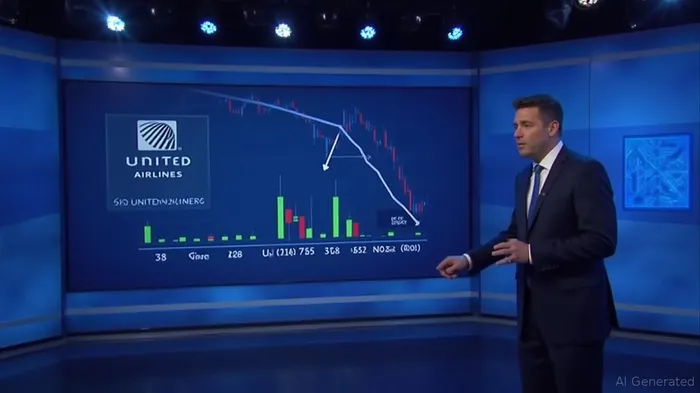
Candlestick Theory
Recent price action for United Airlines HoldingsUAL-- reveals notable bearish patterns. The June 17, 2025 session formed a long red candle closing near $73.65 after testing resistance near $77.24, confirming the $75–$78 zone as strong resistance. Prior to this, the June 16 green candle closed at $78.52, but the subsequent engulfing bearish candle invalidated its bullish sentiment. Key support is emerging near $72–$73, aligning with the March 2025 lows. The rejection near $78 highlights selling pressure, and failure to hold $72 may trigger further downside.
Moving Average Theory
The 50-day moving average (MA) has crossed below both the 100-day and 200-day MAsMAS--, signaling a "death cross" and reinforcing a bearish long-term trend. The 200-day MAMA-- (sloping downward near $75) and 100-day MA (near $77) act as dynamic resistance. The current price ($73.65) trades below all key MAs, confirming a downtrend. Short-term bounces face resistance confluence at the 50-day MA ($75–$76), which aligns with the June 16 peak.
MACD & KDJ Indicators
The MACD histogram shows sustained negative momentum, with the MACD line below the signal line and both in negative territory. The KDJ oscillator (14-period) exhibits bearish alignment: the %K line (26) remains below %D (31), while the J-line approaches oversold territory (sub-20). Though KDJ nears oversold levels, MACD’s persistent negative divergence warns against premature reversal calls. This divergence suggests lingering bearish control despite short-term exhaustion signals.
Bollinger Bands
Volatility expanded sharply during the June 17 sell-off, with price breaching the lower Bollinger Band (20-day, 2σ) near $73.05 before a slight recovery. Band expansion after compression (mid-June) signals renewed directional momentum—here, bearish. Price closed below the lower band, typically indicating oversold conditions but also potential continuation if volatility persists. The $72–$73 area now serves as a tactical support band.
Volume-Price Relationship
Bearish volume confirmation is evident: the June 17 sell-off occurred on above-average volume (8.56M shares vs. 30-day avg ~7.2M), validating downside momentum. Conversely, rallies (e.g., June 16’s 6.11% gain) saw muted volume (8.55M), indicating weak buying conviction. The April 9 spike to $70.83 (26% gain) coincided with extreme volume (32.9M shares), marking a distribution top. Sustained volume on declines signals distribution.
Relative Strength Index (RSI)
The 14-day RSI sits at 30.8, bordering oversold territory. While this hints at potential near-term consolidation, RSI’s persistent failure to breach 50 during recent pullbacks underscores entrenched bearish momentum. Previous oversold readings (e.g., January 2025 at RSI 29) led only to transient rebounds. Current conditions suggest RSI may linger below 30 before signaling exhaustion.
Fibonacci Retracement
Using the swing high of $78.87 (June 16, 2025) and the prior low of $70.83 (April 9, 2025), key Fibonacci levels emerge:
- 38.2%: $75.60 (tested as resistance June 12–13)
- 50%: $74.85 (brief support June 17)
- 78.6%: $72.58 (critical support, aligned with March 2025 lows)
The breach of 50% retracement and retest of 78.6% support ($72.58) suggests vulnerability. A sustained break below $72 opens the door to $68–$70 (December 2024 swing lows).
Confluence and Divergence Insights
Confluence exists at $72–$73, where Fibonacci support, Bollinger Band lows, and horizontal price structure converge. A breakdown here would align with bearish MACD/MA trends and high-volume selling. Notable divergence occurs between KDJ’s oversold signal and MACD’s unresolved bearish momentum, advising against contrarian longs. Resistance confluence resides at $75–$77 (50-day MA, Fibonacci 38.2%, prior swing highs), making rallies difficult to sustain without significant volume confirmation. Overall, technicals favor continued downside bias, with $72 acting as a pivotal support zone.

Divulgación editorial y transparencia de la IA: Ainvest News utiliza tecnología avanzada de Modelos de Lenguaje Largo (LLM) para sintetizar y analizar datos de mercado en tiempo real. Para garantizar los más altos estándares de integridad, cada artículo se somete a un riguroso proceso de verificación con participación humana.
Mientras la IA asiste en el procesamiento de datos y la redacción inicial, un miembro editorial profesional de Ainvest revisa, verifica y aprueba de forma independiente todo el contenido para garantizar su precisión y cumplimiento con los estándares editoriales de Ainvest Fintech Inc. Esta supervisión humana está diseñada para mitigar las alucinaciones de la IA y garantizar el contexto financiero.
Advertencia sobre inversiones: Este contenido se proporciona únicamente con fines informativos y no constituye asesoramiento profesional de inversión, legal o financiero. Los mercados conllevan riesgos inherentes. Se recomienda a los usuarios que realicen una investigación independiente o consulten a un asesor financiero certificado antes de tomar cualquier decisión. Ainvest Fintech Inc. se exime de toda responsabilidad por las acciones tomadas con base en esta información. ¿Encontró un error? Reportar un problema


SOBRE NOSOTROS
Nuestra historiaAutores de noticiasBase de conocimientosPolítica de privacidadTérmino de usoDescargo de responsabilidad de corretaje de tercerosTérminos de uso de AIMEDivulgaciones de riesgos de AInvest AICarrerasCONTÁCTENOS
Email: support@ainvest.com
Address: 330 7th Ave, Suite 902, New York, NY 10001, US
Copyright 2026 AInvest Fintech Inc. All rights reserved.


Comentarios
Aún no hay comentarios