
Uniswap's UNIfication Proposal: A Structural Catalyst for UNI Value Accrual
Uniswap's UNIfication Proposal represents a watershed moment in decentralized finance (DeFi), redefining how token economics and governance can align to create sustainable value accrual for UNIUNI-- holders. By introducing a fee switch, token burn mechanisms, and a novel legal structure under Wyoming's DUNA framework, the protocol is not only addressing long-standing critiques of value leakage but also embedding deflationary dynamics directly into its economic model. This analysis unpacks the structural implications of the proposal, arguing that it establishes a flywheel of scarcity, governance alignment, and regulatory resilience that could catalyze UNI's long-term value.
Token Economics: From Value Leakage to Value Capture
At the heart of the UNIfication Proposal is a reimagining of Uniswap's fee structure. The protocol has activated a fee switch that reduces liquidity provider fees from 0.30% to 0.25% for UniswapUNI-- v2 pools, with the remaining 0.05% redirected to protocol-controlled mechanisms. This 0.05% fee will be used to burn UNI tokens, creating a direct link between trading volume and token scarcity. According to a report by Yahoo Finance, this mechanism is expected to generate "deflationary pressure" by reducing the circulating supply of UNI, a critical step in aligning token holder incentives with protocol growth.
The deflationary impact is further amplified by a one-time burn of 100 million UNI tokens from the treasury, a move that immediately reduces supply by over 10%. This is not just a one-off event but part of a broader strategy to tie token supply dynamics to on-chain activity. For every dollar of trading volume, a proportional amount of UNI is burned, creating a self-reinforcing cycle: higher volume leads to more burns, which increases scarcity, which in turn could drive up UNI's price. This structural change addresses a key critique of DeFi governance tokens-that they often fail to capture value generated by the protocol.
Governance Alignment: The Protocol Fee Discount Auction
To mitigate potential backlash from LPs-whose fees were reduced by 0.05%-Uniswap introduced a Protocol Fee Discount Auction system. This mechanism allows LPs to bid for fee discounts, effectively redistributing a portion of the protocol's revenue back to liquidity providers while maintaining the deflationary burn schedule. By doing so, the protocol ensures that LPs remain incentivized to provide liquidity, even as a share of fees is redirected to token burns.
This auction system exemplifies the power of on-chain governance. Unlike traditional centralized models, where fee adjustments are unilaterally decided by a team, Uniswap's approach allows the community to dynamically balance competing interests. As stated by Yellow.com, the proposal's success-supported by 69 million UNI tokens-demonstrates strong community buy-in for this governance-driven model. The result is a more resilient economic system where token holders and LPs share aligned incentives.
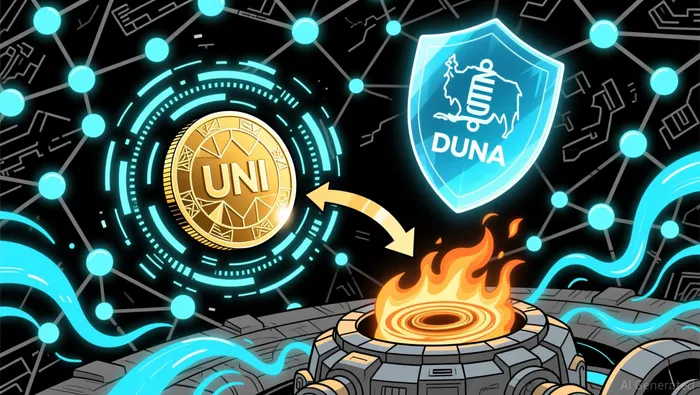
Regulatory Resilience: The DUNA Framework
While token economics are critical, regulatory uncertainty has long been a wildcard for DeFi protocols. Uniswap's adoption of Wyoming's Decentralized Unincorporated Nonprofit Association (DUNA) framework, branded as "DUNI," addresses this head-on. By registering as a DUNA, Uniswap Governance gains the legal capacity to engage in off-chain activities such as tax compliance, legal defense, and contract execution-all while preserving its decentralized nature.
This move is not merely procedural. As highlighted by TheBlock, the DUNA structure allows the protocol to operate within existing regulatory frameworks without compromising its decentralized ethos. For instance, the proposal allocates $16.5 million in UNI to fund a legal defense budget and tax compliance efforts, ensuring the protocol can navigate regulatory scrutiny proactively. Additionally, $75,000 is earmarked for Cowrie, a firm instrumental in drafting the DUNA statute, to serve as DUNI's administrator. This strategic allocation of resources signals a commitment to long-term sustainability, a critical factor for institutional investors wary of regulatory risks.
Synergy Between Economics and Governance
The UNIfication Proposal's true power lies in its synergy between token economics and governance. By redirecting fees to token burns, Uniswap creates a direct financial stake for UNI holders in the protocol's growth. Simultaneously, the DUNA framework ensures that governance can execute on these economic designs without legal friction. This dual-layer approach-deflationary tokenomics and regulatory alignment-positions Uniswap as a model for future DeFi protocols.
Moreover, the proposal's emphasis on execution-driven operations-such as the Protocol Fee Discount Auction-demonstrates a maturation of DeFi governance. As noted by Uniswap Foundation, the DUNI structure enables the community to "act in the real world" while maintaining decentralized control. This is a significant step toward resolving the "governance vs. execution" dilemma that has plagued many DAOs.
Conclusion: A New Paradigm for Token Value Accrual
Uniswap's UNIfication Proposal is more than a technical upgrade-it is a structural redefinition of how value is created and captured in decentralized protocols. By embedding deflationary mechanics into its fee model, aligning governance with on-chain activity, and securing regulatory clarity via the DUNA framework, Uniswap has laid the groundwork for a self-sustaining value accrual model. For investors, this represents a rare confluence of economic innovation and institutional readiness. As the protocol's trading volume grows, so too will the deflationary pressure on UNI, creating a flywheel effect that could drive the token's value higher over time.
In an ecosystem where token economics often lag behind technological innovation, Uniswap's approach offers a blueprint for sustainable value creation. The UNIfication Proposal is not just a catalyst for UNI-it's a catalyst for the next phase of DeFi's evolution.






Comentarios
Aún no hay comentarios