
Uniswap's UNIfication Proposal: A Game-Changer for DeFi Tokenomics and UNI Valuation
The Mechanics of UNIfication: Fee Capture and Supply Reduction
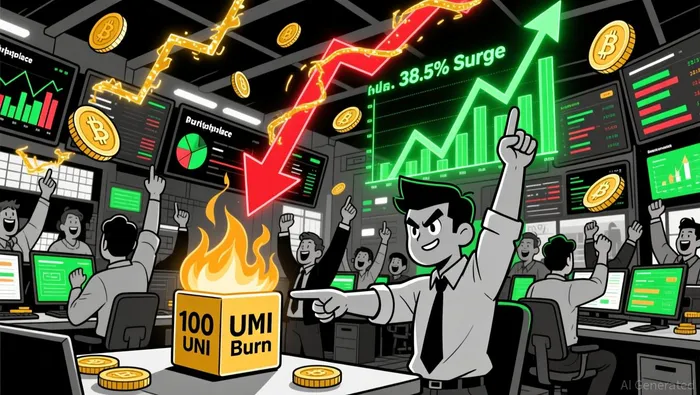
At the heart of the UNIfication Proposal is a dual strategy: fee capture and supply reduction. The protocol will redirect a portion of trading fees-both from its mainnet and layer-2 network, Unichain-into a UNI burn mechanism. This creates a direct link between protocol revenue and token scarcity, a critical step in aligning incentives for holders and liquidity providers (LPs). According to a CoinDesk report, the proposal includes a retroactive burn of 100 million UNI (16% of the circulating supply) from the treasury, simulating the deflationary impact of protocol fees had they been active since launch.
The activation of Protocol Fee Discount Auctions (PFDA) further amplifies this effect. PFDA allows traders to bid for fee discounts, internalizing maximal extractable value (MEV) and channeling these gains into the burn process. This not only incentivizes participation but also ensures that LPs earn a larger share of fees, reinforcing Uniswap's position as the default decentralized exchange (DEX) for tokenized assets, as the CoinDesk report notes.
Structural Value Creation: A New Paradigm for Governance Tokens
The UNIfication Proposal's deflationary mechanisms are designed to create structural value for UNI. By reducing supply while increasing demand through fee-sharing, Uniswap is engineering a scenario where token scarcity drives appreciation. Data from the CoinDesk report shows that the announcement of the proposal triggered a 38.5% surge in UNI's price, rising from $4.95 to $9.70. This price reaction underscores market confidence in the proposal's ability to reshape tokenomics.
Comparatively, SushiSwap's approach to value creation has been less aggressive. While SushiSwap has diversified its treasury into stablecoins and high-potential DeFi tokens to mitigate volatility, as noted in a Cryptodnes article, it lacks a robust fee-burning mechanism. Instead, it relies on dynamic fee adjustments and xSUSHI staking to distribute protocol fees. However, without a hard cap on supply or a structured burn program, SushiSwap's tokenomics remain vulnerable to inflationary pressures.
Balancer, meanwhile, has focused on operational efficiency and security through its V3 Vault model, as noted in the Cryptodnes article. While this enhances gas efficiency and reduces attack surfaces, it doesn't directly address token supply dynamics. Balancer's approach prioritizes liquidity provider returns through yield-optimized pools but lacks the deflationary tailwinds seen in Uniswap's proposal.
Long-Term Implications and Competitive Positioning
The UNIfication Proposal's structural changes position Uniswap to outperform competitors in the long term. By embedding fee capture and supply reduction into its core protocol, Uniswap is creating a self-reinforcing cycle: higher trading volume generates more fees, which fund further burns, reducing supply and increasing UNI's value. This flywheel effect is absent in protocols like SushiSwap and Balancer, which rely on external incentives or governance adjustments to drive growth.
Moreover, the proposal's emphasis on governance alignment-via a quarterly Growth Budget of 20 million UNI-ensures sustained investment in ecosystem development, as noted in the Cryptodnes article. This contrasts with SushiSwap's decentralized but less coordinated approach, where treasury diversification and token allocation are subject to frequent governance debates.
Conclusion: A Blueprint for DeFi's Future
Uniswap's UNIfication Proposal is more than a tokenomics overhaul-it's a blueprint for sustainable value creation in DeFi. By institutionalizing fee capture and supply reduction, Uniswap is addressing the core challenges of token dilution and governance misalignment. The market's enthusiastic response, evidenced by the 38.5% price surge, validates this approach. While SushiSwap and Balancer offer compelling innovations, they lack the structural rigor to match Uniswap's deflationary flywheel. For investors, the UNIfication Proposal represents a rare opportunity to bet on a protocol that's not just adapting to DeFi's evolution but actively shaping its future.






Comentarios
Aún no hay comentarios