
Uniswap's UNIfication: Is the 20M UNI Growth Budget a Sustainable Value Driver or a Hidden Tax on Holders?
The UNIfication Playbook: Burn, Fees, and Growth
At its core, UNIfication is a three-pronged strategy. First, it activates protocol fees on Uniswap v4, . Second, , distributed quarterly to fund protocol development and ecosystem incentives. Third, from the treasury, effectively reducing supply and creating deflationary tailwinds.
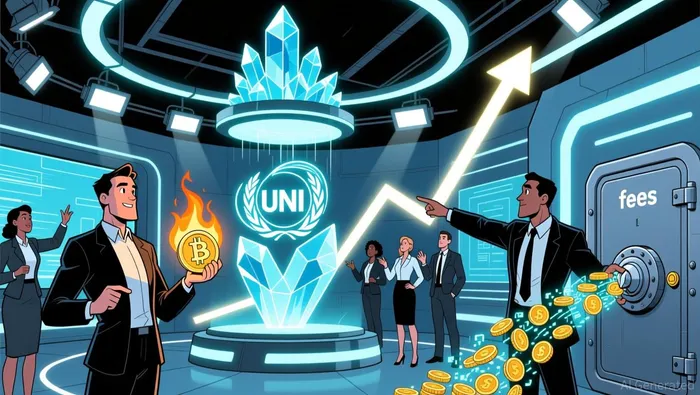 The math here is compelling. in December 2023, . For context, worth of UNI monthly, assuming current volume holds. This is a game-changer for token holders, as it directly counteracts the dilution risks inherent in decentralized finance (DeFi).
The Growth Budget: Fueling Ecosystem Expansion
The 20M UNI Growth Budget is designed to fund builders, developers, and liquidity providers, ensuring UniswapUNI-- remains the dominant DEX. Quarterly distributions will prioritize projects that enhance the platform's utility, . This innovation allows projects to conduct transparent, on-chain token sales, .
Critics, however, , Uniswap risks overextending its resources. Yet, the data suggests otherwise. , . Moreover, , .
Sustainability: Burn Rate vs. Issuance
The long-term viability of UNIfication hinges on balancing token burns with issuance. While the 100M burn is a one-time event, . If Uniswap's volume grows-say, , creating a self-reinforcing cycle of scarcity and value accrual.
However, this model is not without risks. If trading volume stagnates or declines, the burn rate could slow, reducing the deflationary impact. Additionally, , . Yet, , . .
Governance Risks and Holder Sentiment
The final wildcard is governance. UNIfication requires DAO approval, and while the community has largely supported aggressive tokenomics, dissent could emerge. For example, . .
That said, the current momentum is bullish. Whale activity has surged, . Technical indicators like RSI and CMF also suggest strong buyer sentiment, . This isn't just a tokenomics play-it's a psychological one.
Conclusion: A Calculated Bet on Long-Term Value
Uniswap's UNIfication is a bold, calculated move. . While risks exist, , .
For investors, . If Uniswap executes, , .






Comentarios
Aún no hay comentarios