
Uniswap's Protocol Fee Switch: A Catalyst for Sustainable Value Capture in DeFi
The Governance Shift: Aligning Incentives with Protocol Success
Uniswap's governance model has long been criticized for its lack of direct value accrual mechanisms for token holders. Despite generating over $3 billion in revenue between 2022 and October 2025-driven by a surge in DEX volume from $700 billion to $3.3 trillion-the UNI token has traded at around $6, 86% below its 2021 peak of $45, according to a Coinotag analysis. This disconnect highlights a critical flaw: the protocol's success has notNOT-- been economically shared with its stakeholders.
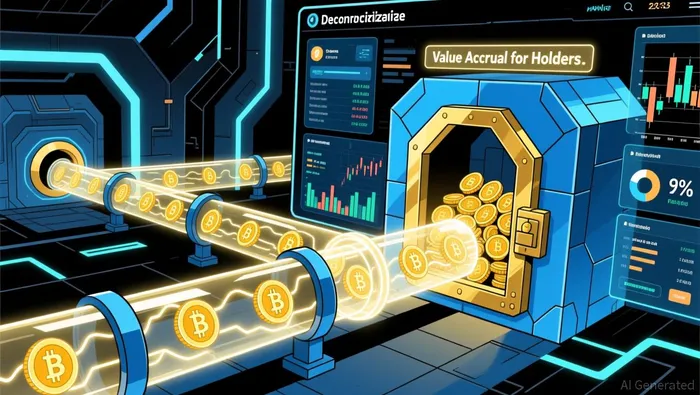
The Protocol Fee Switch, proposed by Uniswap's Executive Director Devin Walsh and co-founder Hayden Adams, seeks to rectify this by activating a fee-sharing mechanism. Once implemented, a portion of Uniswap's trading fees will be distributed to UNI stakers, creating a revenue-sharing model that directly ties token value to protocol performance, according to a Lookonchain report. This move mirrors broader industry trends, such as ZKsync's tokenomics model, which links token value to network usage and enterprise licensing revenues, as detailed in a Financefeeds piece.
Economic Realities: UNI's Struggle for Value Capture
The underperformance of UNI has drawn sharp criticism from analysts. Jeff Dorman of Arca has labeled the token "useless" due to its lack of growth-aligned incentives and downside protection, according to a Coinotag analysis. This critique is compounded by the fact that Uniswap's record $275 million in October 2025 trading fees did not translate into proportional token appreciation, as reported by a Coinotag analysis.
The root issue lies in the absence of mechanisms like buybacks or fee redistribution. While projects like RentStac (RNS) have introduced buyback-and-burn models to reduce circulating supply and enhance token utility, as described in a Cryptopolitan piece, Uniswap's previous tokenomics lacked such safeguards. The Protocol Fee Switch could address this by creating a sustainable revenue stream for UNI holders, potentially driving long-term value accrual.
Broader DeFi Lessons and Future Outlook
Uniswap's initiative reflects a growing recognition in DeFi that tokenomics must evolve to sustain user and investor confidence. For instance, Balancer's recent $116 million exploit underscored the risks of flawed incentive structures, as detailed in a Financefeeds post-mortem, while Aave's founder Stani Kulechov has emphasized the need for robust governance frameworks to mitigate high-leverage trading risks, as noted in a Coinotag report.
However, Uniswap's approach stands out for its simplicity and scalability. By leveraging its dominant market position-Uniswap now accounts for over 50% of DEX volume-the protocol could set a precedent for how DEXs monetize their networks without compromising decentralization. If successful, the fee switch might inspire similar models in projects like SushiSwapSUSHI-- or BalancerBAL--, though detailed comparisons with these platforms in 2025 remain limited, as noted in a Financefeeds post-mortem.
Conclusion: A Defining Moment for DeFi Governance
Uniswap's Protocol Fee Switch represents more than a technical upgrade; it is a strategic reimagining of how decentralized protocols can capture and distribute value. By aligning token holder incentives with protocol performance, the move could catalyze a new era of sustainable DeFi growth. Yet, its success will depend on execution-specifically, ensuring that fee distribution mechanisms are transparent, secure, and resistant to manipulation.
As the DeFi space matures, Uniswap's experiment will serve as a litmus test for whether governance-driven tokenomics can deliver on their promise of equitable value capture. For investors, the coming months will be critical in determining whether this shift translates into lasting value for UNI holders.






Comentarios
Aún no hay comentarios