
Uniswap's Fee Model Overhaul: Implications for UNI Holders and Market Sentiment
Uniswap's 2025 fee model overhaul, dubbed the "UNIfication" proposal, marks a pivotal shift in the decentralized exchange's (DEX) economic architecture. By introducing protocol fees, a UNIUNI-- token burn mechanism, and governance streamlining, the update redefines how value is distributed within the ecosystem. For UNI holders, this transition from a governance-only token to a deflationary asset tied to protocol revenue represents a paradigm shift with profound implications for token value dynamics and market sentiment.
Protocol Economics: A New Fee Structure
The core of the overhaul lies in the activation of a "fee switch" that redirects a portion of trading fees from liquidity providers (LPs) to the protocol. For UniswapUNI-- v2 pools, LP fees drop from 0.3% to 0.25%, with 0.05% allocated as protocol fees. In v3 pools, the protocol captures 1/4th of LP fees for 0.01% and 0.05% pools, and 1/6th for 0.30% and 1% pools. This structure ensures the protocol captures between 10–25% of LP fees, generating annualized revenue of $80–90 million at current trading volumes.
The Protocol Fee Discount Auction (PFDA) further enhances LP returns by auctioning the right to trade without paying protocol fees for limited periods. Early analysis suggests this could boost LP returns by $0.06–$0.26 for every $10k traded, mitigating concerns about reduced fee shares. Meanwhile, Uniswap v4's integration of aggregator hooks and programmatic UNI burns positions it as a hybrid on-chain aggregator, expanding its revenue capture potential.
Token Value Dynamics: Deflationary Pressure and Supply Reduction
The fee model's most direct impact on UNI holders is the introduction of deflationary mechanics. Protocol fees are used to buy and burn UNI tokens, reducing circulating supply. A one-time retroactive burn of 100 million UNI-equivalent to 16% of the circulating supply at the time of the proposal-signals a structural commitment to supply reduction. Analysts estimate this could lead to an annual deflationary rate of ~5% of the total supply, with conservative models projecting $165 million in annual burn value assuming a 15% share of Uniswap's total trading fees.
This mechanism aligns UNI's valuation with Uniswap's fee revenue and network activity. As trading volume grows, the burn rate accelerates, creating a flywheel effect where increased usage directly reduces token supply. For investors, this represents a novel economic model where token scarcity is programmatically tied to protocol performance.
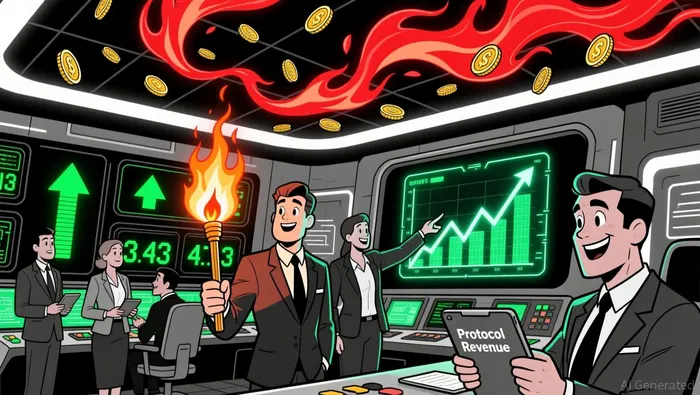
The market's initial reaction to the proposal was robust. UNI surged over 35% within 24 hours, reaching a peak of nearly $10 from ~$6.70. Whale activity amplified this surge, with large investors accumulating over $4 million worth of UNI in a single day. However, not all institutional holders participated in the buying frenzy; one major investor transferred 2.8 million UNI to Coinbase Prime, hinting at potential profit-taking.
Analysts remain cautiously optimistic. Technical analysis highlights key resistance levels around $9.50–$10, with a sustained breakout potentially signaling further bullish momentum. Price predictions range from $12–$15 in the near term, though some warn of a pullback to the $6–$7 range if short-term selling pressure intensifies. Critics, including competitors like Dromos Labs, argue that redirecting fees from LPs could erode Uniswap's market share, while others caution that reduced LP returns might incentivize liquidity migration to rival DEXs.
Long-Term Implications and Risks
The UNIfication proposal's success hinges on its ability to balance deflationary incentives with LP competitiveness. While the burn-first model avoids staking mechanics and preserves a deflationary narrative, it also introduces trade-offs. For instance, the PFDA mechanism's effectiveness in boosting LP returns remains untested at scale. Additionally, the transition of the Uniswap Foundation's operations to Uniswap Labs-aimed at aligning team incentives with protocol success-could face governance challenges.
From an economic modeling perspective, the proposal's sustainability depends on Uniswap's ability to maintain or grow its market share. If trading volume declines, the burn rate and deflationary impact could falter. Conversely, sustained growth could reinforce UNI's value proposition as a scarce, protocol-backed asset.
Conclusion
Uniswap's 2025 fee model overhaul represents a bold reimagining of DEX economics. By embedding deflationary mechanics into its protocol, Uniswap transforms UNI from a governance token into a value-accumulating asset. For investors, this creates a compelling narrative: a token whose scarcity is programmatically tied to network activity and fee revenue. However, the model's long-term success will depend on navigating liquidity provider dynamics, competitive pressures, and macroeconomic conditions. As the DeFi landscape evolves, Uniswap's experiment with protocol-level value capture could set a new benchmark for token economics.






Comentarios
Aún no hay comentarios