
uniQure’s AMT-130 and the Path to FDA Approval in Huntington’s Disease: A Strategic Investment in Gene Therapy Innovation
The gene therapy landscape for rare neurodegenerative diseases is undergoing a transformative shift, driven by advancements in precision medicine and regulatory flexibility. At the forefront of this revolution is uniQureQURE-- N.V.’s AMT-130, a gene therapy candidate targeting Huntington’s disease (HD), a fatal, inherited neurodegenerative disorder. With the FDA’s accelerated approval pathway and a robust clinical pipeline, AMT-130 represents a compelling investment opportunity in a market poised for exponential growth.
Clinical and Regulatory Momentum: A Fast-Tracking to Approval
AMT-130, an AAV5-based gene therapy designed to silence the mutant huntingtin (HTT) gene, has demonstrated groundbreaking results in Phase I/II trials. As of April 2025, 45 patients across the U.S. and Europe had received the treatment, with interim data revealing a dose-dependent 80% slowing of disease progression in the high-dose cohort over 24 months, as measured by the composite Unified Huntington’s Disease Rating Scale (cUHDRS) [1]. These findings, coupled with a reduction in neurofilament light chain (NfL) levels—a biomarker of neurodegeneration—have earned AMT-130 Breakthrough Therapy Designation and alignment with the FDA on an accelerated approval pathway [3].
The FDA’s agreement to use cUHDRS as an intermediate clinical endpoint and external natural history controls from the ENROLL-HD dataset marks a pivotal regulatory milestone. This approach allows uniQure to submit a Biologics License Application (BLA) in Q1 2026 without requiring additional trials [2]. Such regulatory flexibility is rare for gene therapies, reflecting the FDA’s recognition of AMT-130’s potential to address a high unmet medical need.
Market Dynamics: A High-Growth Niche with Strong Investment Potential
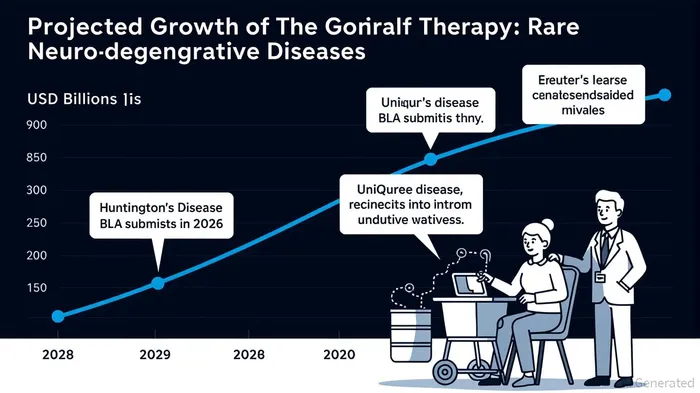
The global gene therapy market for rare neurodegenerative diseases is projected to grow at a 18.79% CAGR, reaching $25.20 billion in 2025 and expanding to $118.63 billion by 2034 [3]. Huntington’s disease, while rare, is a prime target for gene therapy due to its monogenic origin and the absence of disease-modifying treatments. The HD treatment market, valued at $658.31 million in 2025, is expected to surge to $1.69 billion by 2035, driven by innovations like AMT-130 [4].
Investors are increasingly prioritizing therapies with differentiated mechanisms and clear regulatory pathways. AMT-130’s AAV5 vector, which delivers micro-RNAs to silence HTT, offers a targeted approach to reducing the toxic protein driving HD. This contrasts with competitors like Wave Life Sciences’ WVE-003 (an antisense oligonucleotide) and Spark Therapeutics’ RG6662 (a gene therapy), which are in earlier-stage trials and lack AMT-130’s regulatory momentum [5].
Competitive Edge: Efficacy, Safety, and Commercial Readiness
AMT-130’s competitive advantages extend beyond its clinical data. The therapy has demonstrated a manageable safety profile, with no new serious adverse events reported in treated patients [1]. Its one-time administration, while invasive, aligns with the long-term benefits observed in trials, positioning it as a durable solution for HD.
UniQure’s manufacturing scalability further strengthens its commercial viability. By leveraging its existing HEMGENIX® process (approved for hemophilia B), the company can validate AMT-130’s production with a single Process Performance Qualification (PPQ) run, reducing costs and timelines [2]. Additionally, uniQure’s $377 million cash runway through mid-2027 ensures financial stability for BLA submission and post-approval commercialization [6].
Reimbursement strategies are also critical for high-cost gene therapies. uniQure’s experience with Hemgenix—priced at $3.5 million per dose—provides a blueprint for value-based pricing models and risk-sharing agreements with payers [4]. The appointment of Kylie O’Keefe, a rare disease commercialization expert, underscores the company’s readiness to navigate complex reimbursement landscapes [5].
Investment Risk and Mitigation
While AMT-130’s prospects are strong, risks remain. Gene therapies face challenges in long-term safety data, manufacturing consistency, and payer acceptance. However, uniQure’s alignment with the FDA on cUHDRS as a surrogate endpoint mitigates some of these risks by enabling conditional approval based on robust interim data [3].
Competitive threats, such as WVE-003’s 46% reduction in mutant HTT levels in cerebrospinal fluid [5], highlight the need for continuous innovation. Yet, AMT-130’s accelerated timeline and Breakthrough Therapy status provide a significant first-mover advantage.
Conclusion: A Strategic Bet on Gene Therapy’s Future
uniQure’s AMT-130 exemplifies the convergence of scientific innovation, regulatory agility, and market demand in rare disease gene therapy. With a clear path to FDA approval in 2026 and a growing $1.69 billion HD market by 2035, the therapy is positioned to redefine treatment paradigms. For investors, AMT-130 represents not just a bet on a single product, but on the broader potential of gene therapy to transform neurodegenerative care—a sector projected to dominate the biotech investment landscape for decades.
Source:
[1] uniQure’s Phase I/II Clinical Trial of AMT-130 [https://www.uniqure.com/programs-pipeline/phase-1-2-clinical-trial-of-amt-130]
[2] uniQure Provides Regulatory Update on AMT-130 [https://uniqure.gcs-web.com/news-releases/news-release-details/uniqure-provides-regulatory-update-amt-130-huntingtons-disease]
[3] Global Cell and Gene Therapy Market 2025–2034 [https://www.custommarketinsights.com/report/cell-and-gene-therapy-market/]
[4] Huntington’s Disease Treatment Market [https://www.researchnester.com/reports/huntingtons-disease-treatment-market/6517]
[5] HDSA 2025: Speakers Spotlight Huntington’s Clinical Trials [https://huntingtonsdiseasenews.com/news/hdsa-2025-speakers-spotlight-huntingtons-clinical-trials/]
[6] uniQure Q2 2025 Financial Results [https://uniqure.gcs-web.com/news-releases/news-release-details/uniqure-announces-second-quarter-2025-financial-results-and]







Comentarios
Aún no hay comentarios