
Union Pacific: A High-Conviction Dividend Growth Play in a Resilient Railroad Sector
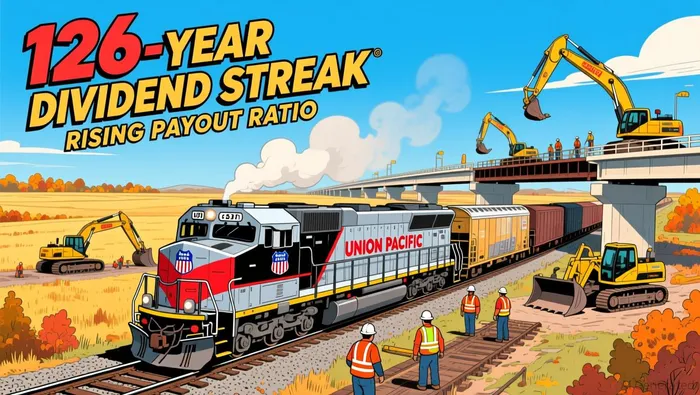
The railroad sector has long been a cornerstone of economic infrastructure, and Union PacificUNP-- (UNP) stands out as a prime example of disciplined capital allocation and sustainable earnings power. With a 126-year streak of uninterrupted dividend payments and a recent 3% increase in its quarterly payout to $1.38 per share, the company continues to reward shareholders while investing aggressively in its long-term resilience. For investors seeking a high-conviction dividend growth play, Union Pacific's combination of operational efficiency, strategic infrastructure spending, and a transformative acquisition on the horizon makes it a compelling case study in value creation.
Sustainable Earnings Power: A Foundation for Dividend Growth
Union Pacific's recent financial performance underscores its ability to generate consistent, scalable earnings. In Q3 2025, the company reported a net income of $1.8 billion, driven by a 3% year-over-year increase in operating revenue and an improved operating ratio of 58.5%. This efficiency is critical for sustaining dividend growth, as the company's payout ratio currently stands at 46.18%, a level that balances shareholder returns with financial flexibility.
 The railroad's operational resilience is further reinforced by its robust cash flow generation. Despite a debt-to-equity ratio of 183.2%, Union Pacific's interest coverage ratio of 8.1x and operating cash flow coverage of 30.7% demonstrate its capacity to service debt while maintaining dividend commitments. This financial discipline is a hallmark of its capital allocation strategy, which prioritizes reinvestment in infrastructure to sustain long-term earnings power.
Disciplined Capital Allocation: Investing for the Future
Union Pacific's capital expenditure plans from 2023 to 2025 reflect a strategic focus on infrastructure renewal and operational efficiency. The company has allocated a $3.7 billion plan in 2023, a $3.4 billion plan in 2024, and reaffirmed a $3.4 billion plan for 2025, with a significant portion directed toward replacing rail, ties, and ballast, as well as expanding freight car capacity and intermodal terminals. These investments are not merely maintenance-driven; they are designed to future-proof the network against volume growth and service demands.
Notably, Union Pacific has paused share repurchases to focus on its pending $85 billion acquisition of Norfolk Southern. This merger, expected to create America's first transcontinental railroad, is projected to unlock $2.75 billion in annualized synergies and enhance operational efficiency through a more integrated network. Fitch Ratings has placed Union Pacific on a positive rating watch, citing the acquisition's potential to boost free cash flow (FCF) to the mid-$2.0 billion range for 2025–2026, a figure that could further strengthen the company's ability to sustain and grow dividends.
A Resilient Sector and Strategic Synergies
The railroad sector's inherent resilience-driven-by its role in transporting essential goods and its inelastic demand-positions Union Pacific to weather macroeconomic volatility. Both Union Pacific and Norfolk Southern reported strong Q3 2025 results: Union Pacific's adjusted diluted EPS reached $3.08, while Norfolk Southern's EPS hit $3.30, exceeding expectations. The combined entity is expected to leverage these strengths to achieve cost savings, expand market reach, and improve service reliability, all of which are critical for maintaining customer loyalty and pricing power.
Moreover, the acquisition aligns with broader industry trends. As stated by Union Pacific's management, the merger will enable "enhanced infrastructure, innovation, and network expansion," with current annual investments in these areas totaling $5.6 billion. This focus on innovation and scale is key to maintaining a competitive edge in a sector where capital intensity and regulatory scrutiny are ever-present challenges.
Conclusion: A High-Conviction Play for the Long Term
Union Pacific's track record of dividend growth, coupled with its disciplined capital allocation and strategic vision, makes it a standout in the railroad sector. While its elevated debt levels warrant cautious optimism, the company's strong cash flow, improving operating ratios, and the transformative potential of the Norfolk Southern acquisition provide a compelling case for long-term resilience. For investors prioritizing sustainable earnings and disciplined returns, Union Pacific offers a rare combination of historical reliability and forward-looking ambition.







Comentarios
Aún no hay comentarios