
UniCredit's Strategic Shift to In-House Life Insurance and Its Implications for Fee-Based Revenue Growth
Vertical Integration and Strategic Rationale
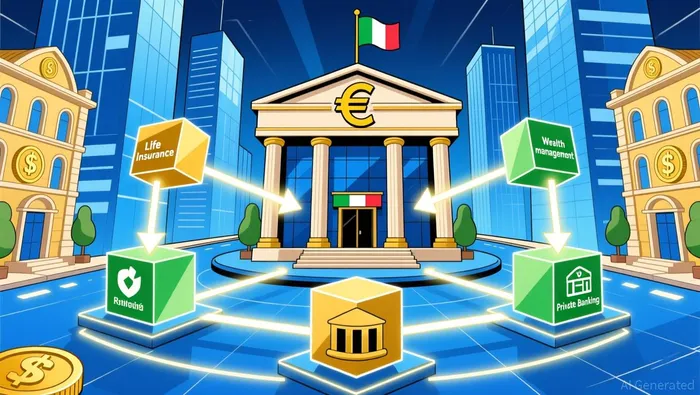
UniCredit's decision to centralize life insurance operations reflects a strategic response to declining net interest income and the need for diversified revenue streams. By acquiring full control of its former joint ventures with CNP Assurances and Allianz-now rebranded as UniCredit Life Insurance (ULI) and UniCredit Vita Assicurazioni (UVA)-the bank has positioned itself to manage the entire value chain of life insurance products. These entities are slated to merge by 2026, forming a unified bancassurance provider focused on Italy's domestic market according to reports.
This vertical integration strategy mirrors broader trends in European banking, where institutions are increasingly seeking to reduce reliance on third-party intermediaries and capture higher-margin fee income. For instance, embedded finance models are reshaping the sector, with traditional banks partnering with fintechs to co-develop infrastructure while retaining control over core operations. However, UniCredit's approach diverges by emphasizing in-house expertise rather than external collaboration, a choice that could amplify both risks and rewards.
Fee-Based Revenue and Margin Implications
The shift to in-house life insurance is a direct attempt to reverse the erosion of fee-based revenue. Analysts project that UniCredit's fees and commissions will rise by 5% annually, reaching €8.6 billion by 2025, partially offsetting a 4% decline in net interest income for the same period. This growth hinges on the success of internally managed products like Premium One, which targets Wealth Management and Private Banking clients. By retaining control over underwriting, pricing, and asset management, UniCredit aims to enhance profit margins typically diluted in third-party arrangements.
However, the financial impact of vertical integration is not without challenges. The failed acquisition of Banco BPM in 2025, thwarted by Italian government "Golden Powers" regulations, highlights the regulatory and political risks inherent in such strategies. The imposition of stringent conditions-such as maintaining loan-to-deposit ratios and exiting Russian operations-forced UniCredit to abandon the deal, potentially delaying cost efficiencies and complicating its vertical integration roadmap. These setbacks underscore the fragility of margin expansion in a highly regulated environment.
Partnership Models and Competitive Dynamics
UniCredit's in-house focus contrasts with the collaborative models adopted by peers like BBVA and Solaris, which leverage fintech partnerships to scale embedded finance solutions. While these alliances allow banks to access new distribution channels without bearing the full cost of digital infrastructure, they also cede control over customer relationships and pricing. For UniCredit, the trade-off appears to be a calculated risk: by retaining end-to-end control, the bank can optimize margins but must bear the higher costs of internal development and compliance.
This divergence raises questions about the scalability of UniCredit's approach. In a sector where regulatory fragmentation and compliance burdens are intensifying-particularly for embedded credit and BNPL products-vertical integration may offer greater flexibility to adapt to evolving requirements. Yet, the bank's ability to compete with pan-European fintechs and infrastructure providers like Treezor or Railsr remains uncertain. These platforms, which offer modular, API-driven solutions, are consolidating their dominance by addressing cross-border regulatory challenges and enabling sector-specific deployments in healthcare, mobility, and B2B services according to reports.
Strategic Implications for European Banking
UniCredit's strategy reflects a broader tension in European banking: the balance between vertical integration and horizontal collaboration. While in-house operations can enhance margin visibility and customer retention, they also require significant capital and operational bandwidth. Conversely, partnerships with fintechs enable rapid innovation but dilute control. The success of UniCredit's approach will depend on its ability to execute the ULI-UVA merger effectively and demonstrate that internally managed products can outperform those offered by external partners.
Moreover, the bank's focus on life insurance aligns with the sector's projected growth. The European embedded finance market is expected to expand at a 8.0% CAGR from 2026 to 2030, driven by sector-specific integrations in areas like health insurance and B2B financing. By positioning itself as a vertically integrated provider, UniCredit may capture a larger share of this growth, particularly in Italy, where bancassurance remains a dominant distribution channel.
Conclusion
UniCredit's strategic shift to in-house life insurance represents a high-stakes bet on vertical integration as a driver of fee-based revenue growth. While the bank's control over ULI and UVA offers potential margin benefits, the path to profitability is fraught with regulatory, operational, and competitive challenges. In a sector increasingly defined by embedded finance and fintech collaboration, UniCredit's approach underscores the diversity of strategies being tested across European banking. For investors, the key question is whether the bank can leverage its in-house expertise to outperform peers while navigating the complexities of a rapidly evolving market.







Comentarios
Aún no hay comentarios