
UNI's Whale-Driven Sell-Off and the Hidden Risks of Narrative-Driven Crypto Rallies
The UNIfication Narrative and Its Limits
Uniswap's 2025 "UNIfication" proposal, which introduced protocol fees and a token burn mechanism, initially catalyzed a 35% price surge within hours of its announcement. The proposal promised to reduce UNI's supply and align incentives for long-term holders, creating a compelling story for investors. Year-to-date, Uniswap's fee generation had already surged to $985 million, with October's $132 million in fees nearing all-time highs. These metrics painted a picture of a protocol regaining its footing after a Q1 slump, fueling retail enthusiasm.
However, the narrative's strength was quickly tested by whale activity. A major institutional holder deposited 1.19 million UNIUNI-- tokens into Binance on November 11, 2025, realizing a $914,000 loss amid a 30% price drop from its peak. This whale had accumulated the tokens between February and October 2025, yet chose to offload them during a rally, signaling a disconnect between the bullish narrative and on-chain behavior. Similarly, a dormant whale sold 512,000 UNI tokens-a 76% loss-shortly after the UNIfication proposal's initial euphoria, further highlighting capitulation.
On-Chain Metrics Reveal Selling Pressure
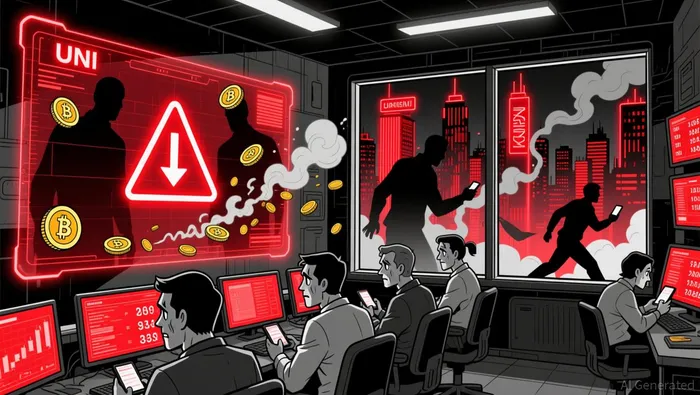 On-chain data painted a grim picture of UNI's liquidity dynamics. During the November 2025 rally, the mean coin age of UNI tokens dropped sharply, while age consumed rose, indicating a wave of previously dormant tokens entering circulation. This pattern is often associated with profit-taking or panic selling. Concurrently, the MVRV (Market Value to Realized Value) ratio fell into negative territory, showing that most holders were underwater and likely to sell to break even. Exchange netflow metrics also spiked with large inflows into centralized exchanges in early November, suggesting whales were preparing to offload their holdings.
These metrics contradict the narrative of a "buy-the-dip" environment. Instead, they reveal a market where whales are strategically exploiting short-term optimism to liquidate positions. For example, the top 10 UNI addresses control roughly 50% of the supply, and their coordinated exits-such as the 635,000 UNI accumulation in November-can artificially inflate prices before triggering sell-offs. Retail investors, often unaware of these dynamics, are left to navigate a landscape where price action is manipulated by a small group of actors.
Retail Investor Behavior: FOMO and Disillusionment
Retail investors initially embraced the UNIfication narrative with fervor. The 63% price surge in the week following the proposal drew comparisons to past crypto rallies, with social media campaigns amplifying the hype. However, this enthusiasm was short-lived. By late November, retail participation in buying dips had waned, as investors grew wary of overvaluation and speculative bubbles. This shift was exacerbated by whale exits, which created a self-fulfilling prophecy of declining confidence.
For instance, the 512,000 UNI sell-off by a long-term whale-realizing a $11.65 million loss-sent shockwaves through retail sentiment. Such events reinforce the perception that whales prioritize profit-taking over long-term value, undermining trust in the narrative. Retail investors, already prone to emotional decision-making, often interpret these exits as signals to sell, even if fundamentals remain intact. This dynamic was evident in January 2025, when retail investors moved 6,000 BTC to exchanges amid bullish sentiment, only to face a subsequent price collapse.
The Broader Implications for Crypto Markets
The UNI case highlights a systemic issue in crypto: the power of whales to distort market perception. Unlike traditional markets, where institutional activity is often transparent, crypto's pseudonymous nature allows whales to execute coordinated exits without immediate scrutiny. This creates a "black box" effect, where retail investors are left to interpret price action through fragmented on-chain data and social media narratives.
Moreover, the interplay between governance proposals and whale behavior raises questions about the integrity of decentralized finance (DeFi). While the UNIfication proposal aimed to align incentives, its success was undermined by the very actors it sought to empower. As one analyst noted, "Whales can weaponize governance to create short-term value while exiting their positions, leaving retail investors to bear the brunt of the fallout."
Conclusion
The 2025 UNI rally, driven by the UNIfication narrative, offers a cautionary tale for crypto investors. While governance upgrades and fee growth are critical to a protocol's success, they cannot offset the risks posed by whale-driven liquidity distortions. Retail investors must remain vigilant, scrutinizing on-chain metrics and whale activity alongside narrative-driven optimism. For the broader market, the challenge lies in developing tools and transparency mechanisms that hold large holders accountable-ensuring that bullish narratives are not hijacked by those with the power to manipulate them.






Comentarios
Aún no hay comentarios