
UNI's Post-UNIfication Value Capture and Breakout Potential
The UniswapUNI-- (UNI) token has undergone a transformative shift in its tokenomics with the execution of the UNIfication proposal in late December 2025. This structural overhaul, which permanently burned 100 million UNIUNI-- tokens-valued at approximately $596 million at the time-has redefined the token's relationship with protocol activity, creating a deflationary mechanism tied to trading volume and liquidity provision. For investors, this marks a pivotal moment in UNI's evolution, positioning it as a token with asymmetric upside potential driven by scarcity, governance alignment, and on-chain momentum.
Structural Tokenomics: From Inflation to Deflation
Prior to UNIfication, UNI's tokenomics were criticized for lacking a direct link to protocol revenue, with liquidity providers (LPs) receiving the majority of trading fees and token holders deriving minimal value from usage growth. The UNIfication proposal addressed this by introducing a protocol fee switch, redirecting a portion of trading fees toward UNI burns. Specifically, in Uniswap v2 pools, LPs now receive 0.25% of trading fees, while the remaining 0.05% is captured by the protocol for token burns. In v3 pools, the protocol captures 25% of fees in low-risk pools and 16.7% in high-risk pools according to analysis. These fees are used to fund a recurring growth budget and further reduce UNI's circulating supply, creating a flywheel effect where higher trading volume directly accelerates token scarcity.
The one-time burn of 100 million UNI tokens-executed from Uniswap's treasury-was a symbolic and corrective action, retroactively capturing value. This move not only reduced the total supply by 10% but also signaled a commitment to aligning token holder incentives with protocol growth. As stated by a report from Bitrue, "The burn represents a structural shift in Uniswap's tokenomics, ensuring that UNI holders benefit from the platform's increasing economic activity."
Deflationary Mechanics and Scarcity-Driven Value
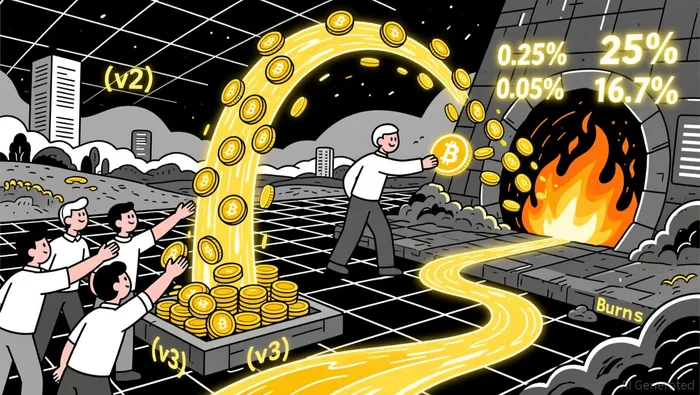
The deflationary model introduced by UNIfication has immediate and compounding implications for UNI's value. By tying token burns to protocol usage, Uniswap has created a self-reinforcing cycle: higher trading volume generates more fees, which fund more burns, further reducing supply and increasing demand for the token. Data from Q4 2025 shows that post-burn, UNI's price surged by 5.2–5.4% within days, with trading volume spiking 52% to $297 million. On-chain metrics also revealed strong accumulation signals, including a Buyers vs. Sellers index of 0.116 and accumulation volume exceeding 744.6k, surpassing the smoothed average of 500k.
Conservative estimates suggest that the compounding burn effects could add $0.5–$1 per UNI token over time, while bullish scenarios project a market capitalization exceeding $10 billion by 2027 according to analysis. This is supported by Uniswap's growing Total Value Locked (TVL), which reached $4.5 billion in 2025, with Uniswap v4 alone surpassing $1 billion in TVL within 177 days. The protocol's cumulative trading volume in v4 hit $100 billion by mid-2025, driven by incentive programs and the introduction of customizable liquidity strategies via "hooks".
Governance and Utility Enhancements
UNIfication also streamlined governance and utility for UNI. The proposal eliminated frontend fees, ensuring Uniswap remains a neutral infrastructure rather than a fee-charging application. Additionally, Uniswap Foundation responsibilities were consolidated into Uniswap Labs, and the protocol adopted Wyoming's DUNA framework for legal clarity according to analysis. These changes strengthen UNI's role as a governance token while reinforcing the platform's decentralized ethos.
Critically, the token's utility has expanded beyond governance to include direct participation in value capture. As noted by KuCoin, "UNI is no longer just a governance token; it is now a vehicle for capturing the economic upside of one of DeFi's most dominant protocols." This shift has attracted institutional and retail investors alike, with accumulation patterns indicating sustained demand.
Risks and Counterarguments
While the bull case is compelling, risks remain. Liquidity providers, particularly in v3 pools, face reduced fee shares, which could impact liquidity depth if not offset by higher trading volumes. Additionally, the success of the deflationary model hinges on sustained protocol growth and DeFi adoption. A slowdown in trading activity could diminish the rate of token burns, limiting scarcity-driven gains.
However, the structural changes introduced by UNIfication have already demonstrated resilience. For instance, Uniswap's TVL and trading volume remained robust in Q4 2025, with incentive programs driving $32.8 billion in cumulative volume and reaching an all-time high of $1.4 billion in Total Value Secured (TVS) according to analysis. These metrics suggest that the protocol's user base and economic activity are expanding, mitigating short-term risks.
Conclusion: A Tokenomics-Driven Bull Case
UNI's post-UNIfication trajectory presents a compelling investment thesis rooted in tokenomics innovation. By aligning token scarcity with protocol usage, Uniswap has created a deflationary mechanism that rewards long-term holders while reinforcing governance alignment. The immediate price response, coupled with strong on-chain accumulation metrics and growing TVL, validates the momentum catalysts for a breakout.
For investors, the key question is not whether UNI can rise but how high it can go. With conservative estimates pointing to $0.5–$1 in added value per token and bullish scenarios projecting a $10 billion market cap by 2027, the potential for asymmetric upside is clear. As the DeFi landscape continues to evolve, UNI's structural repositioning positions it as a cornerstone asset for those seeking exposure to the next phase of decentralized finance.






Comentarios
Aún no hay comentarios