
UNFI's Cyber Attack: A Material Hit or a Manageable Setback?
The event that triggered this analysis was a deliberate cyber attack on UNFI's core IT infrastructure. The company first detected unauthorized activity in its systems on June 5, 2025. In a standard security response, UNFIUNFI-- immediately took certain systems offline to contain the breach, a move that had an immediate and severe operational consequence.
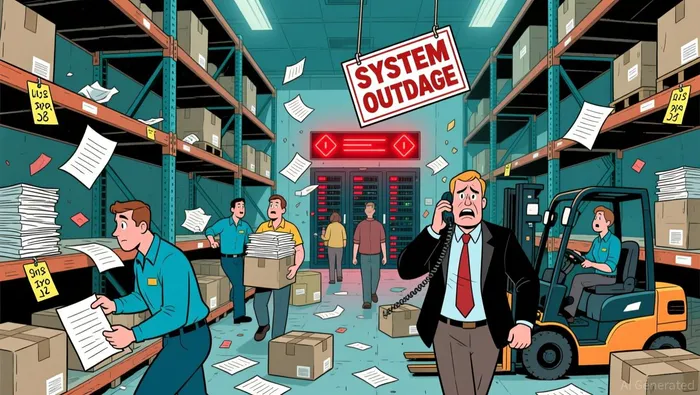
The disruption lasted for over a week, with the attack's effects felt across the entire supply chain. For more than ten days, UNFI's core IT systems were offline, crippling its ability to process orders. This forced distribution centers to revert to manual workarounds using pen and paper, a process that is slow and error-prone. The scale of the impact was massive: the company serves over 30,000 retail locations for major chains like Whole Foods and military commissaries. The loss of automated order processing meant delayed deliveries and empty store shelves nationwide, as frontline employees scrambled to manage the fallout.
Operations returned to normal levels only after the systems were fully restored. UNFI confirmed on June 26 that it had safely restored the core systems and that it was now delivering products at more normalized levels. The company stated the incident was contained, but the damage to its supply chain and customer relationships had already been done.
Financial Impact: Quantifying the Material Hit
The cyber attack delivered a precise and substantial financial blow. UNFI has quantified the damage: the disruption cost the company approximately 5% of its sales in the fiscal fourth quarter, translating to about $425 million in lost revenue. This is not a minor operational hiccup; it is a direct, material hit to the top line. The company had previously estimated the potential sales loss could be as high as $425 million, and the actual figure aligns with that upper bound.
The impact rippled through the income statement, hitting profitability hard. The incident reduced the company's adjusted EBITDA for the fourth quarter by approximately $50 million. This significant reduction contributed to a broader decline in the quarter's adjusted EBITDA, which fell 18.9% year-over-year to $116 million. The company also incurred $15 million in direct costs related to the incident, including expenses for incident response and recovery efforts.
Despite this clear hit, the reported results present a nuanced picture. UNFI's Q4 net sales of $7.7 billion still met expectations. Management attributed the year-over-year decline in sales to two factors: the cyber attack and the fact that the prior-year quarter included an extra week. On a comparable, 13-week basis, sales actually grew 1.6%. This framing is crucial-it suggests the attack was a major, identifiable drag, but not the sole reason for the quarterly decline. The bottom line, however, was a net loss of $87 million for the quarter, a significant increase from the prior-year loss of $37 million.
The financial impact is now in the rearview. The company has moved past the immediate crisis, with systems restored and operations normalized. The revised guidance for fiscal 2026, which targets a return to net income, reflects a forward-looking reset. The attack's cost is a one-time event that has been accounted for, shifting the focus to the company's ability to execute its new growth plan and regain lost ground.
The Recovery and Forward Setup
UNFI is now managing the fallout with a clear focus on the forward path. The company's leadership is signaling confidence in the underlying demand for natural and organic products by raising its three-year sales growth target to the low single digits from a previous goal of flat growth. This upward revision is a key indicator that management views the cyber attack as a discrete, one-time event that does not alter the long-term trajectory of its core business.
Financially, the company is working to contain the damage. UNFI has stated that insurance will cover the expenses it incurred in response to the intrusion. More importantly, it has added that it believes most of the financial fallout stemming from the incident would be contained to its current quarter. This framing is critical-it suggests the company sees the $425 million sales hit and $50 million EBITDA reduction as largely a Q4 event, allowing it to reset its financial outlook for the coming year.
The market's immediate reaction to this setup was telling. When UNFI disclosed the financial impact and raised its guidance, the stock surged that day by more than 12%. Traders interpreted the revised targets as a positive signal, focusing on the raised growth outlook and the contained financial fallout. This price pop indicates investors are treating the cyber attack as a material but manageable setback, not a fundamental business failure. The forward view now hinges on the company's ability to execute its new growth plan and its "lean" operating strategy, which it says is driving improvements across its supply chain.
Catalysts and Risks to Watch
The thesis that this was a contained setback now faces near-term tests. The first is the upcoming Q1 2026 results. This quarter will be critical for confirming that the company has fully normalized operations and that the raised three-year growth targets are not just optimistic talk. Any lingering operational inefficiencies or unexpected costs would undermine the narrative of a clean break from the incident. The market will be watching for signs that the company is executing its "lean" strategy effectively and that the supply chain is running smoothly again.
A more structural risk is the competitive landscape. The cyber attack has accelerated a shift in market leadership. C&S Wholesale Grocers has now overtaken UNFI as the top U.S. grocery wholesaler. This change in positioning is a tangible consequence of the disruption, which may have allowed a rival to capture share. UNFI must now defend its position while also pursuing its new growth plan, adding a layer of competitive pressure that was less acute before the incident.
The most systemic risk, however, is the heightened vulnerability it exposed. The attack highlighted the digital dependence of supply chains and the domino effect a single point of failure can have. While UNFI expects its cybersecurity insurance to cover the direct costs, the incident likely increases the company's future need for investment in cyber resilience. This is a recurring cost that could pressure margins over time, a hidden friction not fully captured in the one-time $425 million sales hit. The company's ability to manage this ongoing security burden will be a key determinant of its long-term profitability.





Comentarios
Aún no hay comentarios