
U.S. Unemployment and Market Volatility: Implications for Fed Policy and Equity Sectors
The U.S. labor market entered November 2025 with a mix of resilience and fragility, as the unemployment rate climbed to 4.6%, a four-year high, despite the addition of 64,000 jobs in the month according to the jobs report. This rise, coupled with revised downward revisions to prior months' job gains, signals a softening labor market that has investors and policymakers recalibrating their strategies. For equity markets, the shift has sparked a reevaluation of sector allocations, with defensive sectors like healthcare and utilities outperforming as investors seek stability, while tech-driven industries face headwinds amid layoffs and shifting demand.
Defensive Sectors: A Safe Harbor in a Shifting Current
Defensive sectors, particularly healthcare and utilities, have emerged as bright spots in a labor market marked by uncertainty. According to the Bureau of Labor Statistics, healthcare employment surged by 46,000 jobs in November 2025, driven by growth in ambulatory services, hospitals, and nursing care facilities. This trend reflects the sector's structural demand, bolstered by an aging population and ongoing regulatory tailwinds. Meanwhile, the healthcare equity sector saw a notable rally, with the XLV fund rising over 9% in November as investors rotated into undervalued, stable assets.
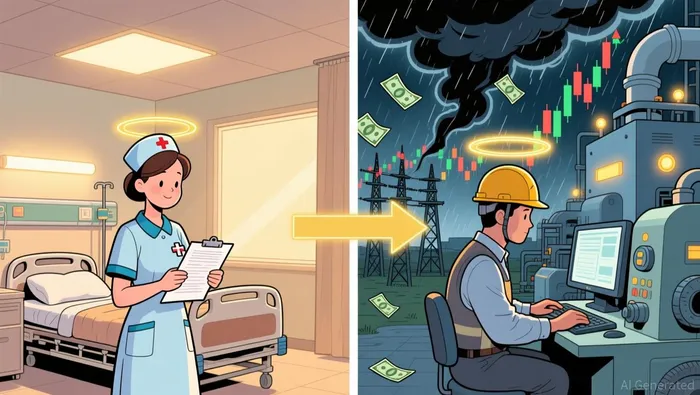 Utilities, another defensive pillar, also demonstrated resilience. With stable demand for essential services and attractive dividend yields, the sector has drawn capital amid concerns over overvaluation in riskier assets like AI-driven tech stocks according to market analysis. This shift underscores a broader market dynamic: as unemployment rises and economic growth moderates, investors increasingly prioritize sectors with predictable cash flows and low cyclicality.
Tech-Driven Sectors: Navigating a Dual-Track Reality
The tech sector, once a dominant force in equity markets, faces a more complex landscape. Data from CompTIA reveals that U.S. tech companies reduced an estimated 6,878 positions in November 2025, with layoffs concentrated in IT services, custom software development, and systems design. Total tech occupation employment fell by 134,000, pushing the unemployment rate for tech workers to 4%. These figures highlight a cooling in hiring activity, driven by tighter credit conditions and corporate caution in the face of macroeconomic uncertainty.
Yet, within this contraction lies a structural shift. Despite overall job losses, 41% of active tech job postings in November targeted AI-related roles or required AI skills according to the same report. This divergence suggests that while the broader tech sector faces cyclical headwinds, AI remains a strategic priority for firms seeking to maintain competitive advantage. Investors must weigh the near-term pain of layoffs against the long-term potential of AI-driven innovation, a duality that complicates sector positioning.
Fed Policy: Balancing Inflation and Labor Market Support
The Federal Reserve's policy calculus has grown more intricate as the labor market softens. Officials have long grappled with the tension between supporting employment and curbing inflation, and November's data adds urgency to this debate. A 4.6% unemployment rate, while not indicative of a collapse, signals a departure from the tight labor market that fueled inflationary pressures earlier in the decade. This could open the door to rate cuts in 2026, particularly if inflation continues its downward trajectory.
However, the Fed's response will likely remain cautious. The recent government shutdown and delayed jobs report underscore the challenges of navigating a policy path amid political and economic volatility. For now, the central bank appears poised to monitor incoming data closely, with a focus on whether the labor market's slowdown translates into broader economic weakness.
Strategic Implications for Investors
The divergent performances of defensive and tech-driven sectors present a clear case for portfolio rebalancing. Defensive sectors offer a buffer against near-term volatility, with healthcare and utilities providing both income and downside protection. For tech investors, the key lies in discerning between cyclical pain and structural opportunity. AI-related roles, though still a fraction of total tech hiring, represent a long-term growth vector that could outperform as productivity gains materialize.
A balanced approach-overweighting defensive sectors while selectively allocating to AI-focused tech firms-may offer the best path forward. This strategy acknowledges the immediate risks of a softening labor market while positioning for the transformative potential of emerging technologies. As the Fed navigates its policy path and the economy adjusts to a new normal, agility in sector allocation will be critical for managing risk and capturing returns.







Comentarios
Aún no hay comentarios