
Undervalued UK Small-Cap Innovators in 2025: Strategic Entry into Overlooked Sectors with Strong R&D Potential
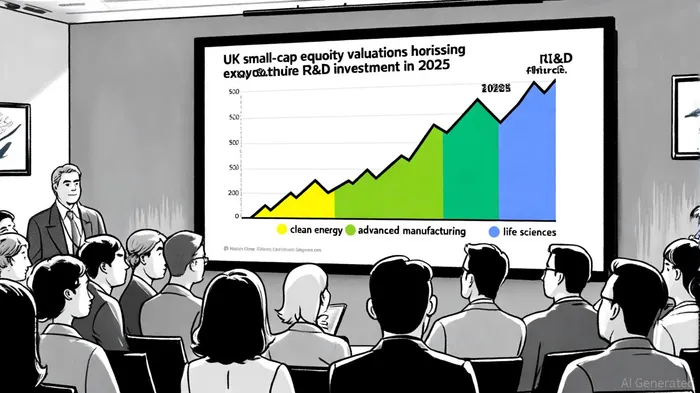
The UK small-cap market has long been a sleeping giant, but 2025 marks a pivotal inflection pointIPCX--. With the government's 2025 Spending Review allocating £22 billion annually to R&D and £30 billion to nuclear and carbon capture technologies, the stage is set for a renaissance in innovation-driven equities[1]. These investments, coupled with reduced taxes, deregulation, and historically low interest rates, create a fertile environment for small-cap firms in overlooked sectors to outperform. For investors, the challenge lies in identifying undervalued innovators poised to capitalize on this structural shift.
The R&D-Driven Opportunity
The UK's 10-year industrial strategy prioritizes advanced manufacturing, clean energy, defence, and life sciences, with targeted funding to accelerate automation, digitization, and commercialization[2]. For instance, the government has committed £2.8 billion over five years to advanced manufacturing, while clean energy investment is set to double to £30 billion annually by 2035[3]. These sectors are not only aligned with global decarbonization trends but also benefit from domestic policy tailwinds, such as the Clean Industry Bonus expansion and the £700 million boost to Great British Energy for hydrogen and offshore wind infrastructure[4].
Small-cap firms in these sectors are uniquely positioned to benefit. Consider Barocal, a cleantech innovator securing $4.5 million for zero-carbon refrigeration technology[5], or Octopus Energy, which has raised $2.9 billion to develop AI-powered smart grid solutions[6]. These companies exemplify how R&D-intensive models can unlock value in niche markets.
Undervalued Gems in Overlooked Sectors
The UK's micro-cap universe is rife with opportunities for those willing to dig beyond the headlines. The Artisanal Spirits Company (UK:ART), for example, holds 18,000 casks valued at cost on its balance sheet—assets that could be revalued significantly if the company pursues a restructuring or strategic sale[7]. Similarly, Cadogan Energy Solutions (UK:CAD), with a market cap of £11 million, owns an oil and gas project in Western Ukraine and has a £10 million cash reserve following a lawsuit payout[8]. Such firms often trade at discounts to their intrinsic value due to limited analyst coverage.
In the clean energy space, Zenobe Energy stands out as the UK's largest independent battery storage operator, managing grid-scale solutions for commercial clients. Meanwhile, Arrival is revolutionizing electric vehicles with its Generation 2 technology, backed by $979.5 million in funding. These companies are not just beneficiaries of policy; they are active participants in reshaping their industries.
Strategic Entry Points and Risk Mitigation
The current valuation gap between small-cap and large-cap equities presents a compelling case for repositioning. Historically, large-cap outperformance cycles average 14 years, and the current one has already reached that threshold[1]. With the Mansion House Accord funneling £25 billion into UK assets—including AIM shares—by 2030, liquidity constraints for small-cap firms are easing.
However, due diligence is critical. Investors should prioritize companies with strong insider buying, as seen in Gamma Communications (projected 13.9% annual earnings growth) and Sirius Real Estate, which has executed strategic acquisitions and bond issuances. Insider confidence often signals alignment with long-term value creation.
Conclusion: A Window of Opportunity
The UK's innovation agenda, combined with favorable macroeconomic conditions, has created a rare confluence of factors for small-cap outperformance. For investors, the key is to focus on sectors with structural tailwinds—clean energy, advanced manufacturing, and life sciences—and identify firms with robust R&D pipelines and undervalued balance sheets. As the government's £25.6 billion scale-up finance program bridges the growth capital gap[1], the next 12–24 months could see these overlooked innovators leapfrog their larger peers.







Comentarios
Aún no hay comentarios