
Undervalued Middle Eastern Penny Stocks in Energy and Tech Sectors: Navigating Geopolitical Tailwinds and Market Inefficiencies in 2025
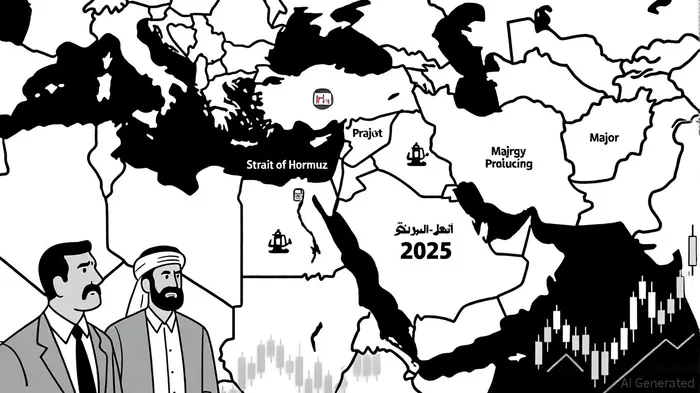
The Middle Eastern penny stock market in 2025 is a tapestry of resilience and volatility, shaped by geopolitical tensions, shifting global trade dynamics, and structural market inefficiencies. For investors with a risk appetite for high-reward opportunities, energy and technology sectors present compelling cases where undervaluation is driven by both external shocks and internal market imperfections. This analysis explores how geopolitical tailwinds and inefficiencies are creating asymmetric opportunities in these sectors, supported by real-world examples and financial metrics.
Energy Sector: Geopolitical Volatility as a Double-Edged Sword
The energy sector in the Middle East remains inextricably linked to regional and global geopolitical developments. In Q2 2025, Brent crude prices swung from $64 to $79 per barrel amid Israel-Iran strikes, underscoring the region's role as a fulcrum for global oil markets[3]. The Strait of Hormuz, through which 18% of global oil production passes, remains a critical chokepoint, and even minor disruptions here can trigger price spikes[5]. However, while short-term volatility creates uncertainty, it also highlights the strategic value of undervalued energy penny stocks.
For instance, Insurance House P.S.C. (UAE) has demonstrated a remarkable turnaround, reporting a net income of AED 2.02 million in Q2 2025 after a net loss the previous year[1]. Similarly, Mega Polietilen Köpük Sanayi ve Ticaret A.Ş (Turkey) has seen a 315.6% year-over-year earnings surge, with a favorable return on equity of 22.4%[3]. These companies benefit from a combination of low valuations and improving operational performance, even as broader energy markets grapple with oversupply and the long-term transition to renewables[5].
Yet, the sector is not without risks. Phoenix Group Plc, a U.S.-listed energy firm, posted a net loss of $182.77 million in H1 2025 despite generating $61.92 million in revenue, illustrating how geopolitical-driven price swings can erode profitability[1]. Investors must weigh these risks against the potential for recovery, particularly as Gulf national oil companies (NOCs) like ADNOC expand global LNG partnerships to hedge against regional instability[2].
Tech Sector: Market Inefficiencies and Diversification Gambits
The Middle Eastern tech sector in 2025 is a microcosm of economic diversification efforts and geopolitical realignments. Gulf markets, including Saudi Arabia ($2.7 trillion market cap) and the UAE ($1 trillion), have shown resilience despite U.S. strikes on Iranian nuclear sites and U.S.-China trade tensions[4]. However, inefficiencies such as high debt-to-equity ratios, inconsistent earnings, and liquidity constraints persist, particularly in smaller firms.
Alarum Technologies (Israel), a web data collection firm, exemplifies the sector's duality. Despite a small market cap and recent volatility, the company boasts strong financial health and innovative positioning[3]. Conversely, Human Xtensions Ltd., a pre-revenue medical robotics firm, faces challenges with limited financial runway and share price instability[1]. These cases highlight the need for investors to scrutinize fundamentals beyond headline metrics.
The U.S.-China trade war has further complicated the landscape, pushing the Middle East to position itself as an alternative manufacturing and logistics hub[2]. This shift has benefited penny stocks like Commercial Bank International P.S.C. (ADX:CBI), which offers attractive valuations but faces risks from high non-performing loans[1]. Meanwhile, Feat Fund Investments LP (TASE:FEAT) has turned around its profitability with a debt-free structure, signaling potential in the fintech subsector[4].
Geopolitical Tailwinds: Opportunities and Structural Challenges
Geopolitical events in 2025 have created both headwinds and tailwinds. For example, a potential U.S. "maximum pressure" campaign against Iran could remove 1.5 million barrels per day of Iranian oil from the market, tightening supply[5]. Conversely, non-OPEC+ producers are expected to maintain a surplus, with global oil supply reaching 105.9 mb/d by December 2025[5]. This duality means investors must balance short-term volatility with long-term structural trends.
In the tech sector, the shift toward digital infrastructure and renewable energy integration is creating niches for penny stocks. However, firms like Ratio Petroleum Energy (TASE:RTPT)—a pre-revenue Israeli oil and gas player—remain unprofitable despite a debt-free balance sheet and reduced losses[2]. Such cases underscore the importance of patience and selective exposure.
Conclusion: Balancing Risk and Reward
Undervalued Middle Eastern penny stocks in energy and tech sectors offer asymmetric opportunities in 2025, but they require a nuanced understanding of geopolitical dynamics and market inefficiencies. Energy firms benefit from strategic positioning amid oil price volatility, while tech stocks reflect broader diversification bets. Investors should prioritize companies with improving financial metrics, manageable debt, and exposure to high-growth subsectors like LNG or fintech.
As always, due diligence is paramount. The Middle Eastern market's inherent volatility demands a disciplined approach, with stop-loss mechanisms and a focus on long-term value creation. For those willing to navigate the complexities, the rewards could be substantial.







Comentarios
Aún no hay comentarios