
Undervalued Industrial and Sustainability Leaders: A Post-Recession Investment Playbook
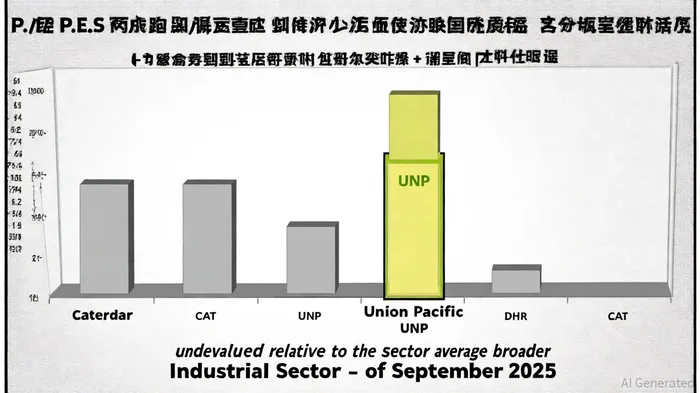
In the aftermath of economic downturns, industrial and sustainability-focused equipment and services stocks often emerge as resilient contenders, driven by their role in critical infrastructure and energy transitions. As of 2025, the industrial sector's trailing P/E ratio stands at 27.91[1], reflecting optimism about long-term earnings growth. However, within this sector, certain leaders stand out for their undervaluation, robust balance sheets, and alignment with sustainability megatrends. Below, we dissect four such companies poised for outperformance in a post-recessionary environment.
1. Caterpillar Inc. (CAT): Engineering Resilience and Energy Transition
Caterpillar, a titan in heavy machinery and energy solutions, exemplifies the intersection of industrial durability and sustainability. With a P/E ratio of 20.72[6] and a P/B ratio of 11.1[5], CATCAT-- trades at a discount to its sector peers, despite a stellar ROE of 52.71%[1]. The company's 2030 sustainability goals emphasize decarbonization through innovations like the Cat® G3520H generator sets, which integrate with renewable energy systems[4]. However, its ESG profile remains mixed: a net impact ratio of -36.3%[3] highlights challenges in reducing greenhouse gas (GHG) emissions. Yet, CAT's dominance in U.S. LNG export infrastructure and its role in AI-driven energy infrastructure[1] position it as a strategic play for investors seeking exposure to both traditional and emerging energy needs.
2. Union Pacific Corporation (UNP): Rail Renaissance and ESG Evolution
Union Pacific, a cornerstone of U.S. freight logistics, has broadened its ESG strategy to include a Health, Safety, and Well-being pillar[3], reflecting stakeholder-driven priorities. Its P/E ratio of 19.15[2] and P/B ratio of 8.04[4] underscore its undervaluation relative to the sector average. While the company lacks specific carbon reduction targets and avoids climate frameworks like SBTi[4], its hybrid-battery electric locomotive pilot with ZTR[1] signals a pivot toward cleaner operations. Union Pacific's net impact ratio of 18.2%[2] and its role in government-backed infrastructure projects[5] make it a compelling bet for investors prioritizing operational efficiency and gradual decarbonization.
3. Danaher Corporation (DHR): Precision and Profitability in Sustainability
Danaher, a diversified industrial conglomerate, leverages its “Danaher Business System” to drive innovation in medical devices, diagnostics, and environmental technologies. With a P/E of 41.44[1] and a P/B of 2.64[1], DHRDHR-- appears less undervalued than CAT or UNPUNP--. However, its ROE of 6.68%[1] and 2025 sustainability report—detailing emissions and water reduction targets[3]—highlight its long-term value proposition. Danaher's focus on precision manufacturing and its alignment with healthcare and clean-tech trends[3] justify its inclusion as a leader in sustainability-driven industrial growth.
4. EDF (EDF.PA): Nuclear Energy's Quiet Giant
While not a traditional industrial stock, EDF—a French nuclear energy behemoth—deserves attention as a critical player in the energy transition. EDF's 2025 nuclear output forecast of 350–370 TWh[5] underscores its role in scaling carbon-free power. Despite a negative ROE of -44.92%[4] and a P/B of 1.12[5], EDF's low-carbon electricity generation (93% in 2023[5]) and ambitious net-zero goals[5] align with global decarbonization mandates. Its recent green bond issuances and thermal plant conversions[5] further solidify its position as a sustainability-focused infrastructure leader, albeit with higher financial risk.
Conclusion: Balancing Valuation and Vision
The industrial and sustainability sectors offer a unique confluence of defensive resilience and growth potential. CaterpillarCAT-- and Union PacificUNP-- stand out for their undervaluation and operational scale, while DanaherDHR-- and EDF represent the future of precision and clean energy. Investors should prioritize companies like CAT and UNP for near-term stability and EDF for long-term energy transition bets. As government policies and market dynamics continue to favor infrastructure and decarbonization, these leaders are well-positioned to outperform in a post-recessionary landscape.





Comentarios
Aún no hay comentarios