
Undervalued Cryptocurrencies with Micro-Investment Potential: A 2025 Guide to High-Growth Digital Assets
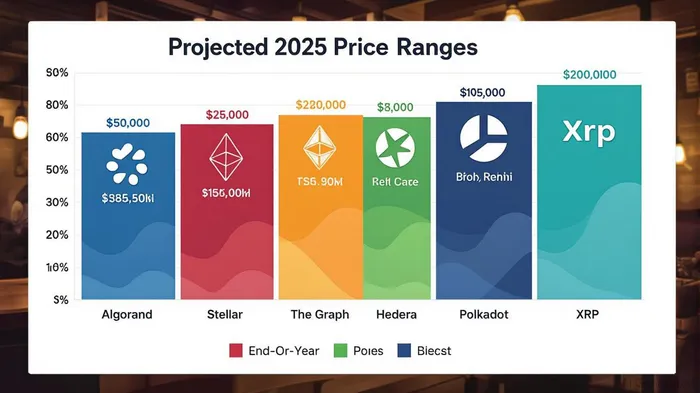
The crypto market in 2025 remains a fertile ground for micro-investors seeking high-growth opportunities. With institutional adoption accelerating and regulatory clarity emerging in key markets, undervalued cryptocurrencies priced under $100 are gaining traction. This analysis evaluates five promising candidates—Algorand (ALGO), StellarXLM-- (XLM), The GraphGRT-- (GRT), HederaHBAR-- (HBAR), and PolkadotDOT-- (DOT)—while benchmarking their potential against XRPXRP--, a recent case study in regulatory-driven recovery and institutional integration.
1. Algorand (ALGO): Speed and Staking for the Long Haul
Algorand's energy-efficient blockchain, capable of processing 10,000 transactions per second (TPS), positions it as a scalable solution for DeFi and tokenized assets[1]. Its decentralized proof-of-stake (PoS) model offers a 7% annualized staking yield, significantly outpacing Stellar's 1%[3]. While ALGO's current price of $0.24 lags behind XRP's $3.40, its TVL growth and institutional partnerships (e.g., with the World Food Programme) suggest a potential rise to $0.50 by year-end[1]. Critics note higher transaction fees compared to Stellar, but the trade-off for speed and security may appeal to risk-tolerant investors.
2. Stellar (XLM): The Cross-Border Payment Powerhouse
Stellar's $0.24 price tag and $4.5B market cap make it a cost-effective entry point for micro-investors. Its low-cost, high-speed transactions ($0.000001 per transfer) have cemented its role in cross-border remittances and stablecoin bridging[1]. Analysts project XLM could reach $0.50–$1.00 in 2025, driven by Ripple's On-Demand Liquidity (ODL) adoption[1]. However, XRP's recent surge—from $2.21 in April to $3.64 in July 2025—highlights the risks of regulatory uncertainty, even as the SEC lawsuit resolution boosted XRP by 5% intraday[2]. Stellar's broader adoption on crypto platforms and lower fees may give it an edge in high-volume use cases.
3. The Graph (GRT) and Hedera (HBAR): Indexing vs. Enterprise Scalability
The Graph's decentralized indexing protocol powers 90+ blockchains, yet its $0.40 price and $990M market cap suggest undervaluation[4]. GRT's potential lies in Web3's data infrastructure, though liquidity constraints could delay a breakout. Hedera (HBAR), with a $10.1B market cap and 455K X followers, offers enterprise-grade hashgraph technology, processing 10,000 TPS with low fees[1]. Price forecasts for HBARHBAR-- range from $0.29 to $0.75 by year-end, contingent on institutional partnerships[5]. While GRT's niche focus on data querying is compelling, HBAR's broader enterprise appeal (backed by Google and IBM) may attract more capital.
4. Polkadot (DOT): Interoperability's Quiet Revolution
Polkadot's $8–$12 price range for 2025 hinges on its 2.0 upgrade, which introduces elastic scaling and improved EVM compatibility[1]. With 170+ parachain projects and real-world applications like Paraguay's $6M real estate tokenization, DOT's multichain interoperability is a key differentiator[3]. Conservative forecasts predict $10, while bullish scenarios envision $25–$40 if parachain demand surges[1]. However, stagnant daily active addresses and thin liquidity remain hurdles[3]. Compared to XRP's institutional traction, DOT's growth depends on developer activity and parachain adoption.
5. XRP: A Case Study in Regulatory Resilience
XRP's 2025 trajectory underscores the impact of regulatory clarity. Post-SEC lawsuit resolution, XRP surged to $3.64, with analysts averaging $3.40–$4.00 by December[2]. Institutional adoption via Ripple's ODL and RLUSD stablecoin further supports its case[2]. While XRP's $3.40 price is 10x higher than ALGO or XLM, its legal resolution and macroeconomic tailwinds (e.g., Bitcoin's price action) make it a high-conviction play[6].
Risk and Reward: Balancing the Scales
Micro-investors must weigh risks like regulatory shifts, whale selling, and competition from stablecoins[5]. For instance, XRP faces headwinds from stablecoin adoption in cross-border payments, while GRT and HBAR must prove their utility in a crowded data infrastructure market. Polkadot's parachain model is innovative but untested at scale.
Conclusion: Strategic Allocation for Micro-Investors
For those with under $100, a diversified approach is prudent. AlgorandALGO-- and Stellar offer complementary strengths: ALGO for staking and speed, XLM for low-cost remittances. The Graph and Hedera cater to niche but growing sectors, while Polkadot and XRP represent high-conviction bets on regulatory and technological progress. As always, due diligence is critical—market dynamics in 2025 remain as volatile as they are promising.







Comentarios
Aún no hay comentarios