
Undervalued Cloud Software Stocks: Strategic Entry Points for Long-Term Growth in 2025
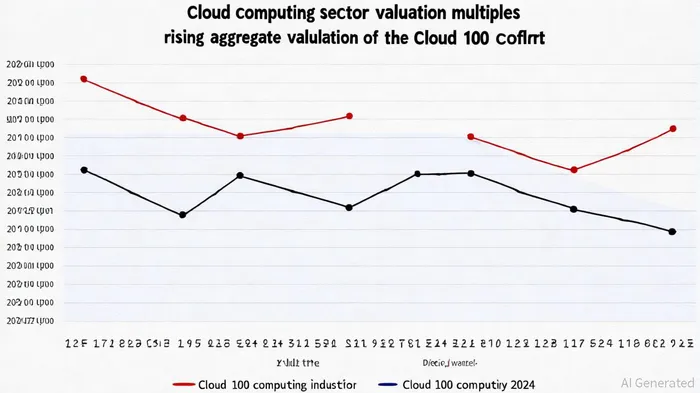
The cloud computing sector, once characterized by sky-high valuation multiples, has entered a period of recalibration. According to a report by Finerva, the median enterprise value-to-revenue (EV/Revenue) multiple for cloud companies fell to 5.1x in Q4 2023, a nearly 30% decline from pre-pandemic levels[1]. Meanwhile, private cloud startups continue to outpace public peers, with the 2024 Cloud 100 cohort achieving a record $820 billion aggregate valuation—a 25% year-over-year increase[3]. This divergence creates fertile ground for identifying undervalued public cloud software stocks, where long-term growth potential remains intact despite near-term headwinds.
Strategic Entry Points: Fundamental and Technical Analysis
Salesforce (CRM): AI-Driven Turnaround
Salesforce (CRM) has faced significant volatility in 2025, with shares down 27% year-to-date due to challenges in its AI transition and competition from MicrosoftMSFT--. However, fundamental metrics suggest undervaluation. The company trades at a forward P/E ratio of 27x[4], well below its 10-year average of 35x and the large-cap software median. Analysts at Piper SandlerPIPR-- highlight Salesforce's Agentforce platform and the $8 billion InformaticaINFA-- acquisition as catalysts for monetizing AI-driven workflows[4].
Technically, CRMCRM-- has stabilized near key support levels. A 2025 earnings report showed non-GAAP EPS exceeding expectations, and the stock holds a "Strong Buy" consensus from 29 analysts, implying a 20.5% upside to $405[1]. Debt-to-equity stands at 0.63[1], reflecting prudent leverage. Investors may consider entry points below $300, where RSI neutrality (55.9) and a 50-day moving average above the 200-day line suggest potential for a rebound[4].
Workday (WDAY): Resilient Free Cash Flow
Workday (WDAY) faces short-term challenges in a cautious IT spending environment but remains a compelling long-term play. The company's forward P/E ratio of 24.61[4] is supported by $2.39 billion in trailing 12-month free cash flow and a debt-to-equity ratio of 0.33[3]. Analysts at Guggenheim note that Workday's AI-powered Illuminate platform and international expansion could drive double-digit growth[1].
Technically, WDAY's 14-day RSI of 56.407[2] and a bullish 50-day/200-day moving average crossover (225.38 vs. 228.20) suggest a buy signal[2]. Key support levels at $222.11 and resistance at $246.08[1] provide a clear risk-reward framework. With 22 Buy ratings and a 22% upside potential to $285[1], WDAYWDAY-- offers a balanced entry for investors prioritizing enterprise software resilience.
Snowflake (SNOW): High-Growth Pure-Play
Snowflake (SNOW) exemplifies the sector's high-growth, high-risk profile. Despite a negative P/E ratio (-57.2) due to recent losses[5], the company generated $884.1 million in free cash flow in fiscal 2025[2], signaling improving profitability. Its debt-to-equity ratio of 2.45[1] reflects aggressive leverage, but analysts at ValueSense argue that Snowflake's role in AI-driven data processing justifies its valuation[5].
Technically, SNOW's RSI of 51.331[3] and a 50-day moving average of $211.6 (above the 200-day $190.5) indicate a bullish trend[3]. Key support at $137 and resistance at $241[4] define a volatile but potentially rewarding trade. Investors should monitor the MACD line (1.9) and signal line crossover to gauge momentum shifts[4].
Broader Sector Trends and Strategic Implications
The cloud sector's valuation compression—median EV/Revenue multiples down from 26x in 2023 to 23x in 2024[3]—reflects macroeconomic pressures but also creates entry opportunities. Microsoft (MSFT) and AlphabetGOOGL-- (GOOG) remain core holdings, with MSFTMSFT-- trading near fair value (P/E 36.9x) and GOOG's GoogleGOOGL-- Cloud showing expansion potential[5]. For specialized exposure, AlibabaBABA-- (BABA)'s 2.1x EV/Revenue ratio[1] highlights its dominance in Asian markets.
Conclusion: Balancing Risk and Reward
Undervalued cloud software stocks like CRM, WDAY, and SNOW offer asymmetric risk-reward profiles. Salesforce's AI monetization, Workday's resilient cash flow, and Snowflake's data-processing leadership position them as strategic entry points for long-term growth. Investors should prioritize technical indicators (e.g., RSI, moving averages) and fundamental metrics (e.g., P/E, debt-to-equity) to time entries, while remaining mindful of sector-wide risks such as interest rate volatility and competitive pressures.
Historical backtests of MACD Golden Cross strategies on these stocks from 2022 to 2025 reveal mixed outcomes: CRM and WDAY delivered negative total returns (-24.70% and -15.98%, respectively), while SNOW showed an 8.01% annualized return despite a -17.47% overall loss. These results underscore the importance of combining technical signals with broader market context and risk management.







Comentarios
Aún no hay comentarios