
Undervalued Altcoins with Explosive 2026 Potential: Positioning for Institutional-Grade DeFi and RWA Tokenization
The cryptocurrency landscape in 2026 is being reshaped by two transformative forces: institutional-grade decentralized finance (DeFi) and real-world asset (RWA) tokenization. As regulatory clarity and infrastructure maturity attract billions in institutional capital, altcoins positioned at the intersection of these narratives are poised for explosive growth. This analysis identifies undervalued projects with strong fundamentals, institutional partnerships, and deflationary mechanics, offering a roadmap for investors seeking to capitalize on the next phase of crypto's evolution.
Institutional-Grade DeFi: Solana and Uniswap Lead the Charge
Solana (SOL) remains a cornerstone of institutional-grade DeFi, leveraging its high-throughput blockchain to process over 65,000 transactions per second. With a total value locked (TVL) of $9.19 billion in late 2025, Solana's ecosystem is expanding rapidly, driven by projects like Firedancer, a high-performance validator client that enhances network scalability. Despite trading below its 2021 all-time high, SOL's undervaluation is justified by its role in hosting DePIN (Decentralized Physical Infrastructure Networks) and AI infrastructure projects, which align with institutional demand for scalable, low-cost solutions.
Uniswap (UNI) is another standout, with its recent "UNIfication" governance proposal transforming the token into a deflationary asset. The burn of 100 million UNIUNI-- tokens-worth $596 million- reduced the circulating supply by 16%, driving a 16.4% price surge in 14 days. This structural shift, combined with Uniswap's expansion to 40 blockchains, positions it as a dominant liquidity protocol for institutional-grade DeFi. As decentralized exchanges capture over 25% of global spot trading volume by 2026, UNI's scarcity and utility will likely drive further appreciation.
RWA Tokenization: Chainlink and Ondo Finance Bridge Traditional and Digital Finance
Chainlink (LINK) is the backbone of RWA tokenization, providing oracle infrastructure to connect blockchains with real-world data. Its Cross-Chain Interoperability Protocol (CCIP) has secured partnerships with J.P. Morgan, Mastercard, and Swift, enabling seamless integration of tokenized assets into traditional financial systems. The launch of the Grayscale LINKLINK-- ETF (GLNK) in 2025 has further solidified institutional confidence, with no outflows since inception. At current prices, LINK is undervalued relative to its peak, offering a compelling entry point for investors anticipating increased demand for oracle services in 2026.
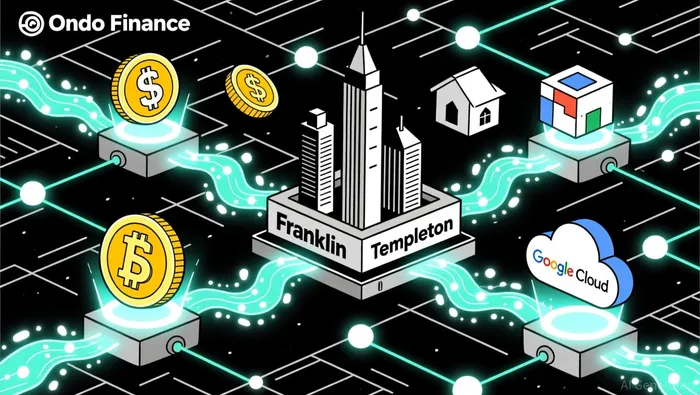
Ondo Finance (ONDO) is revolutionizing RWA tokenization by building a Layer 1 blockchain tailored for institutional-grade assets. With partnerships from Franklin Templeton, Wellington Management, and Google Cloud, Ondo's platform tokenizes U.S. Treasuries, real estate, and private equity, enabling fractional ownership and 24/7 trading. Its expansion to SolanaSOL-- in early 2026 and the launch of tokenized stocks and ETFs underscore its potential to dominate the RWA sector. At $0.40, ONDO remains significantly undervalued, with a projected 185.8% average return for RWA tokens in 2025.
Regulatory Clarity and Institutional Infrastructure: The Catalyst for Growth
The maturation of custody, compliance, and settlement infrastructure has been critical in attracting institutional capital. Projects like Securitize and Tokeny Solutions are enabling tokenized private equity and real estate with full regulatory compliance, while platforms like AaveAAVE-- Horizon integrate RWAs into DeFi protocols for permissioned lending according to industry analysis. Regulatory frameworks in the EU (MiCA) and Singapore (Project Guardian) are further legitimizing RWA tokenization, with the EU classifying real estate tokens as utility assets and Singapore promoting safe digital asset lending.
Institutional adoption is also accelerating through tokenized treasuries and stablecoins. BlackRock's BUIDL fund and Franklin Templeton's on-chain money-market vehicles have already integrated tokenized U.S. debt into their portfolios, signaling a shift toward blockchain-based financial instruments. As Grayscale predicts, DeFi TVL could reach $200 billion in 2026, driven by liquid staking and restaking mechanisms that generate yield for institutional investors.
Deflationary Mechanics and Strategic Partnerships: The Next Wave
Deflationary models are gaining traction as value accrual mechanisms. BitcoinBTC-- Hyper (HYPER), for instance, integrates Solana's Virtual Machine into Bitcoin, enabling a Bitcoin-native DeFi ecosystem while leveraging Solana's scalability according to industry analysis. Similarly, projects like Securitize are preparing for Nasdaq listings, signaling the transition of RWA tokenization from speculative innovation to core financial infrastructure.
Strategic partnerships remain a key driver. Chainlink's collaboration with Swift and Ondo's alliances with Google Cloud highlight the importance of interoperability in bridging traditional and digital finance. As institutional-grade DeFi and RWA tokenization converge, altcoins with robust partnerships and deflationary structures will outperform peers.
Conclusion: Positioning for 2026's Institutional-Grade Revolution
The 2026 crypto market is defined by institutional adoption, regulatory progress, and technological innovation. Solana, UniswapUNI--, ChainlinkLINK--, and OndoONDO-- Finance represent undervalued altcoins with explosive potential, driven by their roles in DeFi and RWA tokenization. As TVL grows, tokenized assets expand, and deflationary mechanics take hold, these projects are well-positioned to capture market share in a rapidly evolving landscape. For investors, the key is to prioritize projects with institutional-grade infrastructure, real-world use cases, and strategic partnerships-ensuring alignment with the next phase of crypto's institutional revolution.






Comentarios
Aún no hay comentarios