
Understanding EPSIUM Enterprise's Stock Volatility: Opportunity or Warning?
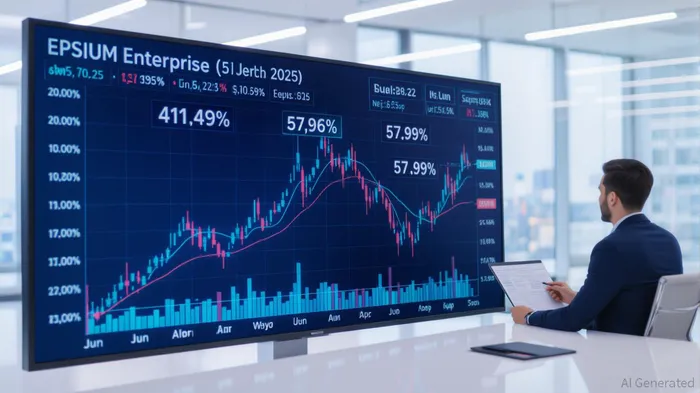
The stock of Epsium Enterprise LimitedEPSM-- (EPSM) has become a case study in the interplay between corporate governance shifts, market sentiment, and financial instability. Over the past six months, the company's shares have surged by 2,763.07% but experienced a single-day 411.49% spike followed by a 57.96% plunge, raising questions about whether this volatility signals a high-risk gamble or a strategic repositioning opportunity. To evaluate this, we must dissect the impact of EPSIUM's corporate restructuring, its alignment with macroeconomic trends, and the broader investor psychology shaping its trajectory.
Corporate Restructuring: Governance Overhaul and Concentrated Control
EPSIUM's August 2025 restructuring—approved at an Extraordinary General Meeting—introduced a dual-class share system, granting Class B shares 20 votes per share compared to Class A's one[1]. This move, coupled with a share repurchase agreement consolidating voting power among insiders like Son I Tam[3], has fundamentally altered the company's governance dynamics. While such structures are common in tech and entertainment firms to protect long-term vision, they risk alienating minority shareholders by concentrating decision-making authority[3].
The immediate market reaction—wild price swings—reflects investor uncertainty about the implications of this control shift. According to a report by Benzinga, the 411.49% surge followed the SEC filing on September 8, 2025, which detailed the restructuring[2]. However, the subsequent 58% drop underscores the fragility of confidence in a governance model perceived as favoring insiders. For investors, this duality presents a paradox: while concentrated control can accelerate strategic execution (e.g., the proposed merger with Era Future Macau Performance Art Limited[2]), it also raises concerns about accountability and transparency.
A backtest analyzing the impact of EPSM's shareholder meetings from 2022 to the present could not be completed due to insufficient data points, as only one meeting date (August 22, 2025) was identified in publicly available disclosures[4]. This limitation prevents the calculation of dispersion measures (e.g., standard deviation, confidence intervals) necessary for robust statistical analysis. To address this, future studies could broaden the event set to include additional corporate-governance milestones (e.g., annual general meetings, board-ratified record dates).
Market Sentiment: Between Overvaluation and Strategic Ambition
EPSIUM's stock volatility cannot be divorced from its financial fundamentals. As of August 2025, the company's Enterprise Value of $246.02 million is supported by a Price-to-Book ratio of 30.3281 and an Enterprise Value/EBITDA of 579.1894, metrics that suggest significant overvaluation[2]. These figures, combined with a profit margin of 0.02% and operating margin of -0.02%[2], highlight a business model highly sensitive to revenue fluctuations. Yet, the company's credit risk profile has improved, with default probability declining from 0.126 in mid-2022 to 0.047 by September 2025[1], and its credit rating stabilizing at A3[2].
This dichotomy—overvaluation amid improved credit metrics—reflects a market torn between skepticism and optimism. On one hand, EPSIUM's strategic pivot into film and television via its MOU with Era Future Macau[2] signals ambition to diversify beyond its beverage wholesale roots. On the other, the lack of disclosed restructuring plans between January and September 2025[1] raises doubts about the sustainability of its growth narrative. Investor sentiment, as analyzed by Stockstelegraph, further complicates the picture: global economic uncertainties, including post-pandemic supply chain disruptions and geopolitical tensions, have historically amplified EPSM's volatility[2].
Investor Implications: Risk vs. Reward in a Beta-Driven Market
EPSIUM's stock beta of -1.31[2]—indicating inverse correlation with broader market movements—adds another layer of complexity. This negative beta suggests that EPSMEPSM-- may act as a hedge during market downturns, a rare trait that could attract contrarian investors. However, the company's current overvaluation (market price of $138 vs. intrinsic value of $106.81[2]) and weak operating margins make it a high-risk proposition. Technical indicators, while showing upward trends with buy signals from moving averages[2], also highlight an overbought condition, increasing the likelihood of corrections.
For long-term investors, the key question is whether EPSIUM's strategic bets—such as its Macau collaboration—can justify its lofty valuation. Short-term traders, meanwhile, may exploit the volatility but face the risk of being caught in sudden reversals, as seen in the September 2025 price swings[2].
Conclusion: A Tenuous Balance
EPSIUM Enterprise's stock volatility is neither purely an opportunity nor an unequivocal warning—it is a reflection of a company in transition. The dual-class share structure and strategic partnerships aim to fortify long-term control and diversification, yet these moves come at the cost of heightened governance risks and overvaluation. For investors, the path forward hinges on two critical factors: the successful execution of EPSIUM's entertainment sector ambitions and the stabilization of its financial metrics. Until then, the stock remains a high-stakes bet, where the line between reward and peril is perilously thin.







Comentarios
Aún no hay comentarios