
The Uncertain Fate of the U.S. Senate Crypto Bill and Its Implications for Crypto Market Stability
The U.S. Senate's ongoing efforts to finalize a comprehensive crypto regulatory framework have reached a critical juncture, with the Digital Asset Market Clarity Act of 2025 (H.R. 3633) and the Responsible Financial Innovation Act of 2025 shaping the trajectory of market stability. As bipartisan negotiations continue, investors face a pivotal decision: position for regulatory clarity that could catalyze institutional adoption or brace for disruptive volatility if the bill falters.
The Current State of the Senate Crypto Bill
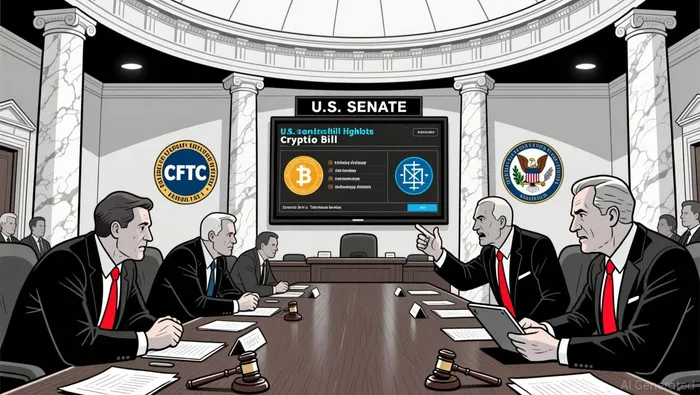
The Senate's version of the crypto bill, building on H.R. 3633, seeks to establish a clear division of regulatory authority between the Commodity Futures Trading Commission (CFTC) and the Securities and Exchange Commission (SEC). Under the proposed framework, the CFTC would oversee spot markets for "digital commodities," while the SEC retains jurisdiction over investment contracts. This bifurcated approach aims to reduce regulatory overlap but remains contentious. For instance, the bill's "no presumption" rule-clarifying that digital assets are not automatically securities-faces pushback from Democrats advocating for SEC involvement in initial regulatory reviews.
Meanwhile, the Senate Banking Committee's "closing offer" in early 2026 introduced bracketed language on unresolved issues, such as custodial standards and digital commodity definitions. These unresolved elements highlight the bill's fragility, as final negotiations could pivot on political dynamics or industry lobbying.
Historical Precedents: Regulatory Shifts and Market Volatility
Past U.S. regulatory actions have demonstrated the crypto market's sensitivity to policy uncertainty. In 2025, the SEC's enforcement actions, including the dismissal of a civil case against CoinbaseCOIN-- and the launch of a Crypto Task Force, signaled a shift toward innovation-friendly oversight. However, prior classifications of crypto assets as securities triggered sharp market corrections. A 2025 study found that such designations led to a 12% average decline in asset returns over one week, with illiquid tokens experiencing steeper drops.
In contrast, the European Union's Markets in Crypto-Assets (MiCA) regulation, implemented in 2025, provided a structured framework that boosted institutional confidence. This clarity enabled traditional financial institutions to engage with digital assets, reducing regulatory arbitrage and fostering stable growth. The U.S. lacks a comparable unified framework, creating a vacuum that the Senate bill could either fill-or exacerbate.
Strategic Investment Positioning: Clarity vs. Disruption
Investors must weigh two scenarios:
1. Regulatory Clarity: If the Senate bill passes with a balanced CFTC-SEC framework, it could unlock institutional adoption. For example, the 2025 Clarity Act and Genius Act spurred hedge funds and banks to increase crypto exposure, with 55% of traditional hedge funds holding digital assets by year-end. Tokenization and stablecoin innovation- bolstered by the Genius Act's federal framework-also present opportunities.
2. Regulatory Disruption: A fragmented or delayed bill could reignite volatility. The 2025 study noted that pre-announcement trading volume spikes indicated informed actors anticipating regulatory shifts. A rushed or contradictory bill might trigger similar patterns, particularly in illiquid assets.
Institutional investors are already adapting. By 2025, 47% of institutional investors cited U.S. regulatory developments as a key factor in increasing digital asset allocations. Hedge funds are exploring tokenized fund structures, leveraging operational efficiencies and broader access. However, these strategies hinge on the assumption that the Senate bill will resolve jurisdictional ambiguities.
Navigating the Uncertainty
For investors, the path forward requires hedging against both outcomes:
- Long-Term Positioning: Allocate to assets aligned with a structured regulatory environment, such as stablecoins (e.g., those compliant with the Genius Act) and tokenized securities. The EU's MiCA-compliant tokens, for instance, have shown resilience amid U.S. uncertainty.
- Short-Term Hedging: Maintain liquidity in assets less sensitive to regulatory shifts, such as BitcoinBTC-- and EthereumETH--, which have demonstrated relative stability during past U.S. policy debates.
- Active Monitoring: Track Senate negotiations and SEC enforcement actions. The final bill's custodial standards and digital commodity definitions could disproportionately impact exchanges and brokers.
Conclusion
The U.S. Senate crypto bill represents a crossroads for the market. While its passage could replicate the EU's success in fostering institutional adoption, its failure-or a poorly designed compromise-risks reigniting volatility. Investors must balance optimism for clarity with caution against disruption, leveraging historical precedents and current regulatory trends to position portfolios resiliently. As the Senate's negotiations unfold, the crypto market will likely remain a barometer of the broader tension between innovation and oversight.





Comentarios
Aún no hay comentarios