
Ukraine-Russia Dynamics and the Impact on Defense and Energy Sectors: Geopolitical Risk as a Catalyst for Strategic Investment
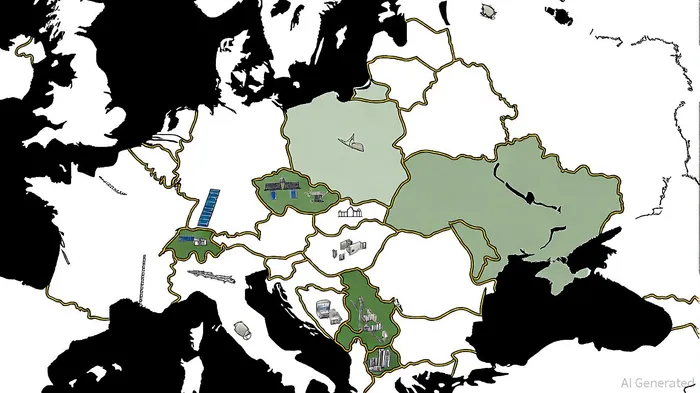
The Russia-Ukraine conflict has emerged as a defining geopolitical event of the 2020s, reshaping global defense and energy markets. As of 2025, the war has accelerated a strategic realignment, with nations prioritizing military readiness and energy security over economic efficiency. This shift has created a fertile ground for investment in defense infrastructure and energy resilience plays, driven by escalating geopolitical risk.
Defense Spending: A New Era of Global Rearmament
The conflict has triggered a historic surge in defense spending, particularly among NATO allies. European NATO members and Canada have increased defense budgets by 50% in 2025, supported by mechanisms like the ReArm Europe Plan and the Security Action for Europe (SAFE) financial framework[5]. This spending spree reflects a broader recognition of Russia's military ambitions and the need to deter future aggression. For instance, Germany, Poland, and the UK have prioritized investments in advanced systems such as cyber capabilities, drones, and air defense[5].
Ukraine itself has become a critical hub for defense innovation. At the Defense Tech Valley 2025 summit in Lviv, international investors pledged over $100 million to Ukrainian defense startups, including NUNC Capital's €20 million commitment to advanced materials and Verne Capital's €25 million for electronic warfare technologies[1]. U.S. firms like Broadband Capital Investments also backed Swarmer, a Ukrainian drone company developing swarm technology, with a $15 million investment[2]. These developments underscore Ukraine's transformation into a “battle-hardened” defense ecosystem, attracting capital seeking high-impact, real-world validation[6].
Geopolitical risk has further amplified demand for defense stocks. A study of 75 global defense companies found that 81.4% experienced stock market responses to the Russia-Ukraine war, with defense equities showing resilience during periods of uncertainty. BlackRock notes that defense spending has become a structural investment theme, outpacing sectors like AI in GDP allocation[3]. However, investors must navigate risks tied to government contract timelines and political shifts, as procurement processes often span years[1].
Energy Markets: Diversification and Decentralization
The war has also forced a radical rethinking of energy strategies. European nations, once reliant on Russian hydrocarbons, have diversified their imports, with U.S. LNG becoming a cornerstone of their energy security[4]. This shift has led to price volatility, disproportionately affecting developing economies in Africa and Asia, which face higher energy costs due to their oil and gas dependence[3].
Ukraine's energy sector, meanwhile, is undergoing a dual transformation. Despite losing 10 gigawatts of generation capacity to Russian attacks, the country is pursuing a €10 billion investment plan to build 12–13 gigawatts of decentralized renewable and storage capacity[1]. Projects like DTEK's €450 million Tyligulska Wind Farm expansion and Ukrhydroenergo's Dniester Pumped Storage Power Plant highlight Ukraine's pivot to resilient, distributed energy systems[1]. These initiatives align with the EU's REPowerEU strategy, which prioritizes renewables and LNG to reduce reliance on Russian energy[4].
Geopolitical risk indices underscore the urgency of such investments. A firm-driven geopolitical risk sentiment index derived from earnings calls reveals stark sectoral divides: while energy firms face supply chain disruptions and price volatility, defense and cybersecurity sectors act as hedges during crises[3]. For example, Aircraft and Rubber and Plastic Products industries saw negative sentiment post-invasion due to disrupted European demand, whereas Agriculture firms benefited from reduced foreign competition[3].
Strategic Investment Opportunities
The interplay of geopolitical risk and sectoral shifts presents clear opportunities for investors. In defense, long-term contracts (three to five years) are stabilizing Ukraine's industry, with the government allocating UAH 739 billion for weapons production in 2025[2]. This creates a pipeline for companies specializing in drones, missiles, and electronic warfare.
In energy, decentralized infrastructure and rare earth elements are emerging as critical assets. The IEA projects global energy investment to reach $3.3 trillion in 2025, with clean energy technologies attracting twice as much capital as fossil fuels[6]. However, geopolitical risks—such as China's rare earth export restrictions—highlight the need for diversified supply chains[5].
Conclusion
The Ukraine-Russia conflict has crystallized a new era of geopolitical risk, where defense and energy sectors are no longer peripheral but central to national and corporate strategy. Investors who align with this paradigm—prioritizing resilience, diversification, and innovation—stand to capitalize on structural shifts. As the war underscores, the cost of inaction in the face of geopolitical uncertainty far outweighs the investment required to build a secure, adaptive future.







Comentarios
Aún no hay comentarios