
Ukraine's Geopolitical Stabilization: Unlocking Investment Opportunities in Eastern Europe and Global Commodities
The geopolitical landscape in 2025 is being reshaped by the evolving dynamics of Ukraine's stabilization efforts, peace talks, and the broader implications for global commodities and Eastern European markets. As the war with Russia enters its fourth year, the interplay between diplomatic initiatives, infrastructure reconstruction, and defense spending is creating a unique window for investors to capitalize on emerging opportunities. This analysis explores the strategic reallocation of capital toward Ukrainian-adjacent markets, infrastructure, and security-oriented equities, while assessing the ripple effects on global commodity prices and regional economic integration.
1. Geopolitical Stabilization and the Path to Peace
The U.S. and EU have taken divergent approaches to brokering peace in Ukraine. The U.S. 28-point proposal, criticized for its concessions to Russia-including territorial cessions and restrictions on Ukraine's military size-has been met with resistance from Kyiv and European allies. In contrast, the EU's counterplan, which removes contentious provisions like the 600,000-member military cap, signals a more balanced approach. While significant hurdles remain, particularly around Ukraine's NATO aspirations, the EU's €50 billion Ukraine Facility and the U.S.-Ukraine Reconstruction Investment Fund (USURIF) are already mobilizing capital for long-term stabilization.
The EU's emphasis on energy security and infrastructure modernization is particularly noteworthy. By integrating Ukraine into Western critical minerals supply chains and expanding renewable energy projects, the bloc is positioning itself to mitigate future vulnerabilities. This alignment with EU standards also enhances Ukraine's attractiveness to foreign investors, particularly in sectors like solar, wind, and battery storage.
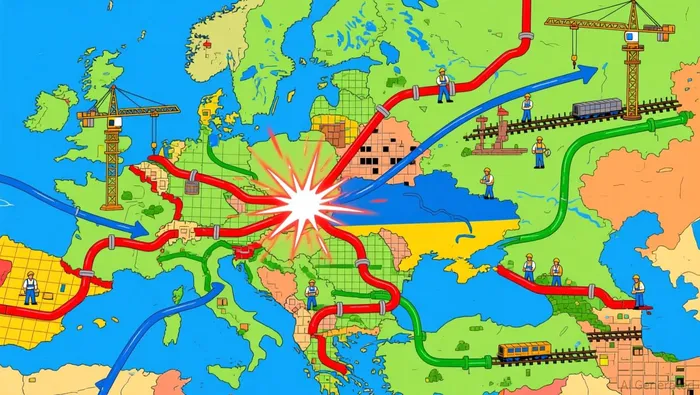
2. Defense Stocks: A New Era of European Rearmament
The war has catalyzed a defense spending boom across Eastern Europe, with Germany, France, and the UK leading the charge. Companies like Rheinmetall (up 174% year-to-date) and Leonardo (13.5% Q1 revenue growth) are benefiting from expanded production of artillery, armored vehicles, and advanced avionics. The EU's €150 billion joint procurement facility and proposed European Rearmament Bank further underscore the region's commitment to self-reliance in defense manufacturing.
Investors should also consider Thales and BAE Systems, which are leveraging AI-driven battlefield technologies and high-tech military contracts. The UK's recent access to the EU's SAFE scheme and Germany's fiscal reforms are expected to sustain this momentum, making defense equities a recession-resilient asset class.
3. Energy Infrastructure: A Dual-Use Opportunity
Ukraine's energy sector is a linchpin for both regional stability and global commodity markets. The EU's Ukraine Investment Framework (UIF) has allocated €9.5 billion to repair and modernize energy infrastructure, including grid interconnections with the EU. By Q2 2025, Ukraine–Moldova electricity exports had surged 18% year-over-year, highlighting the country's growing role in European energy security.
Investment opportunities span renewable energy (solar, wind), battery storage, and grid modernization. The U.SURIF's focus on critical minerals and the EU's emphasis on decentralized energy systems suggest long-term growth potential for firms involved in energy transition technologies.
4. Post-Conflict Reconstruction: A €40 Billion Pipeline
The EU's €2.3 billion guarantees at the 2025 Ukraine Recovery Conference are expected to unlock €10 billion in private investment for housing, transport, and social infrastructure. Key projects include:
- Municipal and social infrastructure: €2 billion for public buildings, healthcare, and affordable housing as part of the Ukraine Investment Framework.
- Transport connectivity: Modernization of railways, urban transit, and EU-Ukraine Solidarity Lanes as part of the Ukraine Investment Framework.
- Energy resilience: €2 billion for hydropower, grid upgrades, and energy efficiency as part of the Ukraine Investment Framework.
These initiatives align with Ukraine's goal to integrate into European value chains, offering opportunities in construction materials, logistics, and dual-use industries.
5. Global Commodity Implications: From Volatility to Normalization
Ukraine's stabilization could reshape global commodity markets. As a key exporter of wheat (10-12% of global supply) and neon gas (60% of global production), the country's return to full production capacity would stabilize food and semiconductor markets. However, the reintroduction of Russian oil into global markets-projected to add 1.2 million barrels per day-could drive WTI prices to $45-70 per barrel, depending on the resolution pathway.
Natural gas prices in Europe, which spiked 7.5% during the war, may normalize as Ukraine's energy infrastructure is rebuilt. This creates a dual opportunity: short-term volatility in energy markets and long-term stability as supply chains reorient.
6. Strategic Asset Reallocation: Where to Invest
- Ukrainian-adjacent markets: Eastern European defense and infrastructure firms (e.g., Rheinmetall, Leonardo) are well-positioned to benefit from regional security spending.
- Energy transition: Solar, wind, and battery storage projects in Ukraine and the EU offer exposure to decarbonization trends as part of the EU's recovery strategy.
- Commodity-linked equities: Firms involved in wheat, neon gas, and critical minerals could see upside as Ukraine's production normalizes according to market analysis.
Conclusion
Ukraine's geopolitical stabilization is not merely a regional issue but a catalyst for global economic realignment. Investors who align with the EU's reconstruction agenda, defense modernization, and energy transition initiatives are poised to capitalize on a unique confluence of geopolitical risk and emerging market growth. As peace talks progress and security guarantees evolve, the window for strategic asset reallocation is narrowing-making now a critical moment to act.







Comentarios
Aún no hay comentarios