
Ukraine's GDP Warrant Restructuring: A Strategic Opportunity Amid Fiscal Risk Mitigation?
Ukraine's proposed $3.2 billion GDP warrant bond swap has emerged as a pivotal moment in its post-war economic strategy, offering a potential pathway to resolve a lingering sovereign debt crisis while navigating the complex interplay of fiscal sustainability and investor confidence. As the country seeks to exit default status and align with IMF conditions, the restructuring's success hinges on balancing fiscal discipline with market incentives-a challenge that mirrors broader trends in emerging markets (EM) debt dynamics.
The Swap Structure: A High-Stakes Bargain
The Ukrainian government's offer to exchange $1,000 of GDP warrants for $1,340 in new C Bonds (maturing 2030–2032) is a calculated attempt to reduce immediate fiscal burdens while extending debt maturities according to Reuters. This swap includes a one-time $50 cash payment per $1,000 of warrants and a $10 consent fee, aiming to sweeten the deal for creditors. However, the Ad Hoc Committee has countered with a more generous package-$1,400 in new bonds and higher cash compensation-highlighting the tension between fiscal prudence and market demands. The government's requirement for 75% acceptance adds urgency, as delays could exacerbate budgetary pressures and strain relations with the IMF.
Structural protections, such as a "claim reinstatement" mechanism, remain contentious. These safeguards, designed to prevent creditors from reneging on agreements, are critical for maintaining trust in the restructuring process. 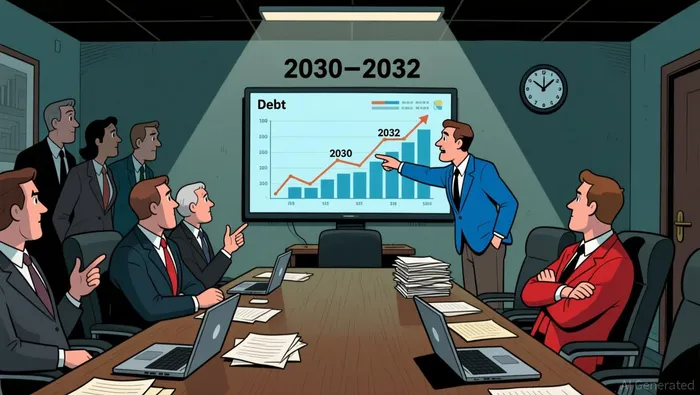 Without resolving these issues, Ukraine risks protracted negotiations that could undermine its credibility in global markets.
Fiscal Risk and EM Debt Dynamics
Ukraine's fiscal deficit is projected to reach 25.7% of GDP in 2025, a red flag for credit rating agencies like Fitch, which has affirmed the country at "Restricted Default". This aligns with broader EM trends, where half of rated emerging market and developing economies (EMDEs) are classified as high-risk, and 10 are in very high-risk or default categories according to OECD data. Shorter debt maturities in EMDEs-compared to advanced economies-heighten vulnerability to interest rate fluctuations, compounding refinancing challenges.
Investor sentiment in EM debt has been volatile, influenced by geopolitical tensions and trade policy shifts. For instance, U.S. tariffs on major EM economies initially triggered yield volatility in 2025, but market optimism returned when trade talks eased. However, EM sovereign bonds are increasingly treated as risky assets, with sentiment-driven mispricing amplifying returns during liquidity crunches. Ukraine's restructuring must navigate this landscape, where fiscal sustainability and market access are inextricably linked.
Lessons from EM Case Studies
Comparative case studies offer insights into Ukraine's potential trajectory. Argentina's 2020–2025 restructuring, which reduced interest rates from 7% to 3% and secured $37.7 billion in debt relief, illustrates the importance of credible fiscal reforms. Despite a "CCC+" rating from Fitch, Argentina's zero-deficit budget and IMF support have stabilized inflation and improved market access. Conversely, Sri Lanka's GDP-linked restructuring, tied to nominal GDP thresholds, has been criticized for insufficient risk mitigation, with a 27% haircut condition if GDP remains stagnant. Egypt's success in upgrading to a "B" rating from S&P underscores the role of structural reforms, including IMF programs and currency flexibility according to S&P Global.
These examples highlight a common theme: successful restructurings require not only favorable terms but also a clear policy framework to restore fiscal credibility. Ukraine's inclusion of GDP warrants-financial instruments tied to economic performance-adds a unique dimension, as their value hinges on post-war recovery. If Ukraine's growth projections materialize, these warrants could become a catalyst for renewed investor interest.
Strategic Implications for Investors
For investors, Ukraine's restructuring presents a dual-edged opportunity. On one hand, the swap could unlock access to capital markets by resolving the GDP warrant issue, a critical step for post-war reconstruction. On the other, the government's fiscal trajectory remains precarious, with a 25.7% deficit and reliance on IMF support. The key question is whether Ukraine can leverage this restructuring to rebuild its credit profile without triggering a new debt crisis.
Historical data suggests that EM sovereigns with robust reform agendas-like Egypt and Argentina-can outperform peers in post-restructuring environments according to S&P Global. However, Ukraine's unique context-war-related fiscal shocks and geopolitical dependencies-introduces additional risks. Investors must weigh the potential for a "Goldilocks" scenario (moderate growth, manageable debt) against the likelihood of prolonged fiscal stress.
Conclusion: A Calculated Bet on Resilience
Ukraine's GDP warrant restructuring is a high-stakes gamble, but one that could pay off if executed with discipline. The swap's success depends on resolving creditor disputes, securing IMF backing, and demonstrating fiscal restraint. For EM investors, this represents a strategic opportunity to bet on Ukraine's post-war recovery, albeit with a clear-eyed understanding of the risks. As the clock ticks toward year-end, the world will be watching to see if Kyiv can turn this fiscal crossroads into a springboard for renewed economic growth.







Comentarios
Aún no hay comentarios