
Ukraine's Energy Renaissance: Unlocking Renewable and Grid Resilience Opportunities in Post-Conflict Reconstruction
In the shadow of war, Ukraine is forging a bold path toward energy independence. The destruction of its energy infrastructure has catalyzed a strategic pivot to decentralized, renewable-driven systems—a transformation that now presents compelling investment opportunities. For investors seeking high-impact, mission-driven ventures, Ukraine's energy sector is a nexus of urgency, innovation, and geopolitical alignment.
A Crisis That Became a Catalyst
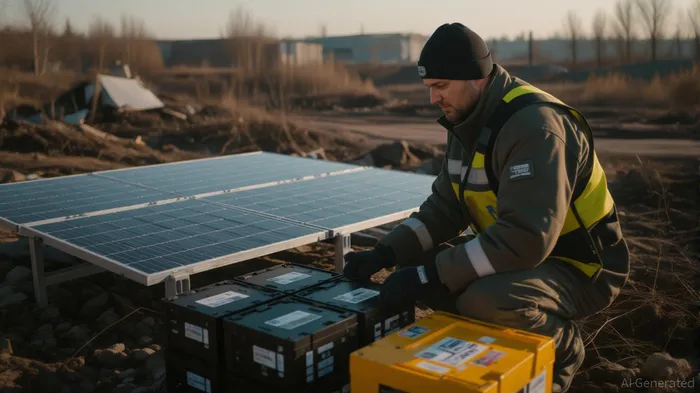
Since Russia's invasion in 2022, Ukraine has lost nearly half of its pre-war energy capacity, with $20.5 billion in infrastructure damage and a $67.8 billion rebuild cost. Yet this crisis has accelerated a paradigm shift. Centralized grids, vulnerable to missile strikes, are being replaced by distributed generation units (5–100 MW) that combine solar, wind, battery storage, and gas. This decentralized model not only enhances resilience but aligns with Ukraine's 2030 target of 27% renewable energy in final consumption.
Policy Frameworks and Financial Incentives
The Ukrainian government has laid the groundwork for investment through a suite of reforms. The National Energy and Climate Plan (NECP) 2025–2030 requires $41.5–$50 billion in investment, with 10 GW of new renewable capacity. Key enablers include:
- Tax exemptions: Import duties and VAT are waived for solar panels, lithium-ion batteries, and inverters under martial law (until 2026).
- Streamlined regulation: Law No. 9381 (2025) simplifies grid connections and promotes transparency, while auction reforms introduce one-way feed-in premiums (FiP) and extended timelines.
- Blended finance: The EU's Ukraine Investment Framework has already unlocked €157 million for OKKO Group and €9.6 million for KNESS to deploy battery systems.
To mitigate policy risks, Ukraine is piloting the Electricity Price Guaranteed Fund (EPGF), a donor-backed mechanism that ensures revenue stability for renewables by covering price shortfalls. This innovation, inspired by models in Kazakhstan and Uzbekistan, could attract risk-averse capital.
Ground-Level Innovation: Subnational Leadership
Local governments are now pivotal. Cities like Mykolaiv and Vinnytsia are pioneering projects that blend urgency and sustainability:
- Mykolaiv's 5.5 MW hybrid system: Solar PV, diesel generators, and 1 MWh of battery storage power critical infrastructure, supported by €7.2 million from NEFCO.
- Vinnytsia's 10 MW waste-to-energy plant: A $30 million public-private partnership converting municipal waste into 80 GWh annually.
- Khmelnytskyi's 14.9 MW solar expansion: Demonstrates the viability of rapid deployment on city-owned land.
These projects are underpinned by anti-corruption measures and public transparency tools, such as Mykolaiv's aid-tracking website. Subnational governments account for 20% of EU Ukraine Facility funding, signaling a shift toward localized energy sovereignty.
International Partnerships and Risk Mitigation
Global stakeholders are critical to scaling Ukraine's vision. The EU's $56 billion Ukraine Facility (2024–2027) allocates 20% to subnational projects, while the U.S. Development Finance Corporation (DFC) is positioning itself as a key player. A proposed “Ukraine Clean Energy Fund” could leverage DFC guarantees to crowd in private capital, particularly in wind and solar.
Currency stability remains a hurdle, but the National Bank of Ukraine is exploring currency swap facilities to ease repatriation of profits. For U.S. investors, the Trump administration's Mineral Resources Agreement offers a geopolitical tailwind, linking aid to access to Ukraine's rare earths and oil.
Investment Priorities and Strategic Considerations
For investors, three sectors stand out:
1. Battery Storage and Hybrid Systems: DTEK Renewables' €67 million BESS project (180 MW capacity by 2025) and KNESS's battery deployments highlight the urgency of storage.
2. Decentralized Solar and Wind: Auctions for 330 MW in 2025 (150 MW wind) and the EPGF's revenue guarantees make renewables attractive.
3. Waste-to-Energy Projects: Vinnytsia's plant and similar initiatives in Kirovohrad Oblast showcase untapped potential in circular energy.
Risk mitigation is key. Investors should prioritize projects with EU or EBRD guarantees, align with local governments for transparency, and monitor policy stability post-2026. The EPGF's success could be a litmus test for broader investor confidence.
Conclusion: A Resilient Future Within Reach
Ukraine's energy transition is not just a national imperative—it's a blueprint for post-conflict recovery in a decarbonizing world. By investing in decentralized, renewable-driven infrastructure, stakeholders can contribute to a resilient Ukraine while capturing returns in a market primed for growth. The risks are real, but so are the rewards—and the global community's alignment with Ukraine's vision makes this a rare, high-impact opportunity.







Comentarios
Aún no hay comentarios