
Ukraine's Currency Policy and IMF Dynamics: Implications for Emerging Market Exposure
In the volatile landscape of emerging markets, Ukraine's ongoing negotiations with the International Monetary Fund (IMF) and its currency policy reforms offer a compelling case study for investors. As the country navigates the dual pressures of war and economic stabilization, its strategic positioning within the broader context of global fiscal and geopolitical dynamics reveals both risks and opportunities.
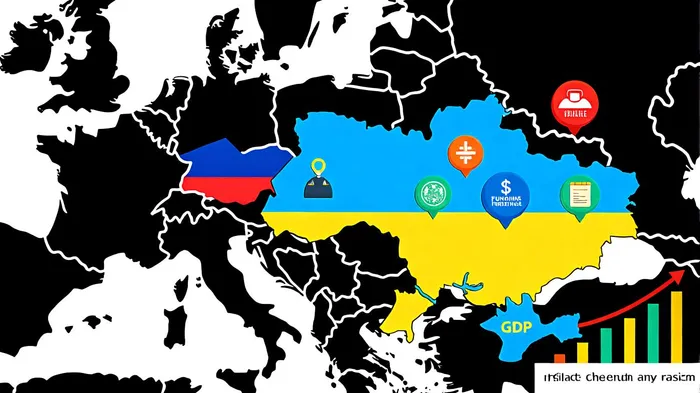
Ukraine's IMF Program: Progress and Stumbling Blocks
Ukraine's Extended Fund Facility (EFF) program, a $15.5 billion lifeline, has seen mixed results. As of June 2025, the IMF completed its Eighth Review, unlocking a $500 million disbursement and bringing total program funding to $10.6 billion, according to an IMF press release. However, the path forward is fraught with challenges. The National Bank of Ukraine (NBU) has resisted IMF pressure to devalue the hryvnia, fearing inflationary spikes and public backlash, according to a Bloomberg article. This standoff underscores the tension between short-term fiscal relief and long-term economic stability.
The government's push for a new four-year IMF program-estimated to require $150–$170 billion-highlights the scale of Ukraine's financial needs, according to a Reuters report. Yet, unmet structural benchmarks under the EU's Ukraine Plan, such as delayed reforms in energy and banking sectors, have triggered negative conditionality, with €1.5 billion in aid withheld in 2025, according to an RPR analysis. This divergence between IMF and EU priorities complicates Ukraine's reform agenda, creating a fragmented support ecosystem.
Comparative Insights: Emerging Markets and IMF Resilience
Ukraine's experience mirrors broader trends in emerging markets, where IMF programs have become critical tools for navigating geopolitical and fiscal volatility. According to the IMF Global Financial Stability Report, stronger policy frameworks-including credible inflation targeting and fiscal guardrails-have enhanced emerging markets' resilience to shocks like the Russia-Ukraine war and pandemic-driven disruptions. For instance, India and Southeast Asia have leveraged structural reforms and digital adoption to sustain growth, even amid rising effective tariff rates and trade tensions, as noted in a StartUs guide.
However, Ukraine's case is unique. Unlike many emerging markets, its reforms are compounded by wartime conditions, necessitating urgent debt restructuring and social safety net expansions. The IMF's 6% interest rate on loans, coupled with Ukraine's obligation to repay nearly as much as it receives, raises questions about long-term sustainability, according to a Carnegie Endowment analysis. This contrasts with countries like Mexico and Vietnam, which have benefited from near-shoring trends and lower debt burdens (see the StartUs guide).
Strategic Positioning for Investors
For investors, Ukraine's trajectory presents a paradox: a high-risk environment with potential for outsized returns. The country's $18.1 billion budget gap for 2026 (reported by Reuters) and the EU's conditional aid create uncertainty, yet successful reforms could unlock access to frozen Russian central bank assets-a potential $50 billion windfall (estimated by Bloomberg). This duality aligns with broader emerging market dynamics, where agility and selective exposure are key.
- Currency Risk and Hedging: The hryvnia's stability hinges on IMF–NBU negotiations. A devaluation, while inflationary, could boost export competitiveness-a critical factor for investors in agriculture and energy sectors.
- Sectoral Opportunities: Accelerated privatization of state-owned banks and energy sector reforms may attract foreign capital, particularly if Ukraine meets IMF benchmarks for transparency and governance (as noted in the IMF press release).
- Geopolitical Contingencies: Investors must factor in the EU's leverage over funding and the U.S. and G7's role in unfreezing Russian assets. A delay in these processes could exacerbate fiscal stress, increasing bond yields and sovereign risk premiums (as discussed in the IMF Global Financial Stability Report).
Conclusion: Balancing Volatility and Resilience
Ukraine's engagement with the IMF reflects the broader challenges of emerging markets in an era of geopolitical fragmentation. While the country's reforms have shown resilience-meeting 90% of IMF benchmarks since 2023, according to the Carnegie Endowment analysis-its uneven progress under EU conditionality highlights the fragility of external support. For investors, the key lies in hedging against currency and political risks while capitalizing on sectors poised to benefit from structural reforms. As the IMF's November–December 2025 review looms, Ukraine's ability to align with both IMF and EU priorities will be a litmus test for its strategic positioning in the emerging markets landscape.







Comentarios
Aún no hay comentarios