
UK Water Sector Reforms and Infrastructure Investment Opportunities: Strategic Equity and Green Bond Allocations in a Transformed Landscape
The UK water sector is undergoing a seismic shift in 2025, driven by a confluence of regulatory overhauls, environmental imperatives, and financial restructuring. These reforms, spearheaded by the Independent Water Commission (IWC), are redefining the sector's infrastructure investment landscape, creating opportunities for equity and green bond allocations that align with long-term sustainability goals.
Regulatory Overhaul: A Unified Framework for Stability and Accountability
The most transformative element of the 2025 reforms is the creation of a single integrated water regulator for England and Wales. This entity consolidates the functions of Ofwat, the Drinking Water Inspectorate, and the Environment Agency, eliminating regulatory fragmentation and introducing a cohesive framework for oversight. Key features include:
- Minimum capital requirements to reduce debt reliance and enhance financial resilience.
- Ownership control powers, enabling the regulator to block takeovers by investors who prioritize short-term gains over long-term infrastructure needs.
- Real-time sewage spill monitoring, which publicly names polluters, creating reputational and financial risks for underperforming companies.
This "super-regulator" is expected to stabilize the sector by aligning incentives between operators, regulators, and investors. For example, Thames Water's current 88% regulatory gearing (debt-to-capital ratio) is being capped at 55%, reducing financial fragility and improving creditworthiness.
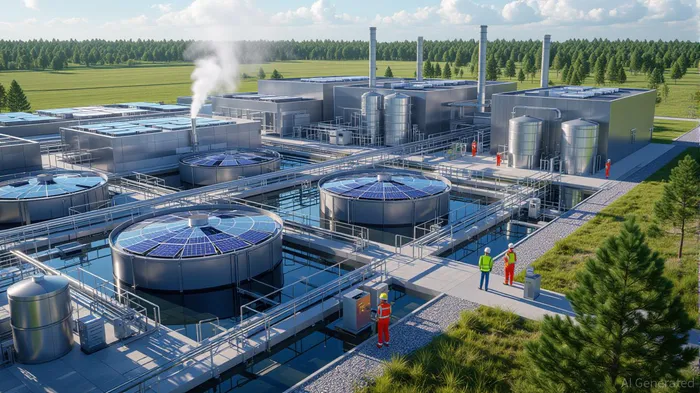
Equity Investment: ESG-Driven Infrastructure and Regional Decentralization
The IWC's proposal for eight regional water planning authorities in England and one in Wales is decentralizing decision-making, ensuring infrastructure investments reflect local needs. These authorities will oversee planning, funding, and accountability, prioritizing projects such as:
- Desalination plants (e.g., Severn Trent's £1 billion Humber project).
- Leakage reduction programs (e.g., United Utilities' £2.1 billion AI-powered initiative).
- Rainwater harvesting and reuse systems to address water scarcity.
For equity investors, this decentralization creates a fragmented but high-conviction opportunity set. Key players like United Utilities (UU.L) and Severn Trent (STAN.L) are capitalizing on AMP8 (2025–2030) funding cycles, with UU.L's regulatory gearing at 62%—well below the proposed cap—providing flexibility for growth.
The sector's shift toward ESG alignment is also reshaping equity valuations. Companies with robust environmental performance, such as those investing in PFAS and microplastic filtration or biodiversity restoration, are likely to outperform peers. The introduction of performance-linked executive incentives further ties management to long-term ESG outcomes, reducing governance risks.
Green Bonds: A Catalyst for Climate-Resilient Infrastructure
The UK water sector's green bond market is poised for growth, supported by the 2025 reforms and global trends. In 2024, global green bond issuance hit $389.4 billion, with Europe dominating. The UK's Green Financing Programme, which raised £43.4 billion since 2021, is now redirecting funds toward water-related projects under categories like Pollution Prevention and Climate Change Adaptation.
Post-2024 reforms, including the European Green Bond Standard, are enhancing transparency. For instance, the Environment Agency's revised water resource framework emphasizes flood resilience and abstraction controls, creating demand for green bonds to fund infrastructure upgrades.
However, challenges remain. Thames Water's debt crisis has exposed weaknesses in the current green bond model, with its £15 billion secured debt—including £3 billion labeled as "green"—now rated as high-risk. This highlights the need for stricter use-of-proceeds standards and impact verification to restore investor confidence.
Strategic Allocation: Balancing Risk and Reward
Investors should adopt a dual approach:
1. Equity Allocations: Prioritize companies with strong ESG performance, low regulatory gearing, and regional planning authority support. UU.L and STAN.L are prime candidates, but smaller firms like Northumbrian Water Group (NWR.L)—which has pioneered water reuse schemes—offer niche opportunities.
2. Green Bonds: Focus on government-backed green gilts and high-impact projects (e.g., desalination, leakage reduction). Avoid corporate green bonds with weak environmental metrics or opaque reporting.
The IWC's proposed 25-year National Water Strategy provides a long-term roadmap, ensuring policy continuity. This is critical for infrastructure investors, who require stable regulatory environments to justify multi-decade commitments.
Conclusion: A Sector Transformed
The UK water sector's 2025 reforms are creating a sustainable, accountable, and investor-friendly ecosystem. While short-term risks—such as Thames Water's restructuring—remain, the long-term trajectory is clear: a sector where ESG alignment, regulatory clarity, and capital discipline drive returns. For investors, this is a rare intersection of environmental necessity and financial resilience, offering compelling opportunities in both equity and green bond markets.
The time to act is now. As the sector transitions from crisis to growth, strategic allocations in infrastructure and green finance will be rewarded with stable, inflation-protected returns.







Comentarios
Aún no hay comentarios