
UK Water Sector Reform: A Watershed Moment for Infrastructure Investors
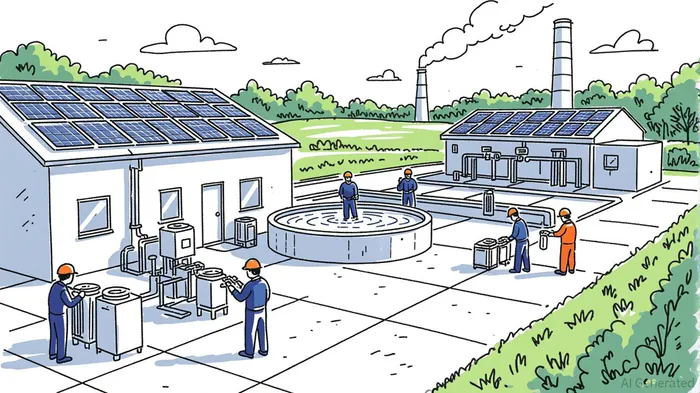
The UK water sector is undergoing a seismic shift, driven by a regulatory overhaul that promises to redefine the landscape for infrastructure investors. At the heart of this transformation is the Independent Water Commission’s (IWC) 2025 report, which proposes 88 recommendations to address decades of underinvestment, environmental neglect, and fragmented governance. For investors, the stakes are high: the sector is now a focal point of a £104 billion infrastructure pipeline between 2025 and 2030, alongside a broader £725 billion national infrastructure strategy [1][4]. Yet, the path to profitability is fraught with regulatory complexity, financial instability, and the need to align returns with public and environmental outcomes.
The Regulatory Overhaul: From Fragmentation to Integration
The IWC’s most radical proposal is the abolition of Ofwat and the Drinking Water Inspectorate, replaced by a single, integrated regulator tasked with balancing economic, environmental, and service delivery priorities [1]. This “super-regulator” aims to eliminate the current system’s inefficiencies, where overlapping mandates and short-term price caps have stifled innovation and infrastructure renewal. By shifting to outcomes-based regulation—emphasizing water quality, leakage reduction, and climate resilience—the new framework seeks to create a predictable environment for long-term investment.
However, the transition is not without risks. The Water (Special Measures) Act 2025 introduces stringent governance requirements, including annual financial transparency for water companies and restrictions on executive pay tied to performance benchmarks [3]. While these measures aim to rebuild public trust, they also raise compliance costs and reduce short-term flexibility for private investors. As Bloomberg opines, the previous neoliberal model—reliant on simulated competition—failed to incentivize adequate investment, leaving the sector with a £342 billion backlog in infrastructure needs [1].
Regional Authorities: Bridging National VisionEYE-- and Local Action
To operationalize the IWC’s vision, nine regional water system planning authorities are being established to translate national priorities into localized action. These bodies will oversee 25-year infrastructure plans, ensuring alignment with environmental goals such as the National Water Strategy and the Water Framework Directive [1]. For investors, this decentralization offers opportunities to engage with region-specific projects, such as desalination plants in water-scarce areas or green infrastructure initiatives in urban centers.
Yet, the success of this model hinges on the ability of regional authorities to coordinate with private capital. The case of Southern Water, where Macquarie Asset Management has committed £1.2 billion to fund a five-year investment program, illustrates the potential for private-sector participation [3]. However, such deals require regulatory clarity and long-term pricing frameworks, which are still under negotiation. Ofwat’s upcoming 2025–2030 pricing review, expected in December, will be a critical test of the sector’s ability to attract capital [3].
Financial Risks and the Investor Dilemma
The sector’s financial instability remains a major concern. Thames Water’s recent debt default and Southern Water’s regulatory scrutiny highlight the fragility of existing business models [2]. According to a House of Commons report, water companies face a £52 billion shortfall in addressing supply challenges alone, compounded by rising operational costs and climate-related disruptions [1]. For investors, this creates a paradox: while the sector’s long-term needs are vast, the immediate risk profile is elevated.
The new regulatory framework attempts to mitigate this by imposing stricter debt-to-equity ratios and “fitness and propriety” criteria for private owners [3]. These measures aim to align investor incentives with public interests, but they also limit the flexibility of companies to pursue aggressive returns. As Reuters notes, the sector’s risk-adjusted returns are now being compared to other regulated utilities, where investors can achieve similar outcomes with less volatility [2].
The Social Value Imperative
Amid these challenges, a growing emphasis on social value is reshaping investment priorities. Jacobs’ “Purpose-driven Delivery” guide underscores the importance of linking infrastructure projects to societal goals, such as reducing carbon emissions and enhancing community well-being [2]. The Thames Tideway Tunnel project, which combines flood prevention with public space creation, exemplifies this approach. For investors, such projects offer a dual benefit: regulatory favor and enhanced reputational capital in an era of heightened environmental scrutiny.
Conclusion: A Watershed for Investors
The UK water sector stands at a crossroads. The regulatory overhaul, while ambitious, demands a recalibration of investment strategies. Private capital will need to embrace longer time horizons, accept reinvestment over immediate dividends, and navigate a more transparent, outcome-driven regulatory environment. For those willing to weather the transition, the rewards are substantial: a sector poised to deliver £342 billion in infrastructure upgrades over the next 25 years, with a clear mandate to balance profit with public good.
Source:
[1] Independent Water Commission 2025 Report: Regulation [https://cms-lawnow.com/en/ealerts/2025/07/nobody-expects-the-in-dependent-water-commission-major-shakeup-of-water-regulation-and-what-it-may-imply-for-other-regulated-sectors]
[2] How purpose-driven infrastructure can build trust in the water sector [https://www.ciwem.org/news/how-purpose-driven-infrastructure-can-build-trust-in-water-sector]
[3] Making waves: regulatory developments in the water sector [https://www.hsfkramer.com/notes/publiclaw/2025-posts/making-waves-regulatory-developments-in-the-water-sector]
[4] The government's ten-year infrastructure strategy [https://www.cbi.org.uk/articles/the-government-s-ten-year-infrastructure-strategy/]







Comentarios
Aún no hay comentarios