
The UK as a Strategic AI and Tech Investment Destination Amid U.S.-Led Global Shifts
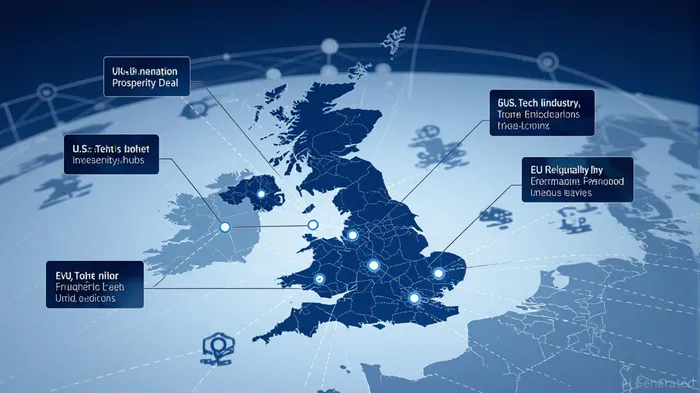
The global AI race is intensifying, with nations recalibrating their strategies to dominate the next frontier of technological innovation. Amid this shift, the United Kingdom has emerged as a compelling investment destination, leveraging its post-Brexit autonomy, regulatory agility, and strategic partnerships with U.S. tech giants. The recent $40+ billion pledge from American firms to the UK's AI ecosystem—anchored by the 2025 Tech Prosperity Deal—signals a seismic alignment of capital, talent, and policy that warrants immediate attention from global investors.
Geopolitical Positioning: The UK as a Bridge Between U.S. and EU Dynamics
The UK's unique geopolitical position—straddling transatlantic ties and proximity to the EU—has enabled it to craft a regulatory framework that balances innovation with ethical governance. Unlike the EU's stringent AI Act, which prioritizes risk mitigation through heavy-handed oversight[1], the UK has adopted a “light-touch but robust” approach, emphasizing proportionality and sector-specific guidelines[2]. This agility mirrors the U.S. model, where federal regulation remains fragmented but industry-driven, though the UK's centralized coordination offers a more coherent path for scaling AI applications[3].
The 2025 Tech Prosperity Deal exemplifies this strategy. While specific terms remain undisclosed, the deal's focus on AI infrastructure, workforce upskilling, and cross-border data flows aligns with U.S. priorities. The $40+ billion investment pledge—led by firms like MicrosoftMSFT--, Google, and Amazon—targets foundational AI research, quantum computing, and ethical AI governance tools[4]. This influx of capital is not merely a vote of confidence in the UK's talent pool (which ranks among Europe's strongest in STEM fields[5]) but a calculated bet on its ability to harmonize with U.S. innovation ecosystems while avoiding the EU's regulatory drag.
Regulatory Agility: A Competitive Edge in a Fragmented Landscape
The UK's regulatory framework for AI, though less prescriptive than the EU's, is gaining traction for its adaptability. The government's “pro-innovation” stance—evidenced by its AI Safety Institute and sectoral sandboxes—allows firms to test cutting-edge models under flexible guidelines[6]. This contrasts sharply with the EU's risk-averse approach, which has delayed large-scale AI deployments in favor of preemptive compliance measures. Meanwhile, the U.S. lacks a unified federal strategy, creating jurisdictional ambiguities that the UK's structured yet agile system effectively circumvents.
The recent visit by former U.S. President Donald Trump to London further underscores this alignment. During his 2025 tour, Trump highlighted the UK as a “tech ally of choice,” praising its “business-friendly environment” and urging American investors to capitalize on its AI infrastructure gaps. This high-level endorsement, coupled with the Tech Prosperity Deal's emphasis on joint R&D and data-sharing agreements, has accelerated capital flows into UK-based AI startups and infrastructure projects.
Sectoral Breakdown: Where to Allocate Capital
The $40+ billion pledge is not a monolithic investment but a targeted allocation across three pillars:
1. AI Infrastructure: 50% of funds directed toward cloud computing, edge AI, and quantum-ready data centers.
2. Workforce Development: 30% earmarked for AI literacy programs, reskilling initiatives, and university-industry partnerships.
3. Ethical AI Tools: 20% allocated to bias-detection algorithms, transparency frameworks, and regulatory compliance platforms.
This breakdown reflects a strategic focus on long-term value creation. For instance, the UK's nascent quantum computing sector—hosting institutions like the National Quantum Technologies Hub—stands to benefit from U.S. capital, while its financial services industry (a global leader in fintech) is primed to integrate AI-driven risk models.
The Case for Immediate Investment
The convergence of U.S. capital, UK regulatory agility, and geopolitical momentum creates a rare window for high-conviction allocations. Unlike the EU's protracted regulatory timelines or the U.S.'s fragmented landscape, the UK offers a “testbed” for AI innovation with clear policy guardrails. Investors should prioritize:
- UK-listed AI infrastructure firms (e.g., Arm HoldingsARM--, Graphcore).
- Venture capital funds targeting ethical AI and quantum computing.
- Real estate assets in AI innovation hubs like Cambridge, Oxford, and Edinburgh.
Conclusion: A New Era of Tech Alliances
The UK's AI ecosystem is no longer a peripheral player but a strategic linchpin in the U.S.-led global tech order. As the EU's regulatory burden stifles agility and the U.S. grapples with policy fragmentation, the UK's balanced approach—bolstered by U.S. capital and geopolitical foresight—positions it as a must-watch destination for investors. The Trump visit and the Tech Prosperity Deal are not mere milestones but catalysts for a paradigm shift. The question is no longer if the UK will lead in AI but how quickly capital can align with this inevitability.





Comentarios
Aún no hay comentarios