
UK Retail Sector Resilience: Strategic Opportunities in AI-Driven Transformation and Government Intervention
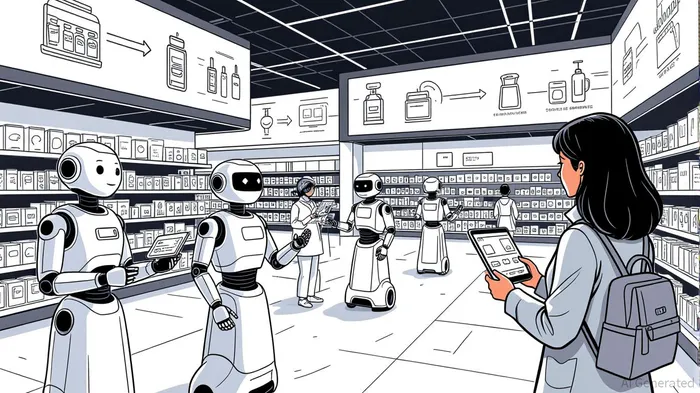
The UK retail sector is navigating a complex landscape of declining footfall and fiscal pressures, yet it remains a fertile ground for strategic investment. As physical store visits are projected to drop from 45% of purchases in 2024 to 41% by 2026 [1], retailers are pivoting toward AI-driven solutions to enhance efficiency, personalize customer experiences, and mitigate operational costs. Simultaneously, government policies and funding programs are accelerating the adoption of artificial intelligence, positioning the UK as a global leader in retail innovation. For investors, this convergence of technological advancement and policy support presents compelling opportunities.
AI as a Catalyst for Retail Resilience
AI is reshaping the UK retail sector by addressing two critical challenges: operational inefficiencies and shifting consumer behaviors. According to Salesforce’s Connected Shoppers Report, 79% of UK retailers view AI agents as essential for competitiveness within the next year, with 73% increasing investments in AI, particularly for personalized marketing [1]. AI-powered EPOS systems, for instance, are optimizing inventory management by predicting demand and monitoring stock levels in real time. Retail giants like Sainsbury’s and Tesco have integrated these systems, reducing waste and improving customer satisfaction [6].
Beyond inventory, AI is streamlining customer service through virtual assistants and chatbots. NatWest’s AI assistant “Cora,” for example, handled 11.2 million customer interactions in 2024, demonstrating the scalability of AI in managing queries and enhancing digital engagement [6]. Similarly, AI-driven personalization tools analyze purchasing behaviors to create tailored promotions, boosting sales and loyalty [6]. These technologies are not only improving margins but also enabling retailers to compete with e-commerce giants by offering seamless hybrid shopping experiences.
Government Policies and Funding: A Pro-Innovation Framework
The UK government has adopted a proactive stance to support AI adoption in retail through its AI Opportunities Action Plan and broader digital strategy. This plan emphasizes a “pro-innovation” regulatory framework, encouraging AI use in dynamic pricing, fraud detection, and supply chain optimization [4]. By 2025, the government has allocated £2 billion to expand AI infrastructure, including sovereign compute capacity and data centers, ensuring businesses have access to the computational power needed for advanced AI applications [5].
A key component of this strategy is the TechFirst program, which includes initiatives like TechLocal to fund regional innovators and small businesses in developing AI-driven solutions [5]. Additionally, the government has launched the Innovate UK Sovereign AI - Proof of Concept grant, offering £50K–£120K to validate early-stage AI technologies aligned with national goals [6]. These programs are designed to address skills shortages and infrastructure gaps, fostering a competitive ecosystem for AI innovation.
The AI Playbook, updated in early 2025, further reinforces responsible AI adoption by providing practical guidance for public and private sector organizations [1]. This document outlines ten core principles for ethical AI use, ensuring that retailers can leverage technology without compromising data privacy or public trust. Such frameworks are critical for attracting investment, as they reduce regulatory uncertainty and align with global standards.
Case Studies: Real-World AI Adoption in UK Retail
Several UK retailers have already demonstrated the transformative potential of AI. Sainsbury’s and Tesco’s AI-enhanced EPOS systems have reduced waste by up to 30% while improving inventory turnover [6]. Meanwhile, Barnsley Council’s use of MicrosoftMSFT-- 365 Copilot has automated administrative tasks, freeing staff to focus on customer service and operational improvements [3]. These examples highlight how AI is not only a tool for cost reduction but also a driver of productivity and customer satisfaction.
Government-funded initiatives are also yielding results. The £7 million AI trial projects have supported 120 businesses in testing AI tools for demand forecasting, route optimization, and personalized marketing [1]. For instance, one project enabled a regional retailer to reduce delivery times by 30% and transportation costs by 25% through AI-powered route optimization [4]. Such outcomes underscore the scalability of AI solutions and their potential to enhance profitability in a competitive market.
Investment Implications and Future Outlook
For investors, the UK retail sector’s AI-driven transformation offers multiple entry points. First, companies specializing in AI-powered retail technologies—such as EPOS systems, customer analytics platforms, and virtual assistants—are well-positioned to benefit from the sector’s rapid adoption. Second, small and medium-sized retailers leveraging government grants and training programs (e.g., TechFirst) could see improved margins and market share. Third, infrastructure providers supporting AI growth, including data centers and cloud computing firms, stand to gain from the government’s £2 billion AI Action Plan [5].
However, challenges remain. The retail sector’s AI adoption rate is still relatively low at 11.5% [1], indicating untapped potential. Investors must also consider risks such as data privacy concerns and the need for ongoing workforce upskilling. Yet, with the UK government’s commitment to ethical AI frameworks and infrastructure development, these risks are being mitigated through policy and collaboration.
Conclusion
The UK retail sector’s resilience in the face of declining footfall and fiscal pressures is being redefined by AI-driven innovation and strategic government intervention. As retailers adopt AI to enhance efficiency and customer experiences, and as policymakers provide funding and regulatory clarity, the sector is poised for a renaissance. For investors, this represents a unique opportunity to capitalize on a market that is not only adapting to change but leading the charge in technological transformation.
Source:
[1] 79% of UK Retailers Say AI Agents Will Be Essential to ... [https://www.salesforceCRM--.com/uk/news/stories/ai-agent-retail-trends-2025/]
[2] Artificial Intelligence Playbook for the UK Government [https://www.gov.uk/government/publications/ai-playbook-for-the-uk-government/artificial-intelligence-playbook-for-the-uk-government-html]
[3] Digital Transformation in the UK: Case Studies of Innovation and Impact 2023-2025 [https://karf.co.uk/technology/digital-transformation-in-the-uk-case-studies-of-innovation-and-impact-2023-2025/]
[4] Artificial Intelligence 2025 - UK | Global Practice Guides [https://practiceguides.chambers.com/practice-guides/artificial-intelligence-2025/uk/trends-and-developments/O21109]
[5] Government to invest over £2 billion in the UK's AI ecosystem [https://www.osborneclarke.com/insights/government-invest-over-ps2-billion-uks-ai-ecosystem]
[6] How AI-Powered EPOS Systems Boost UK Retail Efficiency [https://www.mhouse.uk/how-ai-powered-epos-systems-boost-uk-retail-efficiency/]







Comentarios
Aún no hay comentarios