
UK Rate Cut Outlook Amid Surging Inflation: Navigating Risks in Fixed Income Markets
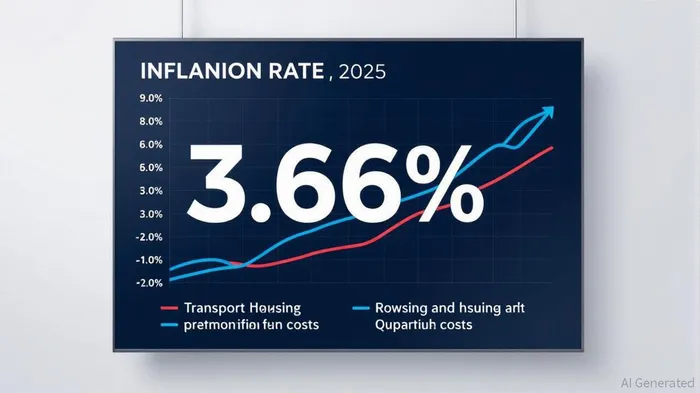
The UK's inflation rate surged to 3.6% in June 2025, marking its highest level since January 2024 and underscoring persistent pressures that complicate the Bank of England's (BoE) path toward monetary easing. With the BoE's 2% target still distant, investors in UK fixed income markets face a critical dilemma: how to balance expectations of rate cuts against the risk of inflation remaining stubbornly elevated. This article dissects the drivers of inflation, the BoE's cautious stance, and the implications for gilts, corporate bonds, and inflation-linked securities.
The Inflation Conundrum
June's inflation report revealed broad-based pressures, with transport costs (motor fuels, airfares) and food prices leading the rise. While motor fuels saw a 9.0% annual decline due to lower oil prices, airfares surged by 7.9%—the largest June increase since 2018—driven by higher demand for long-haul travel. Housing costs also moderated only slightly, with owner-occupiers' housing costs contributing to a 6.7% annual increase in the sector. Meanwhile, food and non-alcoholic beverages posted a 4.5% annual inflation rate—the highest since February 2024.
These trends highlight a disconnect between global commodity prices (e.g., oil) and domestic services inflation, which remains elevated due to persistent demand and supply-side constraints. The BoE's core inflation rate (excluding volatile items) rose to 3.7%, signaling that inflation is increasingly embedded in the economy.
The BoE's Dilemma: Rate Cuts vs. Inflation Persistence
The BoE's Monetary Policy Committee (MPC) cut the Bank Rate to 4.25% in May 2025, but the decision was narrowly split (5–4), reflecting internal disagreement over the pace of easing. The MPC emphasized that monetary policy remains “restrictive” and will adjust based on evolving data, particularly labor market slack and inflation dynamics.
Market expectations, however, have priced in a more dovish path: the yield on 10-year UK gilts (GILT) has fallen to ~3.5%, reflecting bets on further cuts to ~3.5% by mid-2026. Yet this optimism may be premature.
Key Drivers of Uncertainty
- Labor Market Resilience: While the unemployment rate is projected to rise to 5% by late 2026, wage growth remains stubbornly high at 5.9%—well above the BoE's 3.7% forecast for late 2025. A delayed slowdown in wages could force the BoE to pause or reverse rate cuts, raising gilt yields.
- Fiscal Policy: The Spring 2025 Budget maintained a neutral stance, avoiding stimulus measures that might exacerbate inflation. This limits near-term growth but aligns with the BoE's focus on monetary policy to balance disinflation.
- Global Trade Risks: Geopolitical tensions and trade disputes (e.g., U.S.-China tariffs) threaten UK exports and global demand. A weaker global economy could suppress inflation but also drag on UK growth, complicating policy decisions.
Implications for Fixed Income Investors
Gilts: Underweight Long-Dated Exposure
Long-dated gilts (e.g., 10+ years) are vulnerable to upward yield volatility. If inflation surprises to the upside—due to persistent wage pressures or supply-chain disruptions—investors could face significant capital losses.
Tactical recommendation: Reduce exposure to long-dated gilts until labor market softening is confirmed. Shorter-dated bonds (e.g., 2–5 years) offer better insulation from rate uncertainty.
Inflation-Linked Gilts (ILGs): Overweight
Inflation-linked securities, such as the iShares UK Inflation-Linked Government Bond ETF (ILF), directly hedge against rising prices. Their principal adjusts with the Retail Price Index (RPI), making them a safer bet in an uncertain inflation environment.
Investment case: ILGs outperform in scenarios where inflation stays elevated or volatility rises. Their convexity benefit—where prices rise disproportionately when yields fall—also makes them attractive if the BoE reverses course to tighten policy.
Corporate Bonds: Selectivity is Key
- Utilities and Consumer Staples: These sectors benefit from stable demand and low sensitivity to rate hikes. High-quality issuers like National Grid (NG) or Tesco (TSCO) offer decent yields with lower credit risk.
- Avoid High-Yield and Cyclical Sectors: Companies in construction, retail, or travel face margin pressures from persistent inflation and weaker demand.
The Bottom Line
Investors in UK fixed income must navigate a minefield of inflation risks and policy uncertainty. While market pricing leans toward aggressive rate cuts, the BoE's caution and the stubbornness of services inflation suggest a cautious approach:
- Underweight long-dated gilts until wage growth and unemployment data confirm disinflation.
- Overweight inflation-linked securities to hedge against upside inflation risks.
- Focus on defensive corporate bonds in stable sectors, avoiding cyclical issuers.
The next critical data points—August's wage growth report and September's inflation print—will determine whether the BoE can ease further or must recalibrate its stance. Until then, flexibility and risk management should guide fixed income allocations.
This analysis underscores the need for investors to prioritize inflation protection and duration management while awaiting clearer signals on labor market softening.







Comentarios
Aún no hay comentarios