
The UK's Protest Crackdown: A Double-Edged Sword for Markets and Stability
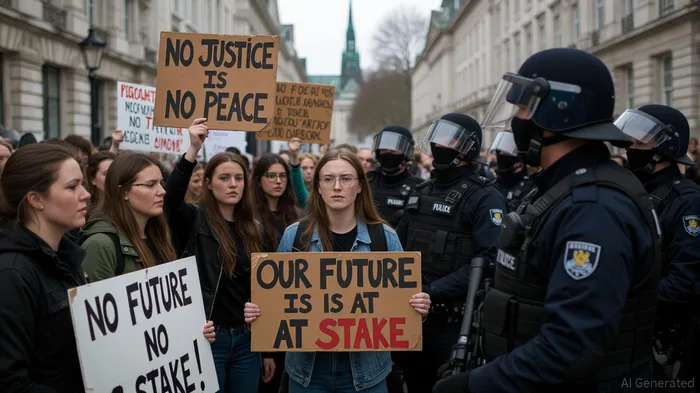
The United Kingdom's recent crackdown on protest activity—particularly targeting climate and human rights activists—has sparked a contentious debate about the balance between public order and democratic freedoms. While the government defends these measures as necessary to maintain stability, the unintended consequences for social cohesion, investor sentiment, and long-term asset allocation strategies are becoming increasingly apparent.
The Social Stability Conundrum
The UK's 2022 and 2023 anti-protest laws, including the Police, Crime, Sentencing and Courts Act and the Public Order Act, have granted authorities sweeping powers to preemptively restrict demonstrations. These include indefinite bail conditions (e.g., GPS tracking, curfews), harsher penalties for non-violent acts, and the criminalization of actions like “slow walking” during protests. By 2024, 34 climate activists had been jailed for up to five years, marking a historic escalation in punitive measures.
While the government argues these laws deter “disruption,” critics warn they stifle dissent and erode trust in democratic institutions. The UN special rapporteur on environmental defenders has labeled the crackdown “regressive,” noting it risks criminalizing peaceful activism under the guise of public nuisance. Such measures, while reducing visible protests, may exacerbate underlying tensions. If economic and environmental grievances remain unaddressed, suppressed dissent could resurface in more volatile forms, threatening long-term social stability.
Investor Sentiment and ESG Exodus
The crackdown has also sent ripples through financial markets. ESG-focused funds, already reeling from global skepticism, saw £4.7 billion in outflows in 2024—a 57% increase from 2023. This trend aligns with broader shifts: investors are increasingly favoring index-tracking funds (which attracted £28 billion in 2024) over active strategies. The UK's reputation as a repressive state has further deterred ESG-aligned capital, particularly from firms prioritizing governance and human rights.
Meanwhile, sectors insulated from regulatory scrutiny—such as US tech stocks—have thrived. The Magnificent Seven's dominance drove inflows into North American equity funds, while UK equity sectors continued to hemorrhage capital. This divergence highlights a growing bifurcation: investors are hedging against political risk by favoring markets with stable governance frameworks, even as they avoid regions where reputational damage looms.
Long-Term Asset Allocation Strategies
For investors, the UK's protest crackdown underscores the importance of diversification and geopolitical risk assessment. Here are three key considerations:
Rebalance Toward Resilient Sectors: Sectors less sensitive to regulatory shifts—such as technology, healthcare, and global infrastructure—offer relative stability. For example, Tesla's stock price has surged amid global demand for clean energy, despite regulatory headwinds in certain markets.
Hedge Against Political Uncertainty: Investors should allocate a portion of portfolios to assets that perform well during periods of geopolitical volatility, such as gold, defensive equities, or emerging markets with strong governance. The UK's potential for future unrest could trigger market corrections, particularly in energy and real estate.
Monitor ESG Rebranding Trends: As European and UK funds rebrand to avoid “greenwashing” accusations, investors must scrutinize fund strategies. The shift from ESG to terms like “climate transition” or “sustainable growth” may obscure alignment with values.
The Global Implications
The UK's approach to protest contrasts sharply with global trends. While many nations are strengthening protections for peaceful assembly, the UK's crackdown risks isolating it diplomatically. This could hinder its influence in forums like the BRICS+ Summit and deter foreign direct investment from ESG-conscious firms. Moreover, the UK's actions may embolden other governments to adopt repressive tactics, fragmenting global markets and increasing cross-border volatility.
Conclusion
The UK's protest crackdown is a double-edged sword. While it may temporarily reduce visible unrest, it risks deepening societal divides and alienating capital. For investors, the lesson is clear: geopolitical stability and social trust are foundational to long-term returns. As the UK navigates this precarious balance, asset allocators must remain vigilant, prioritizing resilience over short-term gains.
In an era where protest and governance intersect with market dynamics, the UK's experiment serves as a cautionary tale—and a call to action for investors to weigh not just risk, but the ethical underpinnings of their portfolios.







Comentarios
Aún no hay comentarios