
UK Political Risk and Investment Opportunities: Reform UK's Decline as a Catalyst for Market Stabilization
The UK's political landscape in late 2025 remains a complex interplay of shifting voter allegiances, fiscal constraints, and the lingering shadow of Reform UK. Once a formidable insurgent force under Nigel Farage, Reform UK's recent poll numbers suggest a softening of its disruptive edge, offering investors a critical inflection point to reassess risk exposure and identify strategic entry opportunities in UK equities and regional governance-linked assets.
Reform UK's Fading Momentum and Internal Divisions
According to a report by , Reform UK's support base remains a heterogeneous coalition of working-class voters, affluent conservatives, and younger moderates disillusioned with mainstream politics. However, the party's internal fractures-particularly around immigration policy-highlight its vulnerability to fragmentation. While immigration remains a top priority for its core base, the lack of consensus on nuanced approaches has eroded its appeal among swing voters. This divergence signals a potential weakening of Reform UK's ability to coalesce a unified front, reducing its capacity to destabilize the political status quo.
Labour's Fiscal Challenges and Market Uncertainty
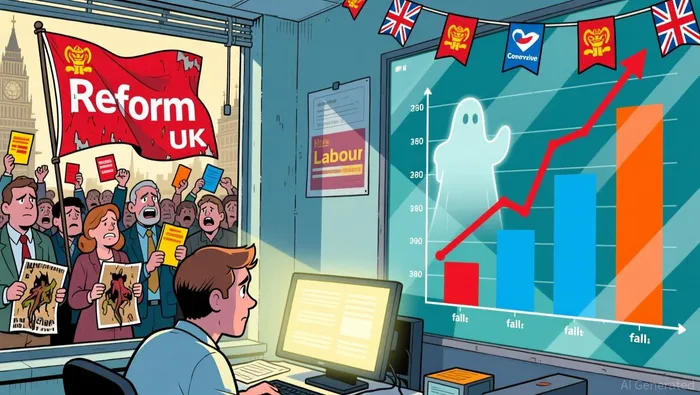 The Labour Government, meanwhile, faces mounting pressure to deliver on public service improvements and economic growth amid a fragile fiscal environment. A report by Edelman Global Advisory notes that rising national debt and high borrowing costs constrain the government's policy flexibility, creating a "perfect storm" of political and economic risk. The Institute for Fiscal Studies (IFS) further underscores this fragility, warning that the public finances are exposed to shocks such as inflationary spikes or prolonged austerity measures. These dynamics have kept investors on edge, with gilt markets pricing in elevated volatility and equity valuations reflecting cautious optimism.
The Upcoming Budget: A Make-or-Break Moment
The 2025 Budget, as analyzed by the Institute for Global Affairs, will be pivotal in determining whether the UK can avoid a deepening economic stagnation. A "growth bargain" that balances fiscal discipline with targeted investments in infrastructure and green energy could restore market confidence. Conversely, a misstep risks exacerbating inflationary pressures and eroding trust in Labour's economic stewardship. Evelyn's analysis of gilt market risks adds urgency to this calculus, emphasizing that even minor deviations from fiscal orthodoxy could trigger a sharp repricing of UK assets.
Strategic Entry Points for Investors
Reform UK's declining poll numbers, coupled with Labour's constrained but stabilizing fiscal agenda, present a window for investors to recalibrate their UK exposure. Key opportunities include:
1. UK Equities: Sectors insulated from political volatility-such as utilities, healthcare, and consumer staples-are likely to benefit from a more predictable policy environment. Companies with strong balance sheets and dividend resilience, particularly in regional markets, offer defensive value.
2. Regional Governance-Linked Assets: Local governments prioritizing infrastructure and public service upgrades under Labour's agenda could drive growth in regional real estate and municipal bonds. Areas with underfunded but high-priority projects (e.g., transport, digital connectivity) may see renewed investor interest.
3. Long-Term Positioning: As political stabilization reduces tail risks, long-dated assets such as UK sovereign bonds and equity index futures could become attractive. A phased entry into cyclical sectors like manufacturing and technology may also align with a post-stabilization recovery.
Conclusion
The UK's political and economic trajectory hinges on Labour's ability to navigate fiscal headwinds and Reform UK's diminishing capacity to disrupt. While risks persist, the softening of Reform UK's insurgent threat signals a potential return to equilibrium. For investors, this represents a strategic moment to capitalize on undervalued UK assets and position for a more stable, growth-oriented future.







Comentarios
Aún no hay comentarios