
UK Manufacturing Sector Fragility: Near-Term Investment Risks in Cyclical Industrial Stocks
A Sector in Contraction: PMI Trends and Structural Challenges
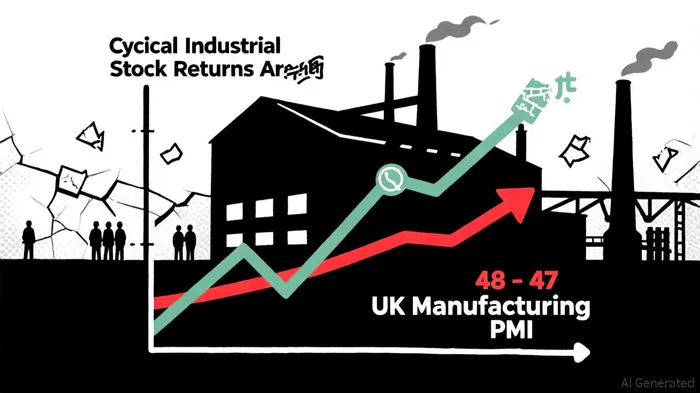
The UK manufacturing PMI, a barometer of sector health, . By August 2025, , . Key drivers include:
- Weakening demand: New orders dropped sharply, , according to the . Subdued client confidence, , , , as shown in recent PMI data.
- Global trade uncertainty: US tariff policies and supply chain disruptions have compounded challenges, particularly for export-dependent firms.
- Labor and cost pressures: Employment in the sector has declined as firms scale back capacity, , according to .
Cyclical Industrial Stocks: Mixed Signals and Lingering Risks
Cyclical industrial stocks, which typically mirror the health of the manufacturing sector, . While Q2 data hinted at resilience-driven by government initiatives like the Modern Industrial Strategy 2025 and UK Infrastructure: A 10-Year Strategy-this was noted in Cushman & Wakefield Marketbeat. Q3 results remain incomplete. Available data, however, reveals troubling trends:
- Ucommune International Ltd, a listed industrial player, . , , according to the Ucommune H1 2025 results. This partial stabilization contrasts with broader sector struggles.
- Export-driven optimism: Make UK's Q3 2025 report noted a rebound in output and export demand, with the US regaining its status as a key growth market. However, , underscoring cautious optimism reported by the Made in Britain barometer.
Investment Risks and Strategic Considerations
For investors, the interplay between PMI contraction and cyclical stock performance highlights several risks:
1. Earnings volatility, particularly for firms with limited pricing power.
2. Liquidity constraints, as noted in Make UK's outlook.
3. Geopolitical exposure, with potential to disrupt export-dependent firms.
Yet, opportunities exist for those who can navigate the volatility. Cushman & . However, .
Conclusion: Navigating Uncertainty
The UK manufacturing sector stands at a crossroads. While structural reforms and government backing offer hope, . Cyclical industrial investors should prioritize firms with strong balance sheets, diversified markets, and cost-control mechanisms. , as will assessing how global trade dynamics evolve. For now, caution remains the prudent stance.







Comentarios
Aún no hay comentarios