
UK Labor Market Resilience: Sustained Vacancies and Investment Opportunities in Consumer-Driven Sectors
The UK labor market in 2025 presents a paradox: declining vacancies in key sectors coexist with wage growth and pockets of resilience, offering both cautionary signals and investment opportunities. For investors, understanding this duality is critical to navigating consumer-driven industries like retail, hospitality, and professional services. While the Office for National Statistics (ONS) reported a 1.4% quarterly drop in vacancies to 728,000 in Q2 2025, sector-specific data reveals a nuanced picture. Retail and hospitality-two of the most labor-intensive industries-accounted for 86% of job losses since October 2024, yet vacancies in accommodation and food services remain 19% above pre-pandemic levels, according to a Savills spotlight. This suggests that while demand for labor is softening, consumer spending in these sectors has not collapsed entirely.
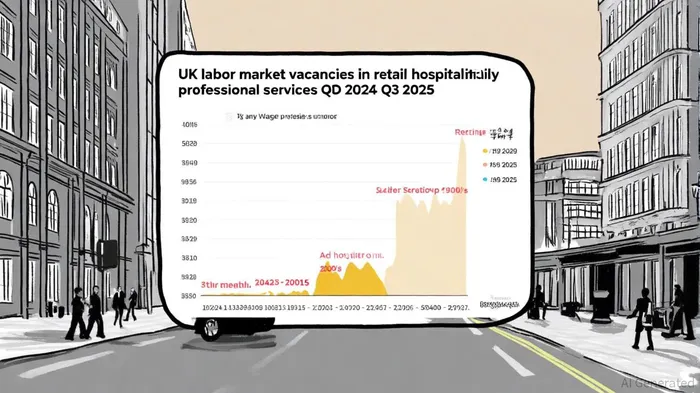
Sustained Vacancies as a Barometer of Spending Power
The persistence of vacancies in hospitality and retail, despite a 25% year-on-year decline in summer postings, according to the CIPD Labour Market Outlook, points to a key insight: businesses are still willing to invest in labor where consumer demand remains robust. For example, the hospitality sector's 79,000 vacancies in Q2 2025-down from 98,000 in Q4 2024-reflect a balance between cost pressures (e.g., higher National Insurance contributions) and the sector's ability to attract discretionary spending. According to the Deloitte Consumer Tracker, UK households are prioritizing travel and leisure over essentials, a trend that supports demand for hotels, restaurants, and event venues. This dynamic creates a unique opportunity for investors: businesses that optimize labor costs through automation or strategic hiring may outperform peers in a tightening market.
Meanwhile, wage growth of 6.1% year-on-year in January 2025, as shown in the CIPD report, provides a buffer against inflationary pressures. While the Consumer Price Index (CPI) stood at 3.6% in June 2025, according to Savills, real-term spending power has not eroded as sharply as feared. This is particularly evident in retail, where online sales accounted for 27.4% of total sales in Q2 2025, driven by price-sensitive consumers seeking value, a trend tracked by Deloitte. For investors, this underscores the potential of e-commerce platforms and value-oriented retailers that cater to budget-conscious shoppers.
Professional Services: A Cautionary Tale
In contrast, the professional services sector lacks granular data on Q3 2025 vacancies, but broader trends suggest caution. The CIPD's Labour Market Outlook notes subdued hiring intentions in the private sector and reduced public sector recruitment, signaling a potential slowdown in demand for skilled labor. Rising employer costs-such as national insurance and minimum wage hikes-are likely to exacerbate this trend, particularly in lower-paid roles. However, the sector's resilience in the face of economic uncertainty could attract investors seeking long-term stability, provided businesses adapt to cost pressures through efficiency measures.
Strategic Investment Opportunities
The interplay between labor market dynamics and consumer behavior highlights three key areas for investment:
1. Automation and AI in Retail and Hospitality: With vacancies falling and labor costs rising, businesses that adopt AI-driven solutions (e.g., self-checkout systems, chatbots) can reduce dependency on tight labor markets while improving margins.
2. Value-Driven Retail Chains: As consumers prioritize promotions and own-label products, per the Deloitte tracker, retailers that excel in cost management and product differentiation are well-positioned to capture market share.
3. Professional Services with Upskilling Focus: Sectors facing labor shortages, such as healthcare and education, may benefit from investments in training programs that align with evolving employer needs.
Conclusion
The UK labor market's mixed signals-declining vacancies, wage growth, and sector-specific resilience-underscore the importance of a nuanced investment strategy. While rising costs and cautious consumer sentiment pose risks, they also create opportunities for businesses that innovate and adapt. For investors, the key lies in identifying sectors where spending power remains intact and labor constraints are mitigated through technology or strategic restructuring. As the economy navigates a 1.3% growth trajectory in 2025, according to British Chambers' analysis, those who act decisively on these insights may find themselves well-positioned for the year ahead.







Comentarios
Aún no hay comentarios