
UK Labor Market Dynamics: Early Signals of Economic Resilience and Stress in Post-Brexit Britain
The UK labor market in 2025 remains a paradox of resilience and fragility, shaped by the enduring aftershocks of Brexit. While employment rates have edged upward-reaching 75.2% for those aged 16–64 in May–July 2025-this figure masks a broader trend of declining employer confidence and sectoral imbalances, according to the House of Commons Library. The unemployment rate, at 4.7%, has risen by 194,000 year-on-year, reflecting a labor market that is neither tightening nor fully loosening, the House of Commons Library notes. For investors, these mixed signals demand a nuanced understanding of early indicators that could foreshadow either economic stabilization or deeper stress.
Labor Market Strains: A Sectoral Divide
The UK's post-Brexit migration system has created stark divergences across industries. Lower-skilled sectors such as agriculture, hospitality, and construction continue to grapple with labor shortages, exacerbated by the end of free movement with the EU, as detailed in a ResearchGate paper. The Resolution Foundation estimates a worker shortfall of over 300,000 in these sectors, with the vacancy-to-unemployment (V/U) ratio reaching one vacancy per unemployed person by mid-2022-a 25–33% increase compared to pre-Brexit trends, according to UK in a Changing Europe. This structural imbalance has driven up operational costs, with 84% of employers reporting higher expenses due to rising National Insurance contributions and minimum wage thresholds, the House of Commons Library reports.
Conversely, high-skilled sectors like IT, finance, and energy have fared better, supported by increased non-EU migration under the new visa regime, according to a post-Brexit migration study. The ManpowerGroup Employment Outlook Survey underscores this divide, noting a global decline in hiring intentions (+11% year-on-year) but identifying growth in roles requiring AI skills and within the finance and energy sectors. This bifurcation suggests that investors should prioritize sectors with adaptability to automation and global talent pipelines while avoiding those reliant on low-skilled labor.
Early Signals of Stress: Employer Confidence and Wage Dynamics
Employer confidence remains a critical barometer. The CIPD's Labour Market Outlook reveals a net employment balance of +9 in 2025-among the lowest levels outside the pandemic-and only 57% of private-sector employers planning to recruit in the next three months, the House of Commons Library reports. Public-sector confidence has deteriorated further, with a net balance of –6, signaling anticipated workforce reductions, the same source notes. These trends align with the Bank of England's recent policy shift: a 0.25 percentage point rate cut to 4.5% in 2025, reflecting the central bank's pivot from inflation control to addressing labor market fragility, according to SYLVON Economic Institute research.
Wage growth, however, remains a double-edged sword. Annual earnings growth of 5%-well above the 3% threshold typically aligned with the 2% inflation target-has forced the Bank of England to prioritize wage-price dynamics over employment levels, SYLVON Economic Institute research argues. This tension is evident in the Resolution Foundation's Q3 2025 data, which shows strong pay growth despite a loosening labor market, with unemployment rising and the employment rate declining, the House of Commons Library reports. For investors, this divergence signals potential inflationary risks and policy uncertainty, particularly in sectors where wage pressures are most acute.
Financial Market Implications: GBP Volatility and Sectoral Stock Performance
The British pound (GBP) has long been a barometer of Brexit-related uncertainty. In 2025, its volatility midpoint remains 83% higher than pre-referendum levels, with the Bank of England's rate cuts likely to depress its value further, according to SYLVON Economic Institute research. While GDP growth forecasts range from 0.7% to 1.7%, investor sentiment remains cautious, with the pound projected to trade in a range-bound pattern under mild depreciation.
Sectoral stock performance mirrors labor market trends. Sectors like industrials, energy, and finance have outperformed, benefiting from post-pandemic recovery and higher interest rates, the ResearchGate paper finds. In contrast, consumer goods and industrials face headwinds due to labor shortages and disrupted supply chains, the ResearchGate paper adds. The Resolution Foundation notes that firms in labor-intensive sectors have increasingly turned to R&D investment as a mitigation strategy, a trend that could reshape long-term sectoral valuations, UK in a Changing Europe observes.
Conclusion: Navigating the Crossroads
The UK labor market in 2025 is at a crossroads. While wage growth and sectoral adaptability hint at resilience, structural imbalances and employer caution underscore underlying fragility. For investors, the key lies in monitoring early signals: the V/U ratio as a proxy for inflationary risks, sectoral hiring trends in high-skill versus low-skill industries, and the Bank of England's evolving policy framework. As the UK grapples with the long-term legacy of Brexit, those who anticipate these signals will be best positioned to navigate the uncertainties ahead. 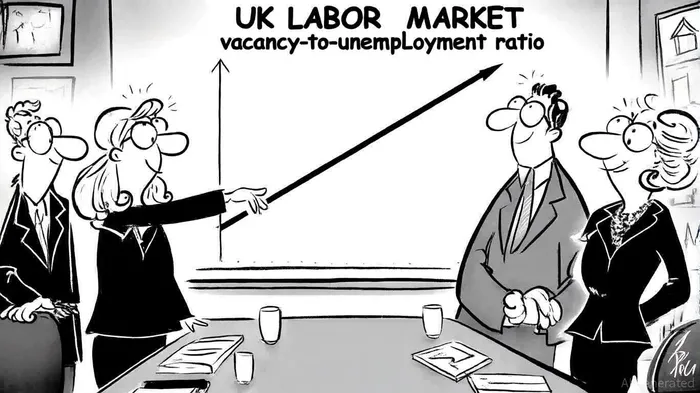







Comentarios
Aún no hay comentarios