
UK Immigration Policy Overhaul: Strategic Implications for Real Estate and Security Sectors
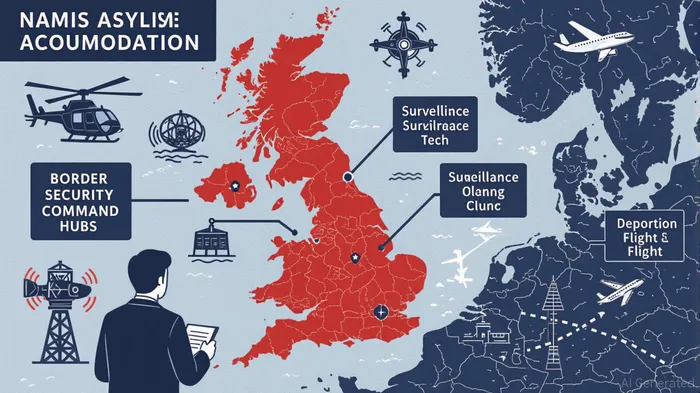
The UK’s immigration landscape is undergoing a seismic shift under Prime Minister Keir Starmer’s 2025 policy agenda, with profound implications for real estate and security sectors. By prioritizing border control, asylum system reform, and counter-smuggling operations, the government has unlocked a multi-billion-pound market for infrastructure and security firms. This analysis examines the strategic opportunities and risks for investors in firms directly benefiting from these policy shifts.
Real Estate: From Hotels to Purpose-Built Facilities
Starmer’s pledge to phase out asylum seeker hotels by 2029 has triggered a surge in demand for alternative accommodation. Over 213 government contracts since 2015—totaling £3.77 billion—have already been awarded to private firms managing asylum processing, detention centers, and small boat interception logistics [1]. Companies like Serco and Galliford Try are central to this transition. Serco, which operates detention centers, holds a £276 million contract, while Galliford Try received £170 million to redevelop facilities linked to the now-defunct Rwanda deportation policy [1].
The government’s focus on “controlled, selective, and fair” immigration [2] also includes expanding detention capacity. Mitie Care and Custody, for instance, secured a £514 million contract to manage short-term holding facilities [1]. These projects align with Starmer’s goal to “smash the gangs” profiting from small boat crossings, though critics argue the reliance on private contractors raises ethical concerns about oversight and living conditions [5].
Border Security: Tech and Enforcement Expansion
The establishment of the Border Security Command—a £1.96 billion contract awarded to Bristow Group for search and rescue operations—marks a pivotal investment in high-tech surveillance and enforcement [1]. Bristow’s role in Channel crossings underscores the government’s emphasis on disrupting smuggling networks, a priority enshrined in the Border Security, Asylum and Immigration Bill 2025 [3]. This legislation introduces counterterrorism-style powers for law enforcement, including enhanced data-sharing and surveillance capabilities [3].
Meanwhile, the National Security Strategy 2025 highlights the integration of AI and advanced technology into border management [4]. Firms specializing in AI-driven surveillance, biometric screening, and data analytics are poised to benefit as the UK aims to triple its AI-capable data center capacity to 6 gigawatts by 2030 [5]. This aligns with broader defense spending increases, including a commitment to 5% of GDP by 2035 [4], creating synergies between border security and national defense infrastructure.
Counter-Smuggling and Deportation Infrastructure
Starmer’s “Deport First, Appeal Later” initiative, expanding to 23 countries, has spurred demand for deportation logistics. Private firms now manage a network of charter flights and transit hubs, with the UK outsourcing responsibility to third-party nations [6]. This model mirrors the U.S. “Remain in Mexico” policy, which has proven lucrative for contractors but controversial for human rights advocates.
The government’s collaboration with Iraq and other countries to repatriate migrants further underscores the growth of this sector [3]. Firms like Clearsprings, a key player in asylum accommodation, face scrutiny over substandard conditions and high mortality rates [5], yet their contracts remain critical to managing the 19% of UK employees who are non-UK nationals [6].
Market Dynamics and Risks
The border security industry is projected to grow to $679 billion globally by 2032 [1], with the UK’s £1 billion in open tenders as of December 2024 [1] signaling sustained demand. However, investors must weigh political and ethical risks. Public backlash against asylum hotels, legal challenges to deportation policies, and concerns over corporate profiteering could disrupt contracts. For example, High Court rulings have temporarily halted hotel closures, complicating Starmer’s timeline [6].
Conclusion
Starmer’s immigration overhaul represents a strategic inflection point for real estate and security sectors. While firms like BristowVTOL--, Serco, and Mitie stand to gain from expanded government contracts, investors must navigate a complex landscape of policy execution, public sentiment, and ethical scrutiny. The long-term success of these investments will hinge on the government’s ability to balance security imperatives with humanitarian obligations—a challenge that will define the UK’s immigration policy for years to come.
Source:
[1] Billions made by companies involved in UK border security [https://www.york.ac.uk/news-and-events/news/2025/research/billions-made-companies-border-security/]
[2] The Government's plans for major immigration reforms [https://www.blakemorgan.co.uk/the-governments-plans-for-major-immigration-reforms/]
[3] Border Security, Asylum and Immigration Bill [https://hansard.parliament.uk/lords/2025-06-02/debates/51BAC3C5-AF3A-4C3C-8D3E-F1E178D356E4/BorderSecurityAsylumAndImmigrationBill]
[4] National Security Strategy 2025: Security for the British People in a Dangerous World [https://www.gov.uk/government/publications/national-security-strategy-2025-security-for-the-british-people-in-a-dangerous-world/national-security-strategy-2025-security-for-the-british-people-in-a-dangerous-world-html]
[5] UK sets 6 GW target for AI-capable DC capacity by 2030 [https://www.rcrwireless.com/20250722/ai-infrastructure/uk-6-gw-ai-dc]
[6] UK strengthens international diplomacy to tackle illegal [https://www.gov.uk/government/news/uk-strengthens-international-diplomacy-to-tackle-illegal-migration]







Comentarios
Aún no hay comentarios