
UK Grocery Inflation Moderation: A Glimpse of Consumer Spending Stability Amid Post-Brexit Economic Uncertainty?
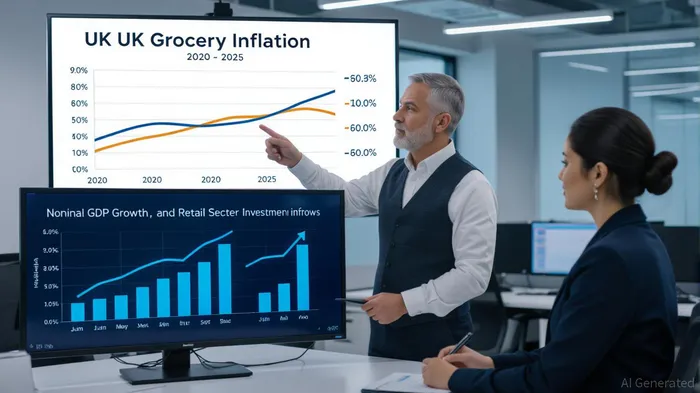
The United Kingdom's post-Brexit economic landscape has been a study in contradictions. On one hand, the nation grapples with the lingering scars of supply chain disruptions, regulatory fragmentation, and currency volatility. On the other, the retail sector—particularly the grocery market—has shown unexpected resilience, offering a glimmer of hope for investors navigating a complex inflationary environment. As 2025 unfolds, the question looms: Is the moderation in grocery inflation a sign of stabilizing consumer spending, or merely a temporary reprieve in a broader economic tug-of-war?
The Post-Brexit Adjustment: A Mixed Bag
Since the UK's formal exit from the European Union in 2020, the retail sector has faced a perfect storm of challenges. According to a report by the Bank of England, rising import costs, labor shortages, and currency depreciation have historically driven grocery prices upward, squeezing household budgets and testing consumer loyalty[3]. Yet, by 2025, anecdotal and macroeconomic indicators suggest a softening of these pressures. The UK's nominal GDP, now valued at $3.839 trillion, reflects a developed economy with a per capita income of $54,949—a figure that underscores the nation's capacity to absorb inflationary shocks[1].
The moderation in grocery inflation, while not yet quantified in granular detail, appears to align with broader trends in consumer behavior. Retailers have adapted to post-Brexit realities by optimizing domestic supply chains, leveraging automation, and shifting toward value-conscious product offerings. These strategies, combined with a cautious but steady return to pre-pandemic spending patterns, have helped stabilize demand. As stated by the Office for National Statistics (ONS), “Consumer spending trends in 2025 indicate a measured approach to inflation, with households prioritizing essentials over discretionary purchases”[3].
Resilience in the Retail Sector: A Structural Shift?
The UK's retail sector has long been a cornerstone of its economy, and 2025 marks a pivotal year in its post-Brexit evolution. The sector's resilience is not merely a function of economic size but also of structural adaptability. London's status as a global financial hub, coupled with the UK's advanced infrastructure and digital commerce ecosystem, has enabled retailers to pivot swiftly to online platforms and localized sourcing[1].
Investment in the sector has also shown signs of renewed interest. Despite initial post-Brexit hesitancy, the UK's strategic location and regulatory reforms under Prime Minister Keir Starmer have attracted capital seeking long-term value. A report by the Nations Online Project notes that the government's focus on balancing economic stability with regulatory flexibility has created a “more predictable environment for retail investors”[2]. This, in turn, has spurred innovation in logistics, sustainability, and customer experience—areas critical to maintaining competitiveness in a fragmented global market.
The Inflationary Tightrope: Risks and Opportunities
While the moderation in grocery inflation is encouraging, it is not without caveats. The UK's reliance on imported goods—particularly perishables—means that any geopolitical or climatic shocks could reignite price pressures. Additionally, the Bank of England's monetary policy, which has been instrumental in managing inflation, remains a double-edged sword. Higher interest rates, while effective in curbing demand, could dampen consumer spending and strain small businesses[3].
For investors, the key lies in discerning between cyclical and structural trends. The UK's retail sector is not immune to global headwinds, but its ability to innovate and adapt—coupled with a robust GDP base—positions it as a compelling, albeit cautious, investment opportunity. As one analyst from CountryReports observes, “The UK's retail sector is learning to dance in the rain. Its agility in navigating post-Brexit challenges suggests that the sector's fundamentals remain intact, even if the path forward is uneven”[3].
Conclusion: A Cautionary Optimism
The UK's grocery inflation moderation in 2025 is a testament to the sector's resilience, but it should not be interpreted as a full recovery. The post-Brexit era has forced retailers to rethink their strategies, and while consumer spending appears stable, the broader economic environment remains fraught with uncertainty. For investors, the UK retail sector offers a mix of risk and reward—a market that demands patience, agility, and a long-term perspective.
As the UK continues to navigate its new economic reality, the interplay between inflation, consumer behavior, and regulatory policy will remain central to its retail sector's trajectory. The coming months will test whether this moderation is a harbinger of stability or a fleeting pause in a more turbulent journey.







Comentarios
Aún no hay comentarios