
The UK Flag Movement: A Barometer of Societal Tensions and Political Shifts with Investment Implications
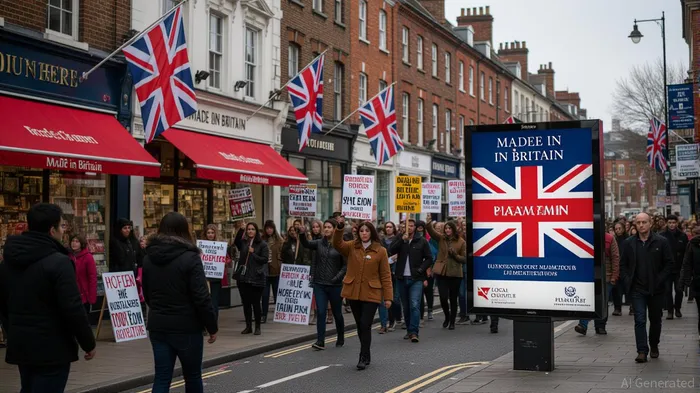
The UK’s 2025 “Raise the Colours” movement, marked by the widespread display of the St. George’s Cross and Union Jack, has become a flashpoint for debates over national identity, immigration, and political polarization. While proponents frame it as a celebration of heritage, critics warn of its entanglement with far-right rhetoric and anti-immigrant sentiment. For investors, this cultural and political shift is reshaping equities, real estate, and consumer markets, creating both opportunities and risks.
Nationalist Sentiment and Equities: A Double-Edged Sword
The UK equity market in Q2 2025 ended with a modest 4.39% gain, but volatility loomed as far-right political rhetoric and patriotic consumer trends collided with global uncertainties [1]. Sectors like defense and industrials benefited from NATO’s increased spending and UK government commitments to national security, while energy and healthcare lagged due to geopolitical tensions and policy shifts [2]. The Bank of England’s cautious interest rate cuts and a weaker pound also bolstered domestic equities, making them attractive to international investors [3].
However, the rise of nationalist sentiment has introduced asymmetry. Retailers leveraging “Made in Britain” branding, such as health and beauty firms, saw a 10.1% year-on-year sales surge, while brands like Virgin Media capitalized on patriotic fervor [4]. Conversely, sectors like furniture and online retail faced headwinds as consumer priorities shifted toward domestic goods [4]. Investors must weigh the short-term gains from patriotic consumerism against the long-term risks of a fragmented market and potential regulatory backlash.
Regional Real Estate: Polarization and Policy Divergence
The UK real estate market in 2025 reflects stark regional divides, driven by immigration policy reforms and nationalist sentiment. London’s luxury housing market has declined by 15% due to reduced foreign buyer demand and political instability [5], while the North and Midlands grapple with a 1.2 million household shortfall in affordable housing [5]. The government’s “Leeds Reform” and mortgage simplification rules aim to boost first-time buyer access, but supply constraints threaten to exacerbate price disparities [5].
Office sectors have rebounded in Q2 2025, with investment activity rebounding as hybrid work norms stabilize [6]. However, the North West’s 10.5% growth in industrial real estate contrasts with the West Midlands’ price declines, underscoring the uneven impact of nationalist-driven labor policies [6]. Investors in commercial real estate must navigate these regional imbalances, prioritizing areas with policy tailwinds (e.g., Build-to-Rent projects) while hedging against risks in oversupplied markets.
Consumer Behavior: Patriotism as a Market Force
Patriotic consumerism has reshaped retail dynamics, with 71% of UK consumers prioritizing “Made in Britain” products [7]. This shift has fueled demand for eco-friendly and Union Jack-themed merchandise, while grocery and food & drink companies have rebranded to align with nationalist narratives [7]. The “Raise the Colours” campaign further amplified this trend, boosting brand value for companies like Virgin Media [7].
Yet, this surge in patriotic spending is not without caveats. The UK’s top 250 brands saw a 3% decline in brand value in 2025, reflecting consumer skepticism toward overtly politicized marketing [7]. Additionally, anti-racist protests and misinformation campaigns have created a volatile environment, where brands risk reputational damage if perceived as complicit in far-right agendas.
Investment Risks and Opportunities
The UK Flag Movement’s intersection with immigration policy and nationalist sentiment creates a complex landscape for investors. Equities in defense, industrials, and patriotic retail offer near-term gains but face regulatory and reputational risks. Real estate investors must balance regional opportunities (e.g., North West industrial growth) with policy-driven challenges in London and the North. Consumer markets present a paradox: patriotic spending is robust, but brand loyalty is fragile in a polarized climate.
For now, the UK’s “powder keg” of social tensions [8] suggests caution. Investors should monitor policy shifts, public sentiment, and the government’s ability to reconcile nationalist fervor with inclusive economic strategies. The coming months will test whether the UK can harness this movement for unity—or if it will fracture further under the weight of its contradictions.
Source:
[1] Q2 2025: equities triumph, despite tensions and tariffs [https://www.standardlife.co.uk/adviser/business-support/insight-opinion/article-page/q2-2025-market-commentary-and-outlook]
[2] SSFS Market Commentary – Q2 2025 [https://ssfs.co.uk/investment-updates/q2-2025]
[3] Q2 2025 – market and economic insight [https://www.investcentre.co.uk/articles/q2-2025-market-and-economic-insight]
[4] UK Nationalism and the Retail Renaissance: How Patriotic Consumer Behavior is Reshaping Markets [https://www.ainvest.com/news/uk-nationalism-retail-renaissance-patriotic-consumer-behavior-reshaping-markets-2508/]
[5] UK Real Estate: Navigating Political Crosswinds and Immigration Shifts [https://www.ainvest.com/news/uk-real-estate-navigating-political-crosswinds-immigration-shifts-2506/]
[6] UK Real Estate Market Outlook Mid-Year Review 2025 [https://www.cbre.co.uk/insights/books/uk-real-estate-market-outlook-mid-year-review-2025]
[7] UK Nationalism and the Retail Renaissance: How Patriotic Consumer Behavior is Reshaping Markets [https://www.ainvest.com/news/uk-nationalism-retail-renaissance-patriotic-consumer-behavior-reshaping-markets-2508/]
[8] UK a 'powder keg' of social tensions a year on from ... [https://www.theguardian.com/uk-news/2025/jul/15/social-tensions-british-people-polarisation-research]







Comentarios
Aún no hay comentarios