
UK Economic Policy Uncertainty: Navigating the Tory-Reform Divide Through Strategic Portfolio Management
UK Economic Policy Uncertainty: Navigating the Tory-Reform Divide Through Strategic Portfolio Management
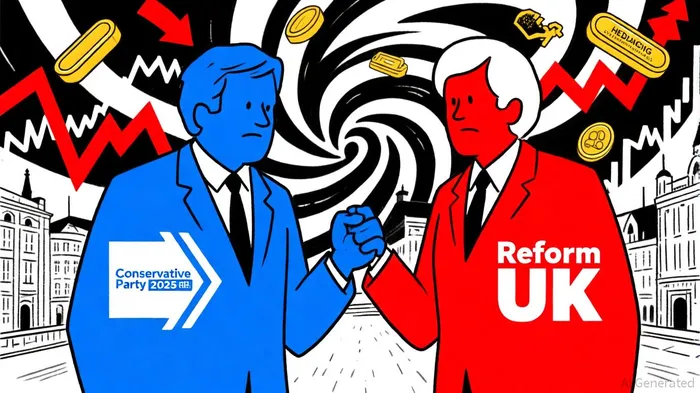
The UK's 2025 political landscape is marked by a stark ideological divide between the Conservative Party and Reform UK, creating a climate of economic uncertainty that demands recalibration of investment strategies. As Reform UK, led by Nigel Farage, gains traction with its populist economic agenda, and the Conservatives pivot toward austerity-driven reforms, investors face a dual challenge: mitigating risks from policy volatility while capitalizing on emerging opportunities. This analysis explores how the Tory-Reform divide impacts sector-specific risks and outlines actionable portfolio management strategies to navigate this turbulent environment.
The Tory-Reform Policy Divide: A Recipe for Uncertainty
The Conservative Party's 2024-2025 manifesto emphasizes gradual tax cuts, such as reducing National Insurance for the self-employed and employees, while maintaining net-zero commitments and increasing defense spending to 2.5% of GDP by 2030, according to a BBC analysis. In contrast, Reform UK's platform advocates for more aggressive tax cuts-abolishing business rates for SMEs, raising the VAT threshold, and scrapping net-zero subsidies-while proposing £50 billion in annual government spending cuts and a 4% online delivery tax on multinationals, as noted in the BBC analysis. These divergent approaches create uncertainty around fiscal policy, regulatory frameworks, and long-term economic priorities.
Reform UK's pledge to eliminate net-zero targets, for instance, could save £30 billion annually but risks destabilizing green energy investments, which have been a cornerstone of Conservative policy, according to the BBC analysis. Similarly, the Conservatives' focus on housing and infrastructure contrasts with Reform UK's deregulatory stance, which may reduce public investment in these sectors, as shown in a This vs That comparison. Such contradictions heighten uncertainty for industries reliant on stable policy environments, including real estate, utilities, and government-contracted services.
Sector-Specific Impacts and Historical Market Reactions
Political instability has historically triggered volatility in UK markets. A 2022 study found that the FTSE 100 underperformed during periods of political uncertainty, such as the Brexit referendum and its aftermath, with healthcare, utilities, and basic materials sectors showing the most pronounced declines, according to the BBC analysis. The prolonged uncertainty surrounding Brexit, for example, eroded investor confidence, causing the pound to plummet and wiping $2 trillion from global equity markets, as documented in a Branston Partners analysis.
In the current climate, sectors like real estate and government contracts face heightened risks. The Conservatives' emphasis on housing and infrastructure contrasts with Reform UK's deregulatory agenda, which could reduce public funding for such projects-a dynamic highlighted in the This vs That comparison. Meanwhile, the energy sector remains vulnerable to policy shifts: Reform UK's rejection of net-zero targets may undermine renewable energy investments, while the Conservatives' commitment to green energy could attract long-term capital, per the BBC analysis.
Portfolio Risk Management Strategies
To mitigate these risks, investors must adopt dynamic strategies tailored to the Tory-Reform divide.
Sector Rotation: Shifting allocations toward sectors less sensitive to policy volatility, such as technology and healthcare, can reduce exposure to politically driven uncertainty. For example, the services and digital infrastructure sectors have shown resilience amid trade tensions and policy shifts, according to a PocketOption briefing. Conversely, manufacturing and steel industries, which depend on stable trade agreements, may require reduced exposure, as that briefing also suggests.
Hedging: Enhanced hedging strategies, such as liability-driven investment (LDI) 2.0, can protect against interest rate volatility and currency fluctuations. Post-2022 pension crisis reforms have led to higher hedging ratios (up to 86–87% of liabilities) and reduced leverage, offering a blueprint for managing UK-specific risks, per the BBC analysis. Investors may also consider currency hedges against pound volatility, particularly if Reform UK's hardline immigration policies trigger economic shocks, as discussed in the Branston Partners analysis.
Diversification: Geographic and asset-class diversification can buffer against UK-specific risks. For instance, UK investors have increased allocations to high-quality fixed income and alternative assets like gold and art to hedge against policy missteps, according to the Branston Partners analysis. Diversifying across global markets-particularly in Asia and North America-can further reduce reliance on UK-centric policies.
Recent Investor Adjustments and Case Studies
Recent portfolio shifts highlight these strategies in action. The Janus Henderson Portfolio Panorama report notes a rise in small-cap equity exposure and a reduced focus on US stocks, as UK investors prioritize domestic opportunities in technology and industrials, according to a Janus Henderson report. Similarly, pension funds have adopted LDI 2.0, emphasizing liquid collateral and reduced leverage to withstand interest rate shocks, as reported in the BBC analysis.
Notably, investors are also factoring in the "Farage premium," pricing in potential risks from Reform UK's hardline stances on EU trade and immigration, a dynamic explored in the Branston Partners analysis. This recalibration reflects a broader trend of balancing UK stability against global geopolitical risks, such as US–China tensions and energy market volatility.
Conclusion: Balancing Risk and Opportunity
The Tory-Reform ideological divide introduces significant uncertainty, but it also creates opportunities for agile investors. By rotating into resilient sectors, enhancing hedging strategies, and diversifying portfolios, investors can mitigate risks while positioning for long-term growth. As the UK approaches the next general election, staying attuned to political developments and policy shifts will remain critical. In this environment, adaptability-not just to market trends but to the evolving political landscape-will define successful portfolio management.







Comentarios
Aún no hay comentarios