
UK Economic Divergence: GDP Growth vs. Widening Trade Deficit
The UK economy in Q2 2025 presents a paradox: modest GDP growth coexists with a widening trade deficit, creating a divergence that raises critical questions for investors. While the services and construction sectors propelled 0.3% quarterly growth, the trade deficit in goods and services expanded to £9.2 billion, driven by a £61.1 billion goods deficit and a £51.9 billion services surplus, according to the MTA's Q2 2025 GDP report. This imbalance underscores structural vulnerabilities in the UK's economic model, particularly as global trade tensions and domestic policy choices collide.
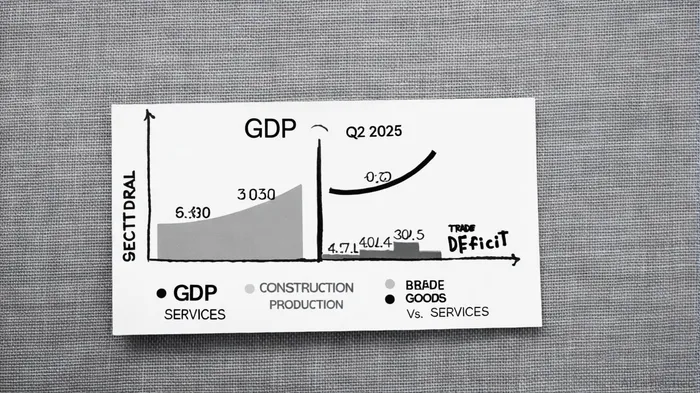
GDP Growth: A Sectoral Mirage
The UK's 0.3% GDP growth in Q2 2025 was fueled by the services sector (+0.4%) and construction (+1.2%), while production fell by 0.3%, as outlined in the MTA's Q2 2025 report. Services growth was concentrated in high-margin activities like computer programming and consultancy, reflecting a post-pandemic shift toward intangible assets. Construction's rebound, meanwhile, was driven by public infrastructure projects, including government-funded health and public administration spending, according to a FocusEconomics Q2 GDP note. However, these gains mask underlying fragility. Private consumption and business investment, key drivers of sustainable growth, weakened compared to Q1, signaling a reliance on short-term fiscal stimulus rather than organic demand, as FocusEconomics notes.
The construction sector's 1.2% growth, though positive, cannot offset the production sector's 0.3% decline, particularly in energy-intensive industries like electricity and gas supply (-6.8%), per the MTA's report. This divergence highlights the UK's overreliance on services-a sector vulnerable to global inflationary pressures and wage-driven cost inflation.
Trade Deficit: A Structural Drag
The UK's trade deficit widened by £1.7 billion in Q2 2025, with goods exports falling £1.9 billion and imports rising £1.7 billion, according to the MTA's Q2 2025 report. This trend is part of a longer-term malaise: goods exports have declined by 20% since 2019, while services exports have failed to compensate, according to a CER analysis. The deficit's persistence is exacerbated by Brexit-related trade frictions, including customs checks under the EU-UK Trade and Cooperation Agreement (TCA), which have increased administrative costs for exporters, as the CER analysis also observes.
The trade deficit's impact on the British pound is mixed. While the Bank of England's 4.25% interest rate and fiscal austerity measures have attracted carry trade flows, the widening goods deficit has pressured sterling, which fell 1.1% between June and July 2025, according to the Equiti Q2 outlook. Currency investors must weigh these conflicting forces: tighter fiscal policy supports GBP, but trade imbalances and global tariff wars (e.g., Trump's 10% UK goods tariff) introduce volatility, as Equiti notes.
Inflation and Monetary Policy: A Delicate Balancing Act
The Bank of England faces a challenging calculus. Inflation remains above target at 3.8% in August 2025, driven by food prices and administered costs, according to the Bank of England report. To address this, the Monetary Policy Committee (MPC) reduced the Bank Rate by 0.25 percentage points to 4% in August 2025, signaling a cautious approach to disinflation, as the Bank's report explains. However, the MPC's focus on medium-term inflation targets risks overlooking short-term trade war risks, which could reignite inflationary pressures through supply chain disruptions, a point highlighted in the MTA's analysis.
Equity investors are already feeling the strain. The FTSE 100 reversed early 2025 gains after Trump's 10% tariffs on UK goods and a 12% oil price drop hit energy stocks like BP and Shell, according to Equiti. Yet, the private equity (PE) sector has shown resilience, with Q2 deal value reaching £24.1 billion, buoyed by government-backed initiatives like the Pensions Schemes Bill, the MTA's report notes. This duality suggests that while public markets face headwinds, private capital may benefit from long-term structural reforms.
Implications for Investors
For equity investors, the UK's economic divergence demands a nuanced strategy. Defensive sectors like utilities and healthcare may outperform amid inflationary pressures, while cyclical sectors (e.g., manufacturing) face headwinds from trade deficits and global tariffs. The PE sector, however, offers a compelling alternative, with government policies injecting £50 billion into private markets by 2030, according to the MTA's report.
Currency investors should monitor the Bank of England's policy response to trade war risks. While high interest rates currently support GBP, a prolonged trade deficit could erode confidence. A hedged approach-balancing exposure to GBP with diversification into inflation-linked assets-may mitigate risks.
Conclusion: A Tenuous Equilibrium
The UK's Q2 2025 GDP growth, though positive, is unsustainable without addressing the root causes of its trade deficit and inflationary pressures. Structural reforms to boost goods exports, streamline post-Brexit trade processes, and diversify energy production are critical. For now, investors must navigate a landscape of divergent signals: growth in services and construction, but stagnation in production; a resilient pound amid a widening trade gap; and a cautious central bank grappling with global uncertainties. The UK's economic trajectory will hinge on its ability to reconcile these contradictions-or risk repeating the patterns of its post-pandemic malaise.







Comentarios
Aún no hay comentarios