
UK Dividend Resilience in a High-Interest-Rate Environment: Identifying High-Yield Stocks with Sustainable Payouts and Robust Balance Sheets
In 2025, the UK's high-interest-rate environment has intensified scrutiny on dividend sustainability, as companies with high debt or weak cash flows face mounting pressure to maintain payouts. For income-focused investors, the key lies in identifying stocks with sustainable payout ratios, robust balance sheets, and dividend resilience despite macroeconomic headwinds. This analysis evaluates four prominent UK-listed companies-Phoenix Group Holdings, Legal & General, Ithaca Energy, and Airtel Africa-using their 2025 financial metrics to assess their viability in a high-rate climate.
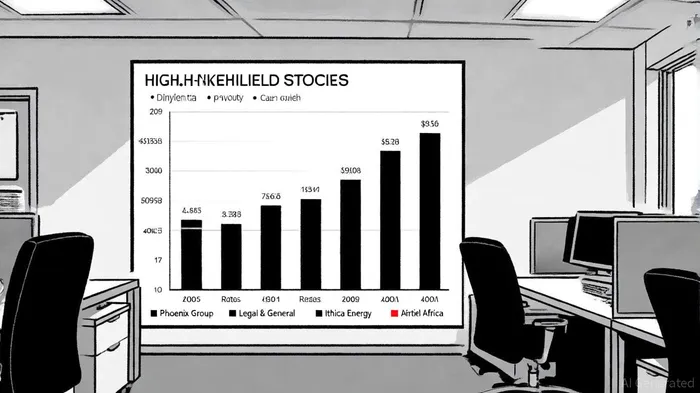
The High-Yield Landscape in 2025: Balancing Yield and Risk
The UK's top dividend stocks, such as Phoenix Group Holdings (8.42% yield) and Legal & General (9.0% yield), have attracted attention for their attractive returns. However, elevated interest rates amplify risks for companies with high leverage or payout ratios exceeding 100%, as noted in a BullBiscuit roundup. For instance, Phoenix Group's payout ratio of 100% (as of Q3 2025) suggests it distributes all earnings to shareholders, leaving little room for reinvestment or buffer against earnings volatility, as shown in its PHNX dividend history. Similarly, Legal & General's payout ratio of 451.41% raises concerns about its ability to sustain dividends without relying on debt or retained earnings, according to LGEN statistics.
Conversely, companies like Ithaca Energy (payout ratio: 70.50%) and Airtel Africa (payout ratio: 70.50%) demonstrate more conservative dividend policies; Ithaca's low leverage is reflected in its Ithaca debt-to-equity, while Airtel's ratio sits at 2.38. These metrics highlight the importance of evaluating dividend cover and cash flow generation alongside yield.
Phoenix Group Holdings: High Yield, High Leverage
Phoenix Group Holdings, a life insurance and asset management firm, offers a compelling 8.42% yield but operates with a debt-to-equity ratio of 1.6 and £7.5 billion in total debt, per the company's PHNX financial ratios. While its Q3 2025 interim dividend of 27.35p per share reflects confidence in its cash flow, the company's payout ratio of 100% leaves no margin for error if earnings decline, as noted in its Q3 2025 earnings report. This contrasts with its 2024 performance, where a 357% payout ratio signaled unsustainable practices, as detailed in a 2024 financial analysis. The improvement to 100% in 2025 suggests tighter financial discipline, but investors must monitor its £6.2 billion in long-term debt and £1.3 billion in short-term obligations, according to a financial health breakdown.
Legal & General: A Cautionary Tale of Overleveraging
Legal & General Group PLC (LGEN), a diversified financial services firm, has a 9.0% yield but a staggering 451.41% payout ratio and a debt-to-equity ratio of 11.16, as shown in LGEN earnings. These figures indicate that the company is distributing more in dividends than it earns, potentially relying on debt to fund payouts. While its £12.36 billion in cash reserves provide some liquidity cushion (see the Legal & General reporting hub), the high leverage exposes it to refinancing risks in a rising rate environment. Investors should scrutinize its ability to service £27.09 billion in total debt, per LGEN statistics, while maintaining dividend consistency.
Ithaca Energy: Energy Sector Stability
Ithaca Energy, an oil and gas explorer, presents a more balanced profile. With a debt-to-equity ratio of 0.42 and $3.04 billion in equity, the company has demonstrated resilience in cash flow generation ($853 million in 2024) and dividend payments ($433 million in 2024), as reported in Ithaca financials. Its 70.50% payout ratio, while elevated, is supported by its energy sector's predictable cash flows and low leverage. However, exposure to oil price volatility remains a risk, necessitating diversification in an investor's portfolio.
Airtel Africa: Telecommunications and Liquidity Strength
Airtel Africa, a telecommunications giant, offers a progressive dividend policy with a 70.50% payout ratio and a 2.38 debt-to-equity ratio, according to the Airtel annual reports. Its 2025 cash reserves increased by 17.78% ($160 million), reflecting strong liquidity management, per an AAF dividend review. The company's ability to grow dividends by 9.2% year-over-year, as outlined in its dividend policy, underscores its operational efficiency, though its high leverage requires careful monitoring. For investors, Airtel Africa's dual-listing on the London and Nigerian Stock Exchanges adds flexibility in currency exposure.
Strategic Implications for Investors
In a high-interest-rate environment, UK dividend stocks must balance yield with financial prudence. Phoenix Group and Legal & General exemplify the risks of high payout ratios and leverage, while Ithaca Energy and Airtel Africa demonstrate how sector-specific strengths and liquidity can mitigate these risks. Investors should prioritize companies with:
1. Payout ratios below 100% to ensure earnings cover dividends, according to a dividend sustainability analysis.
2. Debt-to-equity ratios under 1.0 to minimize refinancing pressures, as explained in an analysis of interest rate impact.
3. Growing cash reserves to buffer against economic downturns, per a Morningstar analysis.
Conclusion
The UK's 2025 dividend landscape offers opportunities for income-focused investors, but success hinges on rigorous due diligence. Phoenix Group and Legal & General's high yields come with significant risks, whereas Ithaca Energy and Airtel Africa provide more sustainable models. As interest rates remain elevated, diversifying across sectors and prioritizing balance sheet strength will be critical for building resilient portfolios.







Comentarios
Aún no hay comentarios