
UK Crypto Market Reawakens: FCA's ETN Ban Reversal and Its Implications for Firms and Investors
The UK's financial regulatory landscape has undergone a seismic shift with the Financial Conduct Authority (FCA) lifting its four-year retail ban on crypto exchange-traded notes (cETNs) on October 8, 2025. This decision, hailed as a pivotal moment for the UK's digital asset sector, marks a strategic recalibration of risk management and innovation. By allowing retail investors to access cETNs listed on FCA-approved exchanges like the London Stock Exchange (LSE), the regulator has signaled its recognition of the maturation of the crypto market and its ambition to position the UK as a global digital asset hub, according to an FCA press release.
Regulatory Tailwinds: A New Framework for Crypto Access
The FCA's reversal of its 2021 ban reflects a nuanced approach to balancing investor protection with market growth. cETNs, which track the performance of cryptocurrencies like BitcoinBTC-- and EthereumETH-- without direct ownership, are now classified as Restricted Mass Market Investments (RMMIs). This categorization mandates strict risk disclosures, suitability assessments, and adherence to the FCA's Consumer Duty principles, ensuring investors are fully informed of the high-volatility nature of these products, as Cointelegraph reported.
Notably, the UK government has aligned tax policies to incentivize adoption. From April 6, 2026, cETNs will qualify for tax-free inclusion in Individual Savings Accounts (ISAs) and registered pension schemes, a move expected to attract long-term institutional and retail capital, as CoinDesk reported. This tax advantage, coupled with the FCA's decision, has spurred optimism among market participants. CryptoUK, for example, characterized the reversal as removing "a key barrier for UK investors to access regulated crypto products," in a Charles Russell Speechlys piece.
Market Re-Entry Strategies: Firms Navigate Compliance and Growth
UK-based crypto firms are swiftly adapting to the new regulatory environment. Major asset managers such as 21Shares, WisdomTreeWT--, and ETC Group—previously restricted to professional investors—are now preparing to offer cETNs to retail clients. These firms are prioritizing compliance with FCA's stringent promotional rules, including transparent financial promotion materials and robust custody frameworks, as Securities.io reported.
However, re-entry is not without challenges. Major ISA providers like IG and AJ Bell are expected to take months to integrate cETNs into their platforms, requiring updates to compliance systems and custody arrangements, as Citywire reported. For instance, firms must now implement enhanced due diligence on issuers and ensure operational resilience against cybersecurity threats, as outlined in a ComplyFactor guide.
The regulatory shift also extends to broader crypto compliance. By 2026, the UK will enforce a comprehensive FCA authorisation regime for crypto firms, including capital requirements and prudential oversight. Initial authorisation costs for firms range from £25,000 to £100,000, with ongoing compliance expenses estimated at £50,000–£150,000 annually, according to a Skadden briefing. While these costs pose a hurdle, they are seen as a necessary step to build trust in a sector historically plagued by volatility and fraud.
Investment Flows and Market Projections
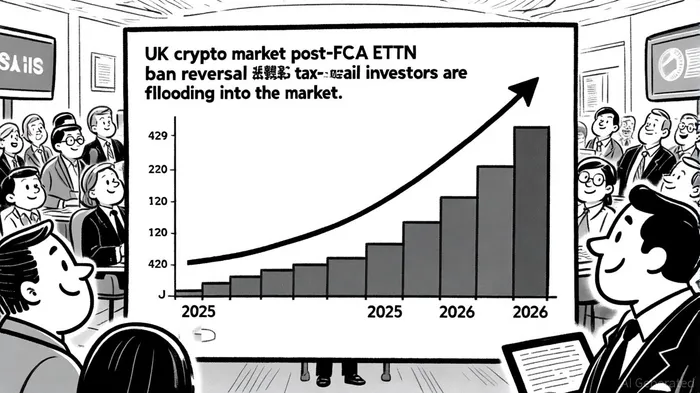
The FCA's decision is projected to unlock significant retail capital into the UK crypto market. Analysts estimate a potential 20% surge in market size by mid-2026, driven by tax-advantaged investment vehicles and increased retail participation, as FinancialContent reported. For example, the inclusion of cETNs in ISAs and pensions could attract conservative investors seeking diversified exposure to digital assets.
A FinancialContent AdvisorAnalyst article notes that major U.S.-listed spot crypto ETFs, such as BlackRock's IBIT, remain ineligible for UK retail access due to non-compliance with FCA requirements. This creates an opportunity for UK-based firms to dominate the domestic market by offering FCA-approved products tailored to local regulations.
Risks and Ongoing Restrictions
Despite the optimism, risks persist. cETNs are not covered by the Financial Services Compensation Scheme (FSCS), leaving investors vulnerable to total loss in case of issuer failure, as a Leaman Crellin blog post explains. Additionally, the FCA has maintained its ban on crypto derivatives, such as futures and contracts for difference (CFDs), for retail investors, citing their high-risk profiles, as CCN explained.
Industry leaders acknowledge these limitations but view them as temporary. As Russell Barlow of 21Shares notes, the FCA's phased approach "allows the market to mature while safeguarding investors," as Cryptopolitan reported.
Conclusion: A Strategic Turning Point
The FCA's reversal of the cETN ban represents more than a regulatory adjustment—it is a strategic pivot to align the UK with global crypto markets. By fostering a structured framework for retail access, the regulator has created a fertile ground for innovation while addressing historical concerns about investor protection. For UK-based crypto firms, the challenge lies in balancing compliance costs with the promise of a 20% market growth. As the sector navigates this transition, the coming months will test the resilience of both regulators and market participants in shaping a sustainable digital asset ecosystem.





Comentarios
Aún no hay comentarios