
The UK Budget's Mixed Signals: Implications for Sterling and Global Markets
Fiscal Adjustments: A Delicate Balance
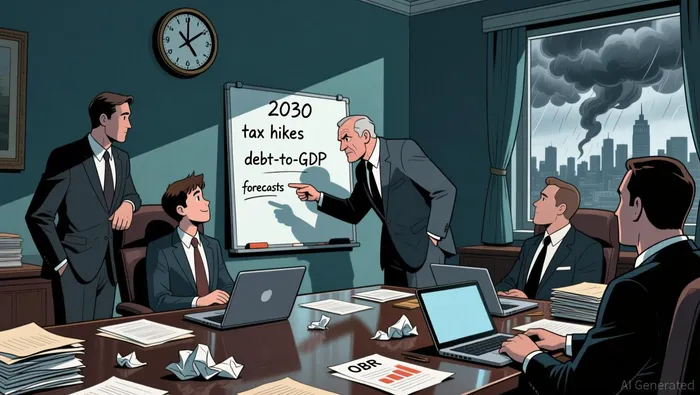
The budget introduces a series of tax hikes and spending freezes to reduce the deficit. Key measures include extending the freeze on income tax thresholds until 2030/31, projected to raise £7.6 billion annually by 2029/30, and a new annual tax on properties valued above £2 million, expected to generate £400 million by 2029/30. Additional revenue is targeted through increased gambling duties (£1.1 billion) and a future mileage-based charge on electric vehicles (£1.4 billion) according to OBR projections. These measures aim to create a fiscal buffer of £21.7 billion by 2029/30, according to the Office for Budget Responsibility.
However, the OBR's growth forecasts-1.5% GDP growth for 2025 and 1.4% in 2026-remain cautious, with inflation projected at 3.5% in 2025 and 2.5% in 2026 according to OBR analysis. Debt-to-GDP is expected to rise to 97% by 2028/29, raising concerns about fiscal sustainability. Critics argue that the backloaded nature of tax increases, particularly those delayed until 2028, may undermine long-term credibility according to financial analysts. As stated by Deutsche Bank analysts, the "mix of front-loaded spending and back-loaded tax rises" risks creating volatility in gilt yields and investor confidence.
Sterling's Mixed Market Reaction
Sterling initially rallied following the budget announcement, with the currency rising against the dollar and euro amid improved fiscal headroom according to market analysis. However, this relief was short-lived. Analysts warn that the delayed fiscal consolidation could pressure the pound in the medium term. For instance, the Bank of England's potential rate cuts-anticipated as inflationary pressures ease-may weaken sterling, with GBP/USD expected to trade between 1.3000 and 1.3200 according to market forecasts.
Investor sentiment remains divided. While the budget's avoidance of immediate income tax hikes was welcomed, measures like the freeze on income tax thresholds and the new "mansion tax" on high-value properties have been criticized as regressive according to industry reports. John Stopford of Ninety One noted that the OBR's growth forecasts appear "overly optimistic," with the backloaded fiscal strategy potentially eroding market trust according to financial commentary. The bond market's cautious response further underscores this uncertainty, as gilt yields fluctuated in reaction to the budget's mixed signals according to market data.
Political Stability: A Double-Edged Sword
Political stability has historically influenced sterling's performance, as seen during the Brexit referendum and subsequent elections. For example, the pound depreciated sharply in 2016 due to Brexit uncertainty but rebounded by 2% in 2019 after Boris Johnson's decisive electoral victory according to economic analysis. The 2025 budget, however, introduces new risks. With elections scheduled for May 2026, internal dissent within the Labour Party over policies like the pension tax and income threshold freeze could amplify political uncertainty according to political analysts.
This uncertainty is compounded by concerns about fiscal credibility. The OBR's revised productivity forecasts and the government's reliance on delayed tax measures have led to skepticism about the budget's ability to meet its deficit reduction targets according to parliamentary analysis. As noted in a report by CNBC, the "worst of both worlds" scenario-growth drag from fiscal tightening paired with limited gains in fiscal credibility-could deter long-term investment according to market commentary.
Historical Context and Global Market Reactions
Historical precedents highlight the interplay between fiscal policy and currency performance. The 2022 fiscal announcements, for instance, triggered heightened market nervousness, a pattern that resurfaced in 2025 according to economic analysis. Similarly, the 1980s saw significant exchange rate fluctuations under Geoffrey Howe and Nigel Lawson, underscoring how fiscal credibility shapes investor behavior according to historical records.
The 2025 budget's mixed reception reflects these dynamics. While the FTSE 100 rose to a multi-week high post-budget, sectors like gambling and banking experienced divergent reactions, with some stocks benefiting from tax changes while others faced headwinds according to market analysis. Global investors are now closely monitoring how the UK balances fiscal discipline with growth ambitions, particularly as the OBR's forecasts suggest a prolonged period of modest expansion according to official research.
Outlook: Navigating Uncertainty
The UK's fiscal and political landscape remains fraught with challenges. The backloaded nature of tax increases may delay meaningful deficit reduction, while the upcoming election could disrupt policy continuity. For sterling, the immediate outlook hinges on the Bank of England's response to inflation and the government's ability to maintain fiscal credibility. If the OBR's growth projections hold, the pound could stabilize in the 1.30–1.32 range against the dollar according to market forecasts. However, political instability or weaker-than-expected economic data could reignite volatility.
Investors should also consider the broader implications for global markets. The UK's focus on supply-side reforms and public investment may attract long-term capital, but short-term uncertainties-such as potential fiscal rule breaches or election-related policy shifts-could deter risk appetite. As one analyst summarized, the 2025 budget "delivers more headroom but less clarity," leaving markets to navigate a complex mix of fiscal and political signals according to financial commentary.







Comentarios
Aún no hay comentarios