
The UK’s £240 Billion Green Energy Push: Is Now the Time to Invest in Renewable Infrastructure?
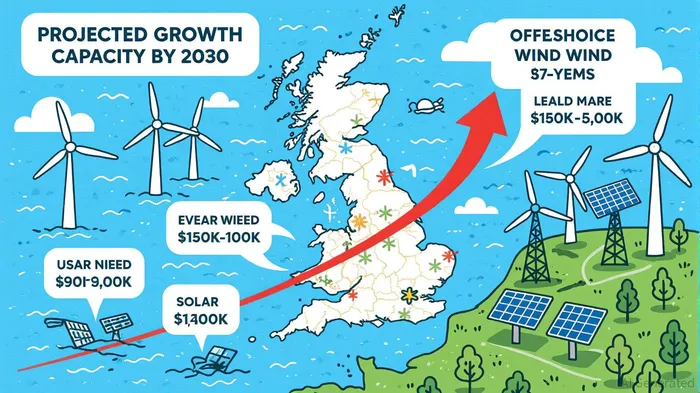
The UK’s Clean Power 2030 plan represents one of the most ambitious energy transitions in modern history, aiming to achieve a fully clean electricity grid by 2030. With a £240 billion investment, the Labour government has positioned itself at the forefront of global decarbonization efforts, promising to unlock £40 billion in annual private investment while creating thousands of skilled jobs [1]. However, the path to a green energy superpower is fraught with strategic, financial, and geopolitical risks that investors must weigh against the potential rewards.
Strategic Risks: Supply Chain Vulnerabilities and Geopolitical Tensions
The UK’s reliance on critical materials for renewable infrastructure—such as rare earth metals for wind turbines and semiconductors for energy storage—exposes it to global supply chain bottlenecks. In 2023, China supplied 75% of the UK’s rare earth imports, a dependency that raises concerns over geopolitical leverage and trade disruptions [2]. While initiatives like the Critical Minerals Strategy and partnerships with Australia aim to diversify supply chains, domestic production capacity remains limited. For instance, the Pensana Saltend refinery, a key project to process rare earths, is still in its early stages of operation [2].
Geopolitical risks further complicate the energy transition. Elevated tensions in regions supplying critical minerals or competing for green technology leadership could disrupt project timelines and inflate costs. A report by ScienceDirect notes that geopolitical risks reduce international energy trade flows, often followed by sharp import/export swings that destabilize markets [3]. For the UK, this underscores the urgency of accelerating home-grown solutions like Sizewell C nuclear and Carbon Capture, Usage, and Storage (CCUS) programs [1].
Financial Rewards: ROI and Corporate Case Studies
Despite these challenges, the financial case for UK clean energy investments is compelling. Corporate Britain has already demonstrated the viability of renewable projects, with companies like Tesco, BT, and UnileverUL-- saving over £50 million annually through power purchase agreements (PPAs) and on-site solar generation. These projects yield 8–15% annual returns, with some facilities locking in predictable energy costs for 25 years [4].
The government’s Great British Energy (GB Energy) initiative, with an initial £8.3 billion budget, aims to amplify such successes by co-investing in large-scale projects. By blending public and private capital, GB Energy could replicate the ESA’s £7.49 return model per £1 invested in space technology [5]. While direct ROI metrics for Clean Power 2030 remain unquantified, the plan’s emphasis on battery storage expansion (a sixfold increase to 23–27 GW by 2030) and hydrogen infrastructure suggests long-term value creation [1].
Geopolitical Rewards: Energy Security and Industrial Leadership
The UK’s pivot to clean energy is not just an environmental imperative but a strategic one. By reducing reliance on volatile foreign gas markets, the Clean Power 2030 plan enhances energy security—a critical lesson from the Russia–Ukraine conflict [2]. The government’s hydrogen strategy and marine energy investments further position the UK as a leader in emerging green industries, potentially capturing a significant share of the global low-carbon technology market [1].
However, this leadership comes with competition. The EU’s Alternative Fuels Infrastructure Regulation (AFIR) and U.S. Inflation Reduction Act (IRA) incentives are reshaping global clean energy dynamics, forcing the UK to accelerate deployment to stay competitive. Delays in permitting or grid connection—averaging 12–24 months—could erode investor confidence, particularly in projects requiring rapid scalability [6].
Is Now the Time to Invest?
The answer hinges on risk tolerance and time horizon. For long-term investors, the UK’s £240 billion commitment and streamlined planning reforms present a unique window to capitalize on infrastructure growth. The corporate sector’s proven ROI and GB Energy’s public-private model mitigate some financial risks, while strategic diversification of supply chains reduces geopolitical exposure.
Yet, short-term volatility remains. Biomethane projects, for example, face breakeven costs 2.9 times higher than 2019 levels, highlighting the need for policy supports like carbon credits [7]. Investors must also monitor the Review of Electricity Market Arrangements (REMA) for clarity on market reforms, which could influence profitability [4].
Conclusion
The UK’s Clean Power 2030 plan is a bold bet on the future of energy. While supply chain dependencies and market volatility pose challenges, the strategic and financial rewards—ranging from energy security to corporate ROI—justify a cautious but optimistic outlook. For those willing to navigate the risks, the UK’s green energy transition offers a rare opportunity to align environmental stewardship with substantial returns.
Source:
[1] Clean Power 2030 Action Plan: A new era of clean electricity [https://www.gov.uk/government/publications/clean-power-2030-action-plan/clean-power-2030-action-plan-a-new-era-of-clean-electricity-main-report]
[2] Deirdre Congdon: Without rare earth materials we can't go ..., [https://www.brightblue.org.uk/deirdre-congdon-rare-green/]
[3] Geopolitical risks and energy market dynamics [https://www.sciencedirect.com/science/article/pii/S0140988325006413]
[4] UK Corporations Are Saving £50M+ Annually: The ... [https://www.crgdirect.co.uk/blog/corporate-renewable-energy-uk-2025]
[5] Evaluating the benefits of the UK's investments in the European Space Agency [https://www.gov.uk/government/publications/evaluating-the-benefits-of-the-uks-investments-in-the-european-space-agency/evaluating-the-benefits-of-the-uks-investments-in-the-european-space-agency-impact-and-value-for-money-report]
[6] EV Charging Infrastructure in Europe: Grid Integration, Utilization Rates, and ROI Metrics 2025–2030 [https://www.transcript-iq.com/product/ev-charging-infrastructure-in-europe-grid-integration-utilization-rates-roi-metrics-2025-2030?87a72fd5_page=8]
[7] Updated insights under market volatility [https://www.sciencedirect.com/science/article/pii/S2213138825003947]







Comentarios
Aún no hay comentarios